
Most published comparisons of cob vs smd led strip stop at appearance: COB looks smoother, SMD shows dots. That is true and it is also the least useful part of the decision, because it treats SMD as one product. It is not. It is a family of packages with different die counts, efficacies, and colour capabilities, and choosing between the two constructions properly means knowing which SMD you are actually being offered.
This comparison is written from a manufacturing and procurement position for buyers weighing COB LED strip against the SMD LED strip range across commercial, hotel, retail, cabinet, and architectural work.
What the Two Constructions Actually Are
An SMD strip uses finished LED packages — a die, its own phosphor, its own lens, on a small carrier — reflow-soldered onto the board at fixed intervals. Each package is a self-contained light source that was tested and sorted before it reached the strip.
A COB strip skips the package. Bare dies are bonded directly to the board in a dense line, wire-bonded, then covered by one continuous phosphor and silicone layer applied across the whole run in a single process. There is no individual package and no gap between light points.
That single manufacturing difference drives everything in the cob vs smd led strip decision, including several things that are not about appearance at all: how colour consistency behaves, what happens when one chip fails, how heat leaves the strip, and how many separate items a distributor has to hold in stock.
| Comparison Point | COB Construction | SMD Construction |
|---|---|---|
| Light source | Bare dies under one continuous phosphor layer | Individually packaged and pre-sorted LEDs at intervals |
| Appearance | Continuous line; no dotting at close range | Depends on density and available diffuser depth |
| Colour variation | Very consistent within a reel; controlled reel to reel by phosphor batch | Controlled by the bin specified at package level |
| Multi-channel colour | Available, built on a narrower range of options | Broadest ecosystem, built around multi-die packages |
| Failure behaviour | A fault takes out a visible segment | A fault leaves a single dark point |
| Heat path | Continuous along the run; profile does the work | Point sources with cool board assisting |
| Cost per metre | Higher at comparable specification | Lower, with more levels to choose from |
SMD Package Types: 2835 and 5050 Are Not Interchangeable
“SMD” on a quotation means almost nothing without the package number, and the two that dominate commercial strip lighting behave differently enough that substituting one for the other changes the project.
2835: The Efficient Single-Die Workhorse
The 2835 is a mid-power package of roughly 2.8 × 3.5 mm holding one die, driven at modest current — which is why packages of this type reach some of the highest efficacies in strip lighting. It is a white-light package: one die, one phosphor, one colour temperature. Where a project needs single-colour linear light at good efficiency and sensible cost, this is the default, and the SMD strip guide covers the density ladder built on it.
5050: The Multi-Die Package That Makes Colour Possible
The 5050 is a 5 × 5 mm package with room for three to five separate dies, and that is its real purpose. RGB needs three independently driven emitters, RGBW four, RGBCW five. Those channels have to sit physically close together or the colours will not mix into one apparent source, and a 5 × 5 mm package is how the industry solves that.
This is the substantive limitation on the COB side and worth stating plainly. COB colour-changing strips exist and work well, but the option range around multi-channel SMD — packages, controllers, protocols, pixel densities — is considerably wider, so a project needing unusual channel combinations or specific IC behaviour will usually find a route through SMD first.
So the honest framing is not COB against SMD. It is COB against 2835 for white light, where the argument is uniformity and depth, and COB against 5050 for colour, where the argument is control options and channel count.
Uniformity: Density Buys Smoothness Until It Doesn’t
Have an LED Lighting Project?
Share your project requirements — our engineering team will configure the complete LED strip system (strips + profiles + controllers + power supplies) and send you a detailed proposal within 24 hours.
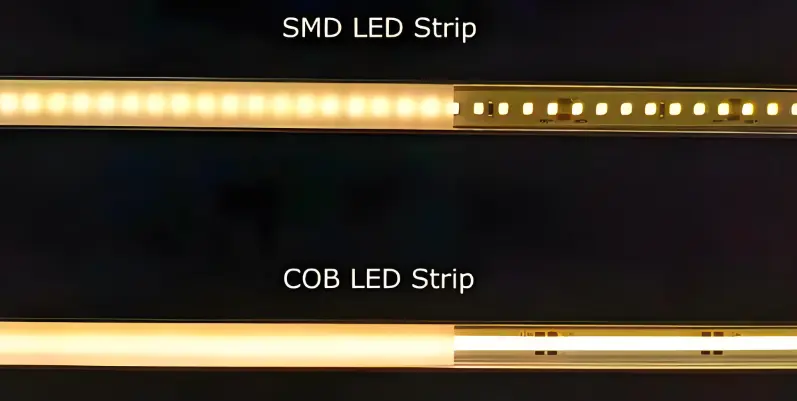
SMD strips get smoother as density rises, because the gap between light points shrinks. A 60 LEDs/m strip has points roughly 16 mm apart; at 120 LEDs/m that halves to around 8 mm; at 240 LEDs/m it is roughly 4 mm. A COB strip at 320 LEDs/m or above is near 3 mm and effectively continuous.
Density alone does not settle it, because what the viewer sees depends on how much space sits between the light points and the diffuser in front of them — the depth behind the diffuser has to be at least as large as the point spacing before those points blend into a line. That geometry is set out in the appearance-led comparison of COB and conventional strip.
Two consequences matter for procurement. Buying higher density purely to fix dotting has a ceiling: past a point you are paying for lumens you do not need to solve a geometry problem the profile should solve. And raising density raises wattage per metre, which raises heat and shortens the maximum run from one feed point. Chasing smoothness through density quietly changes the electrical design.
Output, Efficacy and Where the Heat Goes
Neither construction is inherently brighter or more efficient. Output follows wattage and thermal design, and both span low-level decorative light through to high-output linear runs. On efficacy the two pull in opposite directions and land close together: COB runs many dies at low current each, which favours efficiency, but its continuous phosphor and silicone layer scatters and reabsorbs some light on the way out. Treat any claim that one construction is categorically more efficient as something to verify with a photometric report.
Heat is where they genuinely differ, and the difference runs opposite to intuition. A COB strip produces heat continuously along its whole length with no cool board between chips to spread it, so at equal wattage it has less self-cooling than an SMD strip. Because COB needs less optical help from a profile, buyers often conclude it needs less profile — but it needs the aluminium more, as a thermal component rather than a diffuser. Heat is what shifts colour over time and shortens life, so profile contact is functional. The installation guide covers driver sizing, feed strategy, and thermal mounting.

Colour Consistency: The Question Most Buyers Skip
CRI 80 or CRI 90 tells you how faithfully colours render. It says nothing about whether two reels of the same product will look the same next to each other, and on multi-room projects that second question causes more disputes than the first.
The metric for it is colour consistency, expressed in MacAdam ellipse steps or SDCM, defined within CIE colorimetry. A tighter step figure means less visible tint variation between units nominally at the same colour temperature. Three steps is generally accepted for quality commercial interiors; five is where the difference starts becoming visible when two runs are seen together on the same wall.
The two constructions arrive at consistency by different routes, and it changes what you should ask for:
- SMD is controlled at the package. LEDs are measured and sorted into bins before assembly, so consistency depends entirely on which bin the supplier used. A strip built from tightly binned packages is very consistent; one built from loosely binned stock can vary within a single reel. The bin is a specification you have to request — it is not implied by CRI or colour temperature.
- COB is controlled at the coating. The phosphor is applied across the whole strip in one process, so variation along a single reel is typically very low. The risk moves to reel-to-reel: a different phosphor mixing batch can shift an entire production run slightly, and because the shift is uniform it is invisible until two reels from different batches meet in the same room.
The procurement action is the same for both: where runs will be seen together, request single-batch material, ask for the SDCM figure rather than accepting CRI as a proxy, and keep a labelled reference offcut so a reorder can be checked against what was installed. For phased projects, the manufacturer selection guide covers what to verify before committing a rollout to one supplier.
Installation, Cut Intervals and What Happens When One Fails
Both types cut at marked points only, need matched drivers, and need voltage drop planned before ordering. Three differences reach the installer and the maintenance team.
Handling the Emitting Surface
An SMD strip’s light-emitting parts are hard, sealed packages. A COB strip’s emitting surface is a continuous silicone and phosphor layer that scratches, dents, and contaminates, and the damage is permanent and visible because there is no dark board to hide it. Pressing a COB strip into a profile with a screwdriver marks the light line itself.
Failure Behaviour and What Repair Means
One failed SMD package leaves a single dark point — poor at close range, often unnoticeable in a concealed cove, rarely urgent. A fault on a COB strip takes out the whole series segment, so a visible length goes dark at once and the replacement unit is that entire cut section. On high-visibility installations that argues for holding matched spare material from the original batch, which loops back to the consistency question above.
Cut Interval Against Voltage
Cut intervals follow the series-group layout, so they change with voltage and density rather than with construction type. A 24V version of the same product generally has roughly double the cut unit of the 12V version, which matters when sections must fit short joinery lengths. Confirm the figure in millimetres per model before joinery is machined; the 24V layout guide covers how it interacts with run length and feed points.
Procurement: Stock Breadth and System Cost
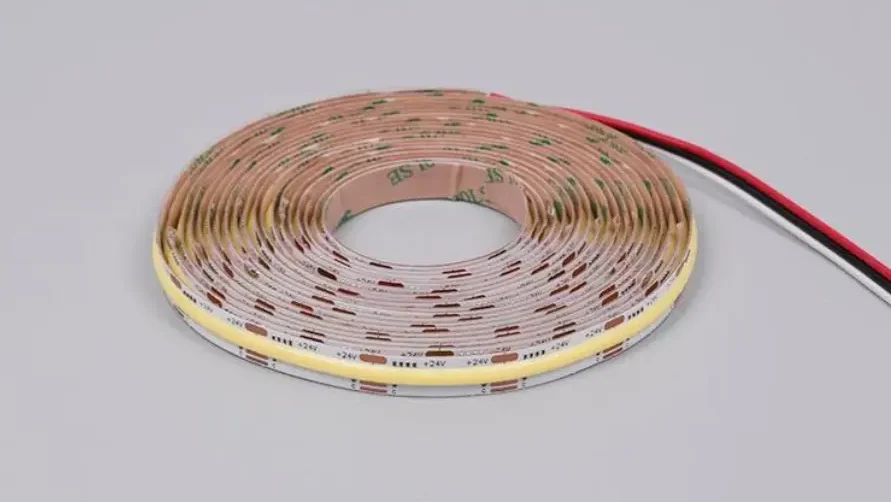
For distributors and contractors holding stock, the comparison shifts from optics to inventory arithmetic, and here SMD’s breadth is a concrete advantage rather than a vague one. A 2835 range built on one board width gives several output levels that all share the same profile, connector, and accessories — three or four density options become one connector line item and one profile line item. A COB range spanning 8 mm, 10 mm, and 12 mm boards covers more visual requirements but multiplies the connector and profile items behind it. That cost never appears on a per-metre quotation.
The same logic applies to a single project. COB carries a premium per metre, but a strip needing no diffuser depth may remove a deeper profile, a diffuser lens, and the joinery space to house them. An 8 mm COB strip in a 10 mm machined groove can be cheaper as an assembly than an SMD strip requiring 12 mm of diffuser depth and a surface-mounted channel to provide it. Reverse the position — a concealed cove where the profile was specified anyway and nobody sees the source — and the arithmetic reverses with it. Compare assemblies, not strips: strip, profile, diffuser, connectors, driver, labour, and the spare material the maintenance plan needs.
Using Both in One Project — and the Trap
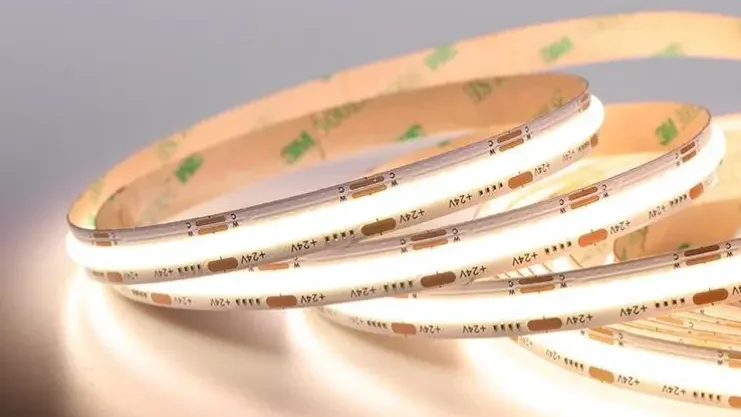
Specifying COB where the light line is seen and SMD where it is concealed is the correct answer on most mixed commercial fitouts. It has one failure mode that catches projects repeatedly.
Two products both labelled 3000K, one COB and one SMD, will very likely not match. They use different phosphor systems, are binned by different methods, and came from unrelated batches. In separate rooms nobody notices. In one room — a COB cove washing a wall while an SMD strip lights the shelving below it — the difference is immediate, and there is no fix short of replacing one of them.
So where both constructions will be seen together, get samples of both, power them side by side at working current, and approve the pair rather than each product separately. Keep the driver and dimming behaviour matched too, since two strips dimming on different curves diverge in tint at low levels even when they match at full output. Project references by application are in the case study library.
A Direct Head-to-Head
Three products from our range make the trade-off concrete. All are 8 mm boards at 12V or 24V, IP20, for dry concealed positions — so board width, voltage, and environment are held constant and only construction and density change.
- SMD 2835, 60 LEDs/m — CRI 80, points roughly 16 mm apart. The economical option for concealed runs and general indirect lighting where the source is never in view.
- SMD 2835, 120 LEDs/m — CRI 80, points roughly 8 mm apart. Blends well behind a diffuser with around 8 mm or more of depth behind the strip.
- COB, 320 LEDs/m — CRI 90, near-continuous emission. Reads as a line in a shallow groove with no diffuser depth available.
The CRI difference across these is a specification choice rather than a property of either construction, and it matters where materials or merchandise are judged under the light.
Approving the Samples
Samples judged on a desk mislead, because the desk supplies a viewing distance and angle the project will not.
- Mount both candidates in the actual profile with the actual diffuser.
- Check dot visibility from the real viewing position and angle, including any reflection off adjacent glossy surfaces.
- Run a section at the intended length with the intended cable to see the far-end brightness and tint.
- Confirm colour temperature, CRI, the SDCM or bin figure, voltage, IP rating, and PCB width.
- Confirm the cut interval in millimetres and that connectors physically fit inside the profile.
- Test the dimming method at low output, where mismatches show first.
- Agree batch control, reel labelling, and spare quantity for maintenance.
Where the environment is damp or exterior, settle the protection requirement first, since an IEC 60529 rating applies to a sealed assembly and both constructions lose it at an unsealed cut end.

FAQ
Is COB better than SMD?
For a smooth line at close range or in a shallow profile, yes. For concealed positions, multi-channel colour options, stock standardisation, and cost-led rollouts, SMD is frequently the better engineering answer rather than merely the cheaper one.
What is the difference between 2835 and 5050?
2835 is a compact single-die package used for efficient white light. 5050 is larger and holds three to five dies, which is what makes RGB, RGBW, and RGBCW possible in one apparent source. They are not substitutes for each other.
Is COB more efficient than SMD?
Not reliably. COB runs more dies at lower current, which helps, but its continuous phosphor layer scatters and reabsorbs some output. Good examples of both land close together, so ask for photometric data rather than accepting a general claim.
Which has better colour consistency?
They control it differently. SMD depends on the bin specified at package level; COB is very consistent within a reel but can shift between phosphor batches. For either, request the SDCM figure and single-batch material where runs will be seen together.
What happens when an LED fails?
An SMD failure leaves one dark point. A COB failure darkens a whole series segment, so the replacement unit is the entire cut section. That is worth planning spare material around on high-visibility installations.
Does COB still need an aluminium profile?
Yes, and for thermal reasons rather than optical ones. Continuous heat along the run with no cool board to spread it means the profile is functioning as a heat sink, and heat is what shifts colour and shortens life.
Can COB and SMD be used in the same project?
Yes, and it is often the right specification. Just do not assume two products both labelled 3000K will match if they will be seen in the same room — approve them as a matched pair before ordering.
Reference Resources
For broader background on lighting metrics, design practice, and controls:

Request Project Support
If you are deciding between cob vs smd led strip for a hotel, retail, cabinet, office, or commercial project, the most useful things to send are the profile section with its internal depth, the run lengths, the voltage, and whether the light line will be visible or concealed in each position. With those the comparison can be answered per position rather than as a single site-wide choice.
You can contact Senfey to request matched samples of both constructions, confirm batch and consistency requirements, or get a project quotation.
