
Residential developments
Smart Home LED Strip Lighting for Apartments, Villas and Developments
Lighting specified room by room, then repeated across every unit — dimming that holds at 5%, colour that matches between apartments, and drivers a maintenance team can actually reach.
A development is one specification multiplied, so the details that barely matter in a single house become the snagging list here. We manufacture in Shenzhen and supply developers, fit-out contractors, smart-home integrators and distributors, priced per unit type and per amenity area rather than per metre.
- Scope
- Unit to amenity
- Dimming
- Down to 5%
- Control
- Phase · 0–10V · DALI
- Made here
- COB · SMD · RGBIC
Space by space
Six spaces in a home, six different specifications
What each space has to do after dark, and what that fixes about density, colour, dimming and the driver position. The same six decisions then repeat across every unit in the development.
Living rooms and open-plan spaces
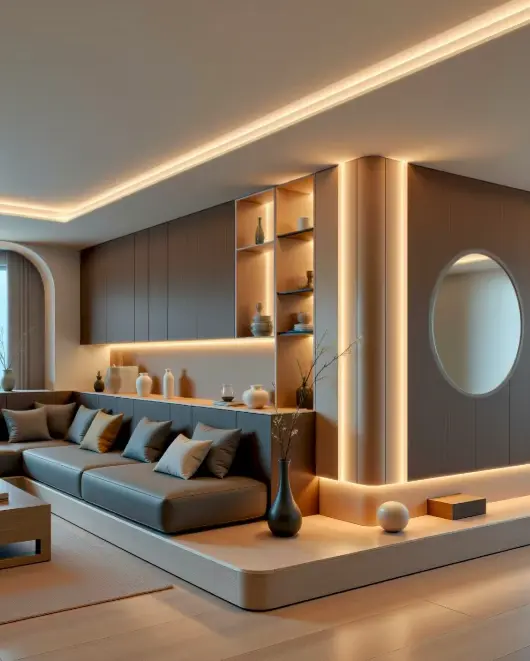
This is the room people dim. A ceiling cove or a shadow gap gives indirect light that makes the room feel larger and the ceiling feel higher, without a single visible source — which is the whole reason residents notice it and buyers pay for it.
Two things decide whether it looks built-in or stuck-on: the cove needs enough depth to hide the strip from every seat in the room, and the dimming has to stay smooth at the bottom of the range. This is the space that sells the apartment, and where LED strip lights for home decor earns its place in the spec.
Typical: 2700–3000K warm white · CRI 90+ · 24V · high density for a dotless line · smooth dimming to 5% · driver in a hatched, ventilated void

Kitchens, pantries and utility
Under-cabinet lighting is the one run in a home that is genuinely functional: it puts light on the worktop where the wall cabinet blocks the ceiling fitting. Mount it at the front edge of the cabinet underside, not the back, or you light the tiles instead of the chopping board.
Colour rendering matters more here than anywhere else in the unit, because this is where people look at food. Keep it warm — 3000K makes ingredients look like ingredients, and anything cooler makes a domestic kitchen read like a commercial one.
Typical: 3000K warm white · CRI 90+ · 24V · aluminium profile with a diffuser · switched at the cabinet or on the room scene · sealed build behind a sink or hob

Bedrooms, hallways and circulation
The job here is getting to the bathroom at three in the morning without turning on a ceiling light. A low run under the bed frame, along a skirting or under a handrail gives just enough to read the floor, and it needs to be dim — brighter is worse, because it wakes people up.
Put it on a motion sensor with a low preset rather than a wall switch, and keep the level under about 10%. Circulation runs are also where a smart home LED strip actually earns its cost, because the behaviour is automatic rather than something anyone operates.
Typical: 2700K warm white · CRI 80+ · 24V · very low output or dimmed preset · motion or time triggered · source hidden from a lying eye height

Balconies, terraces and roof gardens
A balcony is outdoors, whatever the floor plan calls it. It gets rain, it gets washed down, and in most climates it freezes — so this is a sealed outdoor build even though it sits three metres from a sofa.
Aim it down and keep it warm. A balcony run that throws light upward and outward becomes the neighbours' problem, and on an apartment block that is a complaint rather than a design detail.
Typical: 2700–3000K warm white · CRI 80+ · 12V neon or 24V COB · IP65 minimum, IP67 exposed · aimed downward, no upward spill · sealed cut ends, driver inside

Bathrooms and wet zones
Mirror lighting is the only light in a bathroom that people actually judge, because it is the one they use on their own face. Two vertical runs either side of the mirror beat a single strip above it, which throws shadows down and makes everyone look tired.
Zone the room properly: a sealed build inside the shower zone, and everything else at least splash rated. Steam is the quiet failure here — it gets into an unsealed cut end over months, not minutes.
Typical: 3000K warm white · CRI 90+ for mirrors · 24V · IP65 in the wet zone, IP44 elsewhere · vertical runs beside the mirror · driver outside the wet zone

Lobbies, corridors and amenity areas
The common parts are the only lighting every resident and every visitor sees, and they run far more hours than anything inside a unit. That changes the calculation: this is where continuous operation, long unbroken lines and serviceability matter more than atmosphere.
Long runs mean sections, injection points and several drivers, all in a labelled, reachable cupboard rather than above a plastered ceiling. Amenity spaces are also where scene control pays off, and where a home automation LED strip can shift the lobby between day, evening and night without anyone touching a panel.
Typical: 3000K warm white · CRI 80–90 · 24V · continuous profile runs, sectioned and injected · timeclock or scene control · drivers in a labelled service cupboard

Product selection
What we supply for residential schemes
Four builds cover almost every unit and common part. Interior runs come from the COB LED strip range because a dotless line is what makes a cove look built-in, with SMD LED strip where a lower budget or a concealed position allows it. Colour-changing and scene work uses addressable LED strip, and anything on a balcony or terrace moves to LED neon flex.
Where dimming quality is the deciding factor, start with dimmable COB LED strip and dimmable LED strip lights — the strip and driver are specified as a pair, because that pairing is what holds at 5% rather than flickering. Smart RGB work sits with RGB COB LED strip and addressable RGB LED strip.

ES-COB-528-10MM-24V
COB LED strip 528 LEDs/m 10 mm 24V
The default for coves, shadow gaps and any run a resident can see the light from. No visible diodes at any viewing distance, and CRI 90 keeps skin and timber looking right.
- Density528 LEDs/m
- Width10 mm
- Voltage24V
- CRI90
- IPIP20

ES-COB-840-12MM-24V-RGBCW
RGBCW COB LED strip 840 LEDs/m 12 mm 24V
Warm and cool white in one strip plus colour, so a living room can run 2700K in the evening and cooler by day from a single run. One strip instead of two saves a channel per room.
- Density840 LEDs/m
- Width12 mm
- Voltage24V
- CRI90
- IPIP20

ES-COB-576-10MM-RGBIC
RGBIC addressable COB LED strip 576 LEDs/m 10 mm
Individually controllable segments in a dotless body, for lobby feature walls and amenity runs that change with the time of day rather than staying on one colour.
- Density576 LEDs/m
- Width10 mm
- Voltage12V / 24V
- CRI90
- IPIP20

ES-NEON-SIGN-03
PVC LED neon strip 6/8 mm 120 LEDs/m outdoor
The balcony and terrace answer. Sealed as manufactured rather than coated on site, so a railing run survives rain, washing down and a freeze without water finding a cut end.
- Density120 LEDs/m
- Profile6 / 8 mm
- Voltage12V
- IPIP67
- HousingPVC
Residential projects
Apartment, villa and smart home projects already installed
Four residential installations across villa step lighting, apartment balconies, smart home scene control and a lobby run, with locations as recorded in our project files.

LED step lighting for a Marbella villa
One run per tread, recessed so nobody descending looks into the source — the detail that makes step lighting safe rather than dazzling.
Read the project
Apartment balcony waterproof LED strip lighting
A sealed build under the railing, aimed down. An Austrian balcony also freezes, which rules out anything sealed after the fact on site.
Read the project
Smart home addressable LED strip scene lighting
Addressable runs on scene control, so the same strip covers evening, morning and away without anyone choosing a colour by hand.
Read the project
Apartment lobby linear LED strip lighting
A continuous line across the common parts, sectioned and injected so the run reads as one length and services as several.
Read the project