
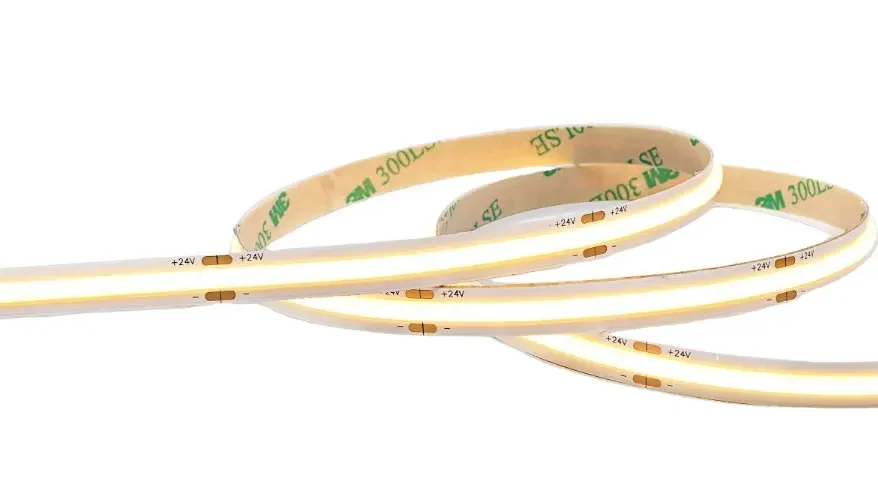
For buyers comparing 24v cob led strip options, the main goal is usually stable project performance rather than only brightness or price. A 24V COB strip is often selected for commercial coves, cabinets, corridors, retail displays, marine interiors, and wholesale supply because it can support more practical voltage planning for longer runs than many 12V layouts. As a manufacturer, Senfey works from our COB LED strip range with attention to voltage matching, power layout, product consistency, and real installation conditions on site.
24V COB LED Strip Specs for Project Selection
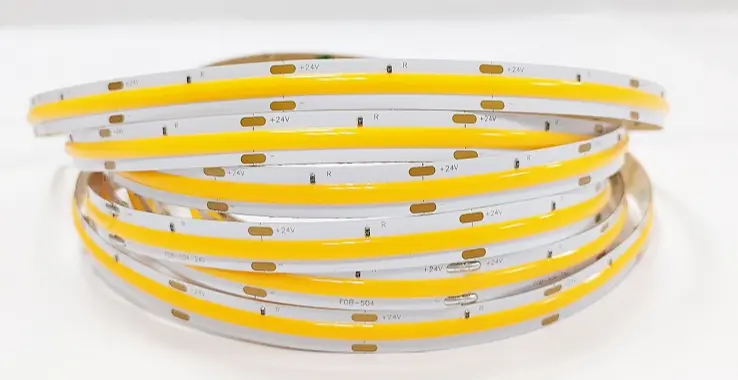
Chip-on-board construction places LED chips densely on the PCB under one continuous phosphor layer, producing a smoother light surface than discrete SMD packages spaced along a board. Running that construction at 24V gives commercial projects more voltage headroom per run, which is the practical reason it dominates specification on larger jobs.
Voltage alone is not the specification, though. Important points include PCB width, LED density, wattage, IP rating, CRI, color temperature, reel length, cutting unit, connector method, and driver compatibility. Any one of these can force a redesign if it is settled late.
| Specification Item | Why It Matters |
|---|---|
| Voltage | 24V supports more stable planning for many longer commercial runs. |
| LED density | Affects smoothness, brightness, and power consumption. |
| CRI | Important for retail, hospitality, cabinet, and display lighting. |
| PCB width | Must clear the machined groove or aluminium profile with working tolerance. |
| IP rating | Determines whether the strip fits indoor, damp, or outdoor applications. |
| Power supply | Must match voltage, wattage, run length, and safety margin. |
Why Choose 24V Instead of 12V COB LED Strip?
The main reason is voltage planning. In commercial installations, longer runs and multiple lighting zones make voltage drop a real design constraint rather than a footnote. Compared with 12V systems, 24V layouts generally support longer practical runs before brightness loss becomes visible, though the actual figure depends on strip power, PCB copper, wiring distance, and where power is injected.
This does not make 24V correct for every project. Short furniture details, small display units, and compact decorative areas often work perfectly well at 12V, and forcing 24V there adds driver cost without benefit. For hotel coves, office ceilings, retail shelves, long corridors, and distributor stock planning, 24V is the more practical default.
The same voltage logic applies to color-changing versions, where the decision has to be settled before controllers and power supplies are selected, since a controller specified for one voltage cannot simply be reused at the other.
Voltage Drop and Power Layout in Commercial Runs
Have an LED Lighting Project?
Share your project requirements — our engineering team will configure the complete LED strip system (strips + profiles + controllers + power supplies) and send you a detailed proposal within 24 hours.
Voltage drop happens when the voltage at the far end of a run falls below the voltage at the input. Both 12V and 24V COB strips operate as SELV circuits per IEC 61140, so the safety case is identical at either voltage; the difference is purely how much headroom the run has before the falloff becomes visible. On site it shows up as one end of a cove reading dimmer than the other, or as a slight colour shift along the line. The risk rises with run length, strip wattage, and undersized wiring.
A 24V strip reduces that exposure in most layouts but does not remove the need for electrical planning. Contractors should still confirm the maximum recommended run length, total wattage, driver capacity, wire gauge, and power injection points before anything is ordered.
On larger projects the run should be divided into controlled zones. Power supplies belong in serviceable locations, and each zone should be laid out so maintenance teams can reach drivers, connectors, and dimming equipment after handover — a point that is far cheaper to resolve on the drawing than in a finished ceiling.
For the hardware side of these decisions, our guide to connector and driver selection covers wiring methods and power supply matching in more detail.
Where These Runs Actually Go
24V COB suits projects that need a smooth linear light line, stable low-voltage design, and repeatable specification control across multiple areas of the same building.
Hotel Cove and Commercial Ceiling Lighting
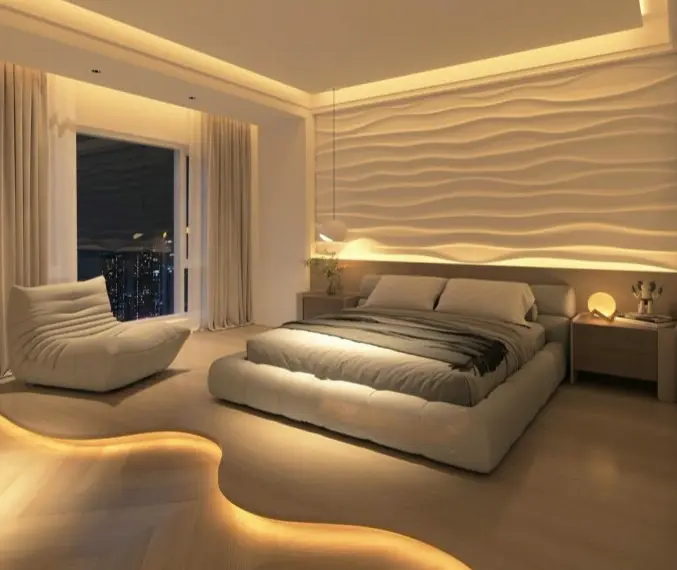
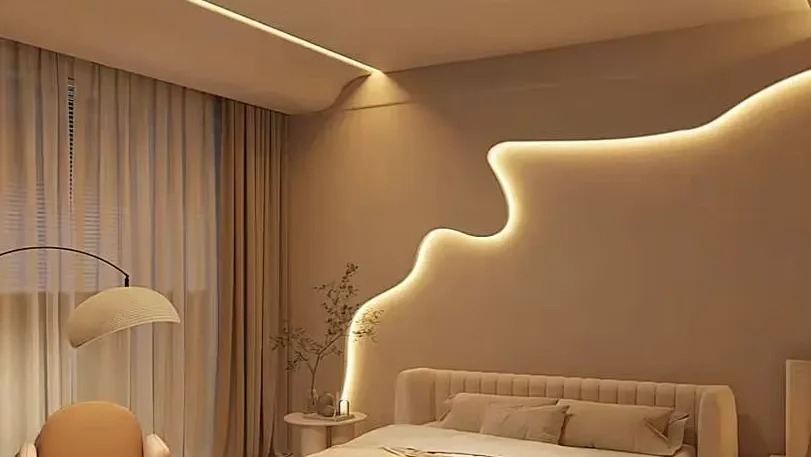
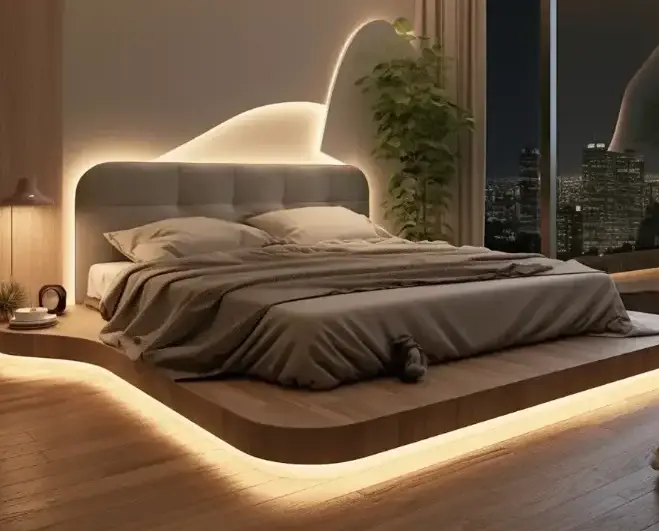
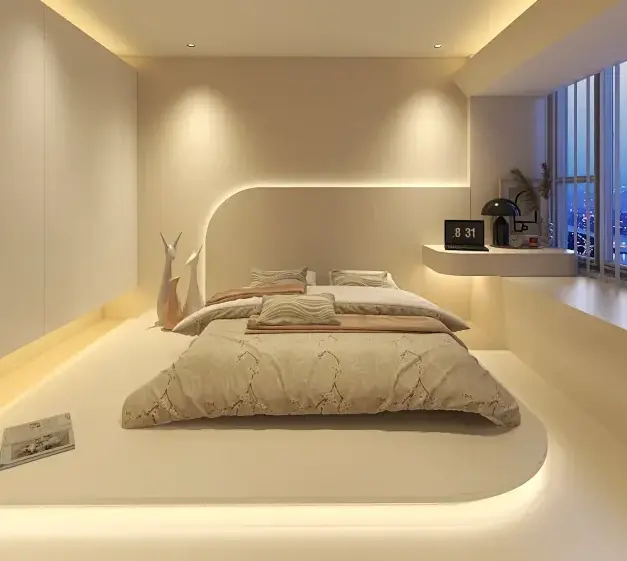
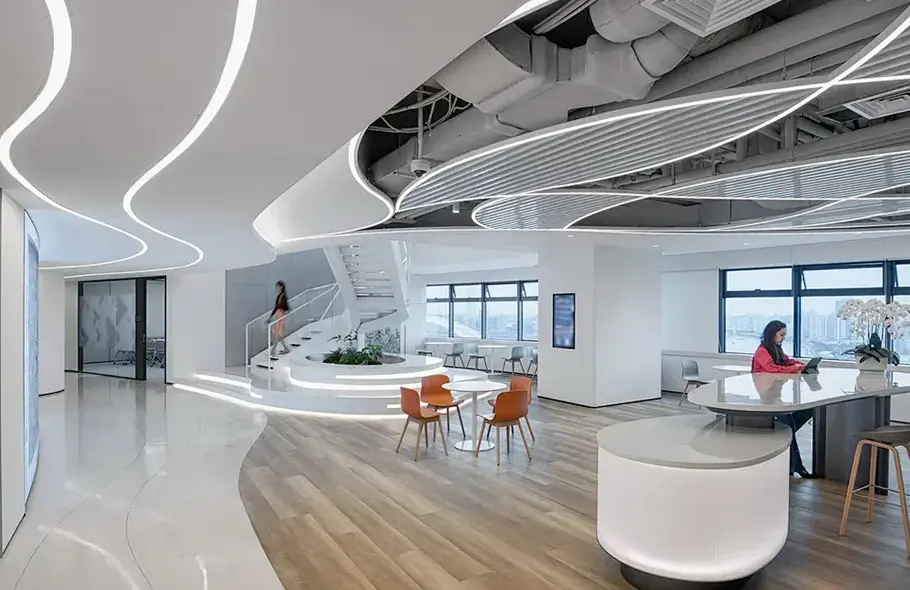
Hotels use these strips in lobby coves, corridors, guest rooms, and lounge areas, where the smooth COB surface gives a clean indirect line and the 24V layout keeps power planning manageable across dozens of repeated runs. Office and commercial ceilings apply the same logic to indirect linear details, meeting rooms, and reception areas, with driver locations and run lengths confirmed before installation begins. A hotel cove lighting COB LED strip project and an office ceiling run we handled both show how these zones are broken up in practice.
Cabinet, Joinery and Damp-Area Work
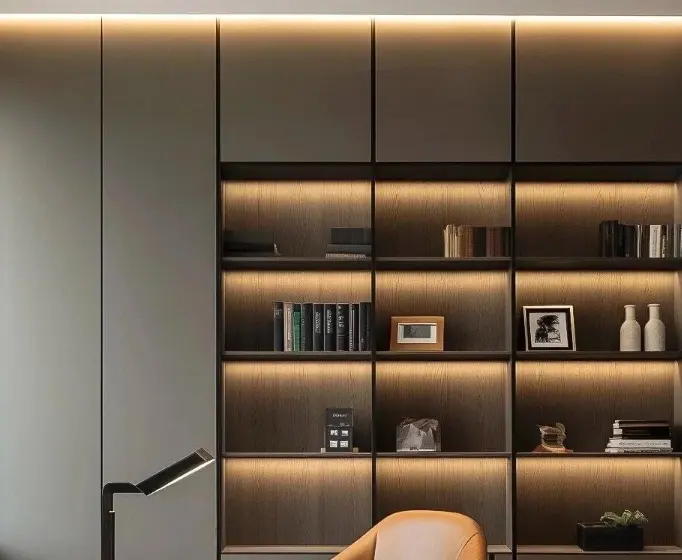
Cabinet makers and interior contractors choose 24V COB for wardrobes, shelves, display cabinets, and machined furniture grooves, where close viewing distance makes the absence of visible LED points the deciding factor. Where moisture is involved — bathrooms, spas, marine interiors, or any exterior position — the IP rating has to be settled before the strip is chosen rather than after, and the waterproof COB LED strip guide covers what changes in that case.
Two Starting Points for a 24V Specification
Different 24V COB strips suit different project needs. The right option usually comes down to the groove or profile width available, the density the design calls for, and how much output the space genuinely needs.
480 LEDs/m on an 8 mm PCB
The 480 LEDs/m 8 mm COB strip runs at IP20 with CRI 90. The 8 mm board suits the common case where joinery or plasterwork is machined to 10 mm, leaving working clearance either side for adhesive and thermal movement. It covers hotel coves, cabinet interiors, and general commercial linear work.
528 LEDs/m on a 10 mm PCB
The 528 LEDs/m 10 mm COB strip is 24V only, also IP20 and CRI 90. The wider board carries higher density, which matters where the light line is viewed at close range, or where the design needs more output from one run instead of a doubled row — a decision that also affects the profile width specified upstream.
Both are IP20 and intended for dry, concealed positions; damp-area, marine, and exterior work needs a separately specified waterproof build. For either product, request samples and confirm color temperature, output, installation method, and driver matching before bulk ordering.
Procurement Checklist Before You Commit
Importers, distributors, lighting contractors, and project buyers should work through a checklist rather than compare on price. It reduces the risk of receiving a product that photographs well but does not fit the actual installation.
- Confirm whether the project needs indoor, damp-area, or waterproof strip. Senfey’s COB range is rated IP20 per IEC 60529, so damp and exterior positions need a separately specified waterproof build.
- Check the CRI level the application actually requires, and whether it is being judged against a reference sample.
- Confirm color temperature — warm white, neutral white, or cool white — and the acceptable variation between reels.
- Calculate total wattage and size the 24V power supply with headroom rather than to the exact figure.
- Confirm maximum run length and whether power injection is needed.
- Check PCB width against the aluminium profile or machined groove.
- Confirm cutting interval and connector method before installation.
- Request samples before final project approval or bulk purchasing.
Wholesale buyers should additionally confirm packaging, labelling, reel length, batch consistency, and whether the supplier can hold the same specification across repeat orders — the last point being what separates a stock item from a one-off run.
Seven Specification Mistakes That Cost Money
Most project problems come from incomplete specification rather than from the product type. A 24V strip still needs correct system design around it.
- Choosing the strip before confirming the driver and controller.
- Running one continuous length without checking voltage drop.
- Ignoring heat dissipation and aluminium profile requirements.
- Specifying an indoor IP rating for damp or exterior locations.
- Using low-grade connectors on commercial work.
- Mixing production batches without sample approval.
- Comparing on price alone without checking CRI, density, and supply terms.
Each of these adds installation time, produces inconsistent output, or creates maintenance problems after handover — usually at a cost well above the saving that caused them.
FAQ
What is a 24V COB LED strip?
It is a chip-on-board LED strip built for 24V low-voltage input. The construction gives a smooth linear light line, and it is used across commercial, hospitality, cabinet, and architectural lighting projects.
Is 24V better than 12V for COB runs?
For longer commercial runs, generally yes, because it holds voltage more stably across distance. For short runs and compact installations, 12V remains perfectly suitable and often cheaper to drive.
Can these strips be cut on site?
Most can be cut at marked cutting points. The interval varies by product design, so confirm the cutting unit before installation — it determines how closely a run can be fitted to an odd-length detail.
Are waterproof versions available?
The COB range listed here is IP20 for dry, concealed positions. Where a project needs damp-area or exterior protection, the waterproof build is specified separately, so confirm the IP requirement and installation environment before ordering.
What power supply does a 24V run need?
A 24V output sized for the total connected wattage with a safety margin rather than to the exact load. Driver placement and power injection points should be planned before installation, not resolved during it.
Is 24V suitable for hotel cove lighting?
Yes, and it is the usual choice there. Cove work involves many repeated linear runs, and 24V keeps the number of power injection points and driver locations manageable across a floor.
Reference Resources
For additional background on LED lighting, controls, and electrical planning, buyers may review these resources:
Request Samples and Project Support
If you are sourcing 24V COB LED strip lights for a hotel, office, cabinet, retail, marine, or commercial linear lighting project, prepare the run length, color temperature, IP requirement, driver position, and installation drawing before making contact.
You can contact Senfey to request samples, discuss custom specifications, or get support with 24V selection and power layout.
