
Shenzhen LED Strip Factory · Entertainment Venues
Bar With LED Lighting: Colour and Control for Bars, Clubs and Restaurants
Specified by what the room has to do after dark — a counter that reads warm and flattering, a dancefloor that changes on the beat, a dining room that holds one mood, a sign that pulls people in from the street. Made in our own factory, supplied direct to operators, contractors and designers.
- Spaces
- Bar to facadesix zones, six specs
- Colour
- RGB · RGBW · RGBICplus tunable white
- Control
- DMX · DALI · pixeladdressable per section
- Builds
- IP20 · IP65 · IP67indoor, wet and exterior
Venue realities
Why venue lighting disappoints once the doors open
A bar, a club and a dining room are three different jobs, and the lighting is usually bought as one. These are the complaints we are called in to fix, and almost none are product failures.
Saturated colour that makes people look ill
Deep RGB is the point on a dancefloor and wrong at a table. Where guests and food are seen close up, saturated colour needs a warm white layer or faces and plates go grey.
Lighting that ruins every photo posted
Venues live on the footage guests shoot. A cheap driver bands on a phone camera and strobes in slow motion, so the room looks worse online.
Sources visible from the seat
In a dark room the eye finds any bright dot instantly. A strip mounted without a deep enough reveal or a diffuser reads as hotspots, not a line of light.
Scenes nobody behind the bar can run
Systems get specified around a designer's showcase, then handed to staff on a Friday night. If service, dinner, late and close are not four buttons, the room stays on one setting.
Failures at the bar back, terrace and pool
Spirits get spilled, terraces rained on, pool surrounds splashed and washed down. Indoor strip put there fails within a season, usually at a joint rather than in the tape.
Colour that drifts by the second year
Venues run long evenings at high output, often in warm rooms with no ventilation behind the joinery. Over-driven strip in a sealed channel loses brightness and shifts hue.
Why the seat sees the source
- 1A shallow reveal puts the strip in the sightline of anyone seated, and a dark room draws the eye to it.
- 2A deeper reveal with a shielding lip and diffuser hides the source, so guests see the lit surface only.
The pattern behind all six: one colour-changing strip bought for the whole venue. A counter, a dancefloor, a dining room, a sign and a terrace need different colour, density, diffusion, IP build and control; buying them as one line produces every problem here.
Zone by zone
Six zones in a venue, six different specifications
Walk a venue from the street to the terrace and the brief changes at every threshold. Each zone sets out what the room has to do, and what that fixes about the strip, colour and control.
The bar counter, back bar and bottle display
The one surface every guest stands at and photographs, doing two jobs at once: lighting bottles so labels and liquid colour read, and faces so people look well — both from concealed positions, so the strip must be narrow enough to hide and render colour well up close.
2700K on the back bar with a colour layer under the counter works best: white flatters, colour brands. Spilt spirits make this a damp zone, so specify a sealed build. See bar LED lighting.
Typical: 2700–3000K warm white plus RGB or RGBW · CRI 90+ · 24V · IP65 at the counter and bar back, IP20 on high shelves · narrow 8 mm profile, concealed in the shelf reveal
The dancefloor, DJ booth and ceiling effects
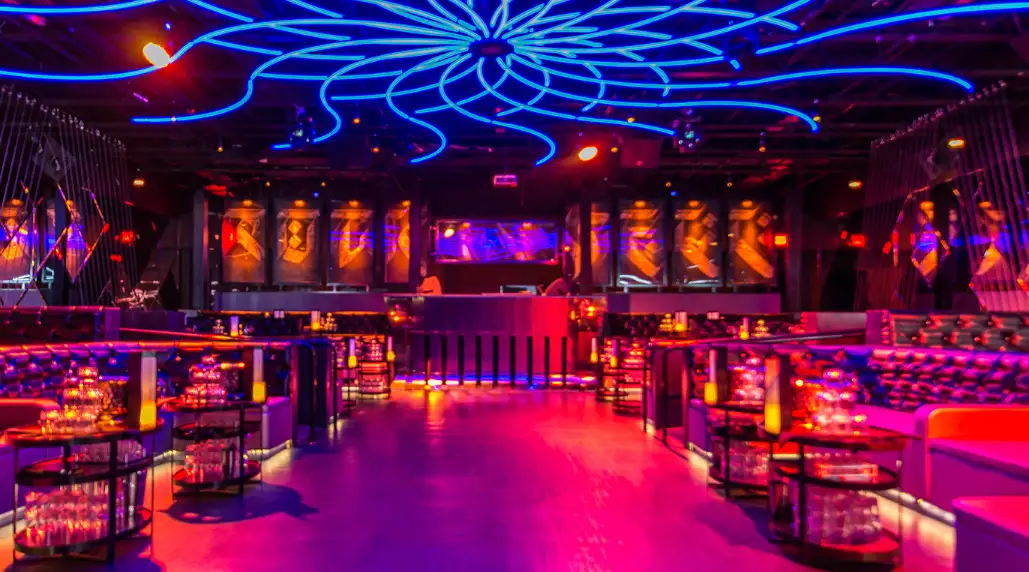
The only zone where saturated colour and movement are the point: colour-changing lines in the ceiling, along bulkheads and around the booth replace a rig of fixtures.
Two decisions matter more than density: whether the run shows one colour at a time or different content along its length, and the driver. Chases need addressable strip, and anything that bands on a phone camera is unusable here. See club LED lighting.
Typical: RGB, RGBW or addressable RGBIC · high density for close-viewed lines · 12V or 24V by run length · IP20 indoors · DMX or pixel control, flicker-free driver confirmed on camera
The dining room, booths and table zones
A restaurant is lit for food and faces, not effect, which inverts most dancefloor decisions. Cove, pelmet and booth lighting is warm, dim and aimed so nothing shines back at a seated guest. Under CRI 80 reds go brown and meat, wine and timber look wrong.
The other requirement is a deep dim. A room that drops through lunch, early evening and late service stays on one setting if the strip steps or cuts out at ten per cent. See restaurant LED lighting.
Typical: 2700K warm white, one temperature throughout · CRI 90+, 95 over food · 24V · IP20 · dimmable to 1% without steps or flicker · dotless line in a cove or pelmet
Signage, lettering and brand elements
The sign has to work from across the street, and is usually the most photographed object inside too. Flexible neon is the right material: the body is diffuser and seal in one, bends to a letterform and holds it, reading as a solid line.
Fabrication matters more than the tape: backing, cut ends and cable exit are decided before anything is glued. See LED neon flex and LED neon bar lights.
Typical: single colour or RGB neon flex · 12V for lettering, 24V for long outlines · IP65 indoors, IP67 street-facing · 6–12 mm body · backing, end caps and cable exit set at drawing
Cinemas, stages and seated auditoria
Seated venues have the opposite problem to a bar: lighting must let people move safely while staying dark enough that nothing competes with the screen. Step edges, aisle nosings and seat rows are lit very low, never in a sightline.
Two things get specified here that nowhere else needs: a dim range reaching very low output without stepping, and a fade that is smooth on a cue.
Typical: 2700–3000K, or a low-glare cool tone for step edges · low density, deeply recessed · 24V · IP20 · dim to 1% on a timed fade, driven from the AV or house control system
Terraces, pool surrounds and smoking areas
Outdoor trading decides a season, and the lighting is exposed to rain, salt, hose-down cleaning, pool splash and sun. This zone fails more than any other, and almost never mid-length — it fails at a joint, an end cap or a driver enclosure.
So the build is specified at order, not sealed on site: factory-sealed lengths, gasketed junctions, a driver location resolved before the decking closes.
Typical: 2700–3000K warm white, or RGB for feature edges · 24V · IP67 at pool and open terrace, IP65 under cover · sealed lengths, gasketed joints, accessible driver enclosure
Technology selection
Matching the strip technology to each zone of a venue
A venue usually needs three of the four technologies, and viewing distance and colour behaviour decide between them rather than price per metre. COB LED strip emits one continuous dotless line, which a bar counter, a dining cove and a step edge all need because guests sit close. Addressable LED strip earns its cost on a dancefloor, where one run must show chases along its length rather than one colour at a time.
LED neon flex handles anything shaped or street-facing — signs, lettering, arches, counter fronts — because the flexible body is diffuser and seal in one. SMD LED strip stays useful back-of-house and in deep coves, where the source is never seen.
RGB alone cannot make a convincing white, so where guests and food are lit, specify RGBW or RGBCW or run a separate warm white layer. Voltage follows run length: 12V for lettering, 24V across a room.
Matched products from the catalogue
RGBW COB LED Strip 784LEDs/m 12mm 24V
ES-COB-784-12MM-24V-RGBW
Colour and a real white from one run, so a counter can be branded and still flatter faces. Dotless close up, 24V for room-length runs.
- Density784 LEDs/m
- Width12 mm
- Voltage24V
- CRI · IP90 · IP20
RGB IC Addressable COB LED Strip 576LEDs/m 10mm
ES-COB-576-10MM-RGBIC
Different colours along one length, for chases and sweeps on a ceiling or booth, with a dotless face so the effect reads as a line rather than pixels.
- Density576 LEDs/m
- Width10 mm
- Voltage12V / 24V
- TypeRGBIC · IP20
COB LED Strip 480LEDs/m 8mm 24V Single Color
ES-COB-480-24V-8MM
The warm white layer that does the flattering — narrow enough to hide in a counter reveal, bottle shelf or booth pelmet, with the colour rendering food needs.
- Density480 LEDs/m
- Width8 mm
- Voltage12V / 24V
- CRI · IP90 · IP20
RGB Silicone LED Neon Strip 6x12mm
ES-NEON-SIGN-02
Bends to a letterform or arch and holds it, in an IP67 silicone body needing no channel and no site sealing. For signs, outlines and counter fronts.
- Size6 × 12 mm
- ColourRGB
- Voltage12V / 24V
- IPIP67
Venue projects
Entertainment and hospitality projects already installed
Six installations across club, cinema, restaurant, immersive and poolside work, with locations as recorded in our project files.
Verona, ItalyNightclub
Nightclub addressable LED strip lighting
Ceiling and bulkhead lines running chases on a pixel controller, sectioned so the dancefloor and bar run on separate cues.
Read the project
Coimbra, PortugalCinema
Cinema ambient LED strip lighting
Step edges, aisle nosings and wall coves at very low output, on a timed fade between trailers and feature.
Read the project
Cluj-Napoca, RomaniaRestaurant
Restaurant warm white LED strip cove lighting
Perimeter cove and booth pelmets at one warm temperature, dimmed deep enough that lunch and late service are different rooms.
Read the project
Prague, CzechiaImmersive venue
RGB neon flex in an immersive venue
Shaped neon runs following wall and ceiling geometry, driven as colour scenes so one room reads differently through the visit.
Read the project
Łódź, PolandRestaurant signage
Neon flex restaurant signage at a pizza counter
Lettering and counter-front outline in neon flex, with backing, cut ends and cable exit set out before anything was mounted.
Read the project
Ghent, BelgiumPoolside
Poolside waterproof LED strip lighting
Coping and surround lines on a splash-and-washdown site, with sealed lengths, gasketed junctions and the driver enclosure resolved before the deck closed.
Read the projectFurther installations are in the project case library. Adjacent scenes are covered by the hotel and hospitality lighting and architectural facade lighting pillars.
Specification guide
Recommended specification by venue zone
A starting point for a schedule, not a substitute for one. Final values depend on reveal depth, finishes and the target level in each room.
| Zone | Colour | CCT | CRI | Voltage | IP | Control | Detail |
|---|---|---|---|---|---|---|---|
| Bar counter and back bar | Warm white + RGBW | 2700–3000K | 90+ | 24V | IP65 counter · IP20 shelf | Scene preset | High CRI COB |
| Dancefloor and DJ booth | RGB · RGBW · RGBIC | — | — | 12V / 24V | IP20 | DMX or pixel | Addressable COB |
| Dining room and booths | Warm white | 2700K | 90–95 | 24V | IP20 | Dim to 1% | Dimmable COB |
| Signage and exterior | Single colour or RGB | — | — | 12V / 24V | IP65 indoor · IP67 exterior | Scene or static | Outdoor neon flex |
- RGB cannot make a white. Where guests, drinks or food are lit, specify RGBW or RGBCW, or run a separate warm white circuit. A dancefloor is the only zone where RGB alone is the right answer.
- Confirm the driver on camera, not on the wall. Venue footage is the marketing, so film a sample run on a phone at the lowest scene level you intend to use before ordering.
- Wet zones are decided by the joints. Counters, terraces and pool surrounds fail at cut ends, junctions and driver enclosures rather than in the tape, so specify the sealed build at order and resolve the driver position on drawing.
Procurement and factory support
Buying venue LED lighting from the factory direct
Senfey manufactures in Shenzhen and supplies venue operators, contractors, designers and distributors rather than retail, so a question about a colour mix or a sealed build is answered by the people running the line.
- Send the plan, or just the zone list
- Room areas, run lengths, wet scope and the mood per zone are enough to start. A reflected ceiling plan lets us comment on reveal depth and driver position.
- Judge samples in the dark, on the real finish
- Warm white on brass reads nothing like it does on dark timber, and a colour scene looks different at the level you will run it.
- Film the sample before you order
- A venue lives on guest footage, so the driver has to be flicker-free on a phone at the lowest scene level — the one test worth doing yourself.
- Fix the control protocol early
- DMX, pixel, DALI, 0–10V or an app changes the driver and sometimes the strip. Name it early, and say how many buttons the bar staff get.
- One specification per zone, one batch per room
- Once the schedule is fixed, the venue is produced against one specification per zone so runs match along a wall. Tell us the phasing if opening is staged.
- OEM, ODM and four technologies in one supply chain
- Cut-to-length runs, custom colour and CRI combinations, IP65 and IP67 builds, connector and lead configurations, private labelling. COB, SMD, neon flex and pixel strip are all made in house, so a mixed specification does not become four suppliers: about Senfey.
Venue project enquiry
Tell us the zones and we reply with a strip, driver, colour and IP build per zone, not one price per metre. Prefer email? Use the contact page.
Prefer email or a message app? Use our contact page.
FAQ
Venue LED lighting questions from operators and contractors
The questions that come up most often during design and pricing.
What colour temperature should a bar or restaurant use?
2700K for dining rooms and bar counters. It flatters skin, makes timber, brass and wine look as the designer intended, and reads as evening rather than office.
3000K suits a brighter, contemporary room. Above that a venue feels like retail.
Can RGB strip produce a usable white light?
Not one you would put a guest under. Mixing red, green and blue leaves gaps in the spectrum, so skin looks grey and food flat even when colour on a wall looks right.
Where both are needed, specify RGBW or RGBCW so a dedicated white chip does that job, or run a separate warm white circuit. RGB alone belongs on a dancefloor, not a table.
Why does the lighting flicker in phone videos?
The driver dims by switching the LEDs faster than the eye notices but not faster than a camera sensor, giving banding on video and strobing in slow motion in every clip a guest posts.
It is a driver problem, not a strip problem. Ask for a flicker-free driver, then film a sample run on a phone at your lowest scene level before ordering.
Do I need addressable strip for a club?
Only where one run has to show different content along its length — chases, sweeps and pixel effects following the music. Club LED lighting covers how the runs are sectioned.
If the whole run changes colour together, RGB or RGBW is brighter per watt, cheaper and simpler to commission. Addressable strip also needs content authored and a controller someone can operate.
How do you stop LED strip glaring in a dark room?
Three things, in order. Hide the source in a reveal deep enough that nobody seated or standing sees the tape. Then diffuse it, so the line reads as light rather than dots — a dotless COB face or a frosted lens both work.
Then aim it at a surface: light bounced off a soffit, wall or shelf makes a venue feel considered.
What IP rating do bar counters, terraces and pools need?
IP65 for spill and splash — under a counter, behind a bar, on a covered terrace. IP67 where there is direct weather, hose-down cleaning or pool splash.
Put the rating on the order — a sealed body is built that way and cannot be retrofitted. The tape rarely fails; cut ends, junctions and driver enclosures do.
Can neon flex be shaped into a logo or lettering?
Yes, and it is the normal way to make a venue sign now. The flexible body bends to a letterform or arch and holds it, reads as a solid line, and needs no channel.
Send the artwork and say whether it faces the street, since that decides the IP build and mounting. See LED neon bar lights for fabrication detail.
Can lighting be changed in a venue that is still trading?
Usually yes, if the work is split by zone and planned around closed hours. Counter, back bar and signage can often be done overnight; ceiling and cove work needs longer.
The constraints are driver access and sectioning, so runs can be isolated without dropping the whole room. Bar-area detail is in bar LED lighting.
Do you supply venue operators and contractors directly?
Yes. We manufacture in Shenzhen and supply operators, designers, contractors and distributors, including OEM and private-label work for groups.
Say which country the venue is in when you enquire; it changes which driver we can supply. Send the zone list through the venue project enquiry form for a specification per zone, not one price per metre.
Not covered here? Questions needing drawings — reveal depth, target level, control topology, phasing around trading hours — are quicker to answer against the plan.
Request a quote