Senfey > SMD LED Strip Light

Shenzhen LED Strip Factory · OEM & ODM

LED Strip Lights for Commercial and Architectural Projects

SMD 2835 and 5050 LED strip lights built to project specification — single colour, RGB, RGBW and RGBCW, in 8, 10 and 12 mm widths at 12V or 24V DC. Senfey makes the strip, the dimmers and the drivers in one factory, so voltage drop, control and cut length are engineered together rather than sourced separately.

Density
60–240LEDs per metre
Voltage
12V / 24Vconstant voltage DC
PCB width
8 / 10 / 12millimetres
Colour
4 systemssingle · RGB · RGBW · RGBCW
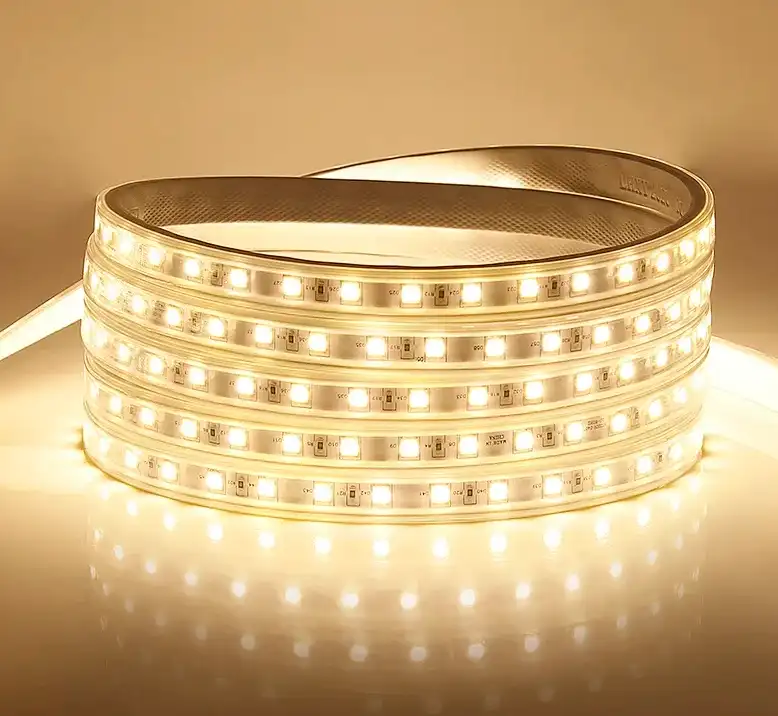
SMD 2835 LED strip lights mounted in an aluminium channel with a frosted diffuser, showing the 8 mm PCB and warm white output
SMD 2835 LED strip lights Density, PCB width and voltage are all specified per project.

The basics

What are LED strip lights?

An LED strip light is a flexible printed circuit board carrying surface-mounted LED packages at a fixed pitch, powered by constant-voltage DC and supplied on a reel that can be cut to length on site. It is also sold as LED tape light — identical hardware, a 5 mm to 12 mm copper-clad flexible PCB with adhesive backing.

The name describes the mounting method: SMD, surface-mounted device. Each package is soldered flat onto the board rather than wired through it, which is what lets an 8 mm to 12 mm PCB stay flexible enough to follow a cove or a curved handrail.

12 34 PCB width 8–12 mm
  1. 1SMD package — 2835 or 5050
  2. 2Copper trace layer
  3. 3Flexible PCB (polyimide)
  4. 4Adhesive backing
SMD package — 2835 or 5050 Copper trace layer Flexible PCB (polyimide) Adhesive backing PCB width 8–12 mm
Surface mounting in section: the package sits on the pads, not through the board — which is what keeps the strip flexible.

What separates one strip from another is the LED package. An SMD LED strip uses discrete chips — 2835 for single colour, 5050 for multi-channel — spaced at regular intervals. That spacing is why an SMD strip shows individual points of light without a diffuser. Raising density from 60 to 120 or 240 LEDs per metre shortens the pitch and softens the effect, the usual lever when a strip is seen at close range.

For a project the decisions come down to four numbers: density in LEDs per metre, PCB width in millimetres, supply voltage, and colour channels. Those four determine the driver, the maximum run before voltage drop shows, whether the strip fits your extrusion, and which controller applies. Mounting, diffuser and IP treatment all follow from them.

A dotless alternative exists. COB LED strip replaces discrete packages with a continuous line of dies, removing the dots entirely. It costs more per metre, so for most ceilings, coves and concealed runs a correctly specified SMD strip behind a diffuser does the job. Where the strip is exposed or grazing a surface at a shallow angle, COB is worth the difference.

Specifications

SMD LED strip specification matrix

Every variant below is a catalogue product, not a configurator option. Pick the row matching your mounting depth and viewing distance, then follow the guide link. All catalogue strips are CRI 80 and IP20 as standard; higher CRI and outdoor sealing are built to order.

Senfey SMD LED strip variants — density, width, voltage and colour system, with the matching selection guide for each family.
Variant LEDs / m PCB width Voltage CRI IP Best suited to Selection guide
SMD 2835 standardsingle colour 60 8 mm 12V / 24V 80 IP20 Concealed cove and pelmet runs where the strip is never seen directly SMD LED strip types
SMD 2835 mid densitysingle colour 120 8 mm 12V / 24V 80 IP20 General commercial linear lighting behind a frosted diffuser LED strip lighting applications
SMD 2835 high densitysingle colour 240 10 mm 12V / 24V 80 IP20 Shallow channels and close viewing distances where pitch would otherwise show COB and SMD compared
SMD 5050 single colourlarger package 60 / 120 10 mm 12V / 24V 80 IP20 Higher output per metre where the 2835 board runs out of headroom 12V and 24V LED strip lights
SMD 5050 RGB3 channels 60 / 120 10 / 12 mm 12V / 24V 80 IP20 Colour-change accent lighting in hospitality and retail interiors RGB LED strip guide
SMD 5050 RGBW / RGBCW4 and 5 channels 60 / 96 / 120 12 mm 12V / 24V 80 IP20 Spaces that need usable white light and colour from one fitting Waterproof outdoor LED strip

Scroll the table sideways on narrow screens to see every column.

Density matters more than wattage

Two strips at the same wattage can look completely different. Density sets the pitch, and pitch decides whether a diffuser hides the dots at your mounting depth. Specify LEDs per metre first, then check the load.

Width is a mechanical constraint

An 8 mm board fits narrow joinery profiles that a 12 mm RGBW board will not. Confirm the extrusion's internal width before the colour system is signed off — multi-channel strips are physically wider.

Choose 24V for long runs

At equal power, 24V draws half the current of 12V, so voltage drop is far less severe and fewer injection points are needed. 12V remains useful for short cabinet runs.

Featured products

Four SMD LED strips that cover most project briefs

These four cover most enquiries we quote: a workhorse single-colour board, a high-density board for shallow channels, an RGB strip for accent work, and a 24V RGBW strip where white light and colour are both needed.

The catalogue also lists 5050 RGBCW five-channel strips, single-colour 5050 boards at two densities, seven dimmers and RGB controllers, and DC12V adapters from 12W to 96W.

See the full catalogue

Applications & projects

Where LED strip lighting is specified

The same four levers land differently in each sector. Below is how we specify by space type, then projects Senfey has supplied. Broader survey in the LED strip lighting applications guide.

Offices and conference rooms

Suspended linear fittings and ceiling coves, usually dimmable and tied into the building control system. Density is chosen so the diffuser reads as a line from floor level.

Typical: SMD 2835 · 120 LEDs/m · 24V · dimmable

Retail and display

Shelf edges, display cases and refrigerated units. Runs are short and repeated, so cut increment and connector method matter more than output.

Typical: SMD 2835 · 120–240 LEDs/m · 24V · 8 mm board

Cabinet and joinery

Under-cabinet and inside-carcass lighting where the profile is shallow and the strip sits close to the eye — where higher density earns its keep.

Typical: SMD 2835 · 240 LEDs/m · 12V · 8 mm board

Long corridors and circulation

Continuous runs measured in tens of metres. 24V with planned injection points is effectively mandatory; 12V would visibly fade before the far end.

Typical: SMD 2835 · 60–120 LEDs/m · 24V · multiple feeds

Distributor and wholesale stock

Repeat orders on a few SKUs, packed and labelled consistently so reels resell without repackaging.

Typical: 2–4 SKUs · OEM labelling · standing schedule

Project cases

Installation, power & control

Installing and controlling LED strip lights

Most site problems with LED strip are not strip failures — they are load calculations done after the driver was ordered, or a dimmer chosen without checking channel count.

Measure the run and set the voltage

Total metres per circuit decides voltage before anything else. Short furniture runs can stay at 12V; anything continuous over a few metres should be 24V so drop stays invisible.

Size the driver with headroom

Multiply watts per metre by length, then leave roughly 20% spare. A driver run at its rating gets hot and ages fast. Senfey supplies DC12V adapters from 12W to 96W.

Cut only on the marked increment

Every strip has a repeating circuit segment with printed cut lines and solder pads. Cut on the line and the segment stays complete; cut elsewhere and it is lost.

Mount in profile, then feed and test

Adhesive backing alone is not a permanent fixing — use an aluminium channel for heat dissipation and a clean line. Test before the joinery closes up.

Choosing the right control method

Control follows the channel count. Single colour needs a one-channel dimmer; RGB needs three; RGBW and RGBCW need four and five. A three-channel RGB controller physically cannot drive the white channel of an RGBW strip — the most common mismatch we see on incoming specifications.

For single colour we stock touch, inline and RF dimmers, including a 30A unit for high loads; 24-key and 44-key IR controllers cover standard RGB. Selection detail is in the dimmable LED strip lights guide, and wiring, connectors and driver sizing in the LED strip connectors and power supplies guide.

Where each metre must be controlled independently rather than the whole run together, the strip type changes: that is an addressable LED strip, with a data line and driver ICs rather than a constant-voltage circuit.

Comparison

SMD LED strip vs COB, neon flex and addressable

Senfey manufactures all four technologies, so there is no reason to oversell one. SMD is the default because it covers the widest range of briefs at the lowest cost per metre. The table shows where it stops being right.

How SMD LED strip compares with the other three Senfey strip technologies across the criteria that decide a specification.
Criterion SMD LED strip COB LED strip LED neon flex Addressable strip
Light appearance Discrete points; even behind a diffuser Continuous line, no visible dots Even glowing tube, sign-like Points, individually controllable
Best position Concealed in cove or profile Exposed or grazing a surface Visible as the design element itself Where movement or zoning is required
Relative cost per metre Lowest of the four Higher than SMD Higher, includes the jacket Highest, includes driver ICs
Control complexity Simple constant-voltage dimming Same as SMD Simple, or pixel on RGBIC versions Data protocol and addressing required
Outdoor suitability Requires sealing to order Requires sealing to order Built for outdoor use, IP65–IP68 Depends on version
Read more LED strip lights COB LED strip LED neon flex Addressable LED strip

Scroll the table sideways on narrow screens to see every column.

Choose SMD when

The strip is concealed, the run is straightforward, and budget per metre matters. This describes most commercial ceilings, coves, shelves and cabinets.

Choose COB when

The strip will be seen directly, or grazes a wall at a shallow angle where pitch would show as scalloping. Full comparison in the COB vs SMD LED strip guide.

Choose neon or addressable when

The lighting is the visible feature — signage, outlines, facades — or each section needs separate control. See LED neon rope light for the former.

Sourcing from the factory

Buying LED strip lights direct from the manufacturer

Senfey manufactures in Shenzhen and sells to specifiers, contractors and distributors rather than retail channels. Strip, dimmers and drivers come from one place, so a control question mid-project is one conversation instead of three. Buyer-side detail is in the LED strip manufacturer and supplier guide.

Samples before commitment
Density and colour are hard to judge from a datasheet. Request samples of the shortlisted variants and evaluate them in the actual profile and diffuser.
OEM and ODM
Custom reel lengths, cut-to-length runs, private labelling and packaging for distributors carrying their own brand.
Matched control and power
Dimmers, RGB controllers and DC12V adapters from 12W to 96W are quoted alongside the strip, so channel count and driver capacity are checked before ordering.
One supplier, four technologies
SMD, COB, neon flex and addressable are all made in house, so a mixed specification is not a mixed supply chain.
Company background
Manufacturing scope and facilities are on the about Senfey page.

Request a quote for LED strip lights

Tell us the run length, the voltage and how the strip will be mounted, and the reply can name a specific SKU and driver rather than a price list.

Prefer email or a message app? Use our contact page.

FAQ

LED strip light questions from project buyers

The questions that come up most often during specification and quoting.

What is the difference between LED strip light and LED tape light?

Nothing technical — two names for the same product. "Tape light" is more common in North American specifications and "strip light" in the UK and Europe, but both mean a flexible PCB with surface-mounted LEDs and adhesive backing. It only causes trouble when a drawing set mixes both. More detail in the LED tape light guide.

Should I use 12V or 24V LED strip lights?

Run length decides it. At equal power, 24V draws half the current of 12V, so losses along the copper are much lower and the far end of a long run stays as bright as the feed end. 24V is the default for continuous architectural runs; 12V still suits short cabinet and display runs. Most Senfey strips come in both — full comparison in the 12V and 24V LED strip lights guide.

Can LED strip lights be cut to length?

Yes, but only at the printed cut lines. The strip is built from repeating circuit segments and each must stay complete to work, so the marks sit between segments beside the solder pads. That segment length — the cut increment — depends on density and voltage, so a 24V high-density strip cannot be trimmed as finely as a 12V standard one. Where exact lengths matter, we cut and terminate at the factory.

How do I calculate the power supply size?

Multiply the watts per metre by the total metres on that circuit, then add roughly 20% headroom. A 60W load belongs on a driver rated near 75W — a supply held at full rating runs hot and its life shortens. Senfey stocks DC12V adapters from 12W to 96W; wiring and driver selection are covered in the LED strip connectors and power supplies guide.

Are LED strip lights dimmable?

The strip is dimmable; whether the installation dims properly depends on the dimmer and driver working together. A constant-voltage strip needs a dimmer designed for DC LED loads — a mains dimmer for incandescent lamps will flicker or fail. It must also match the channel count: one for single colour, three for RGB, four for RGBW, five for RGBCW. See the dimmable LED strip lights guide.

What is the difference between RGB, RGBW and RGBCW?

RGB produces white only by combining all three channels — acceptable as an effect, poor as functional light. RGBW adds a dedicated white die, so real white and colour come from the same strip. RGBCW adds a fifth channel, splitting white into warm and cool so colour temperature can be tuned. More channels means a wider board, which is why RGBW and RGBCW strips are 12 mm rather than 10 mm. Options are in the RGB LED strip guide.

Can SMD LED strip be used outdoors?

Not as supplied. Catalogue SMD strips are IP20 — no protection against water — so they are indoor products. Outdoor and wet-area projects need a sealed version, built to order rather than stocked. For genuinely exposed work, LED neon flex is often better: it is manufactured with an integral sealed jacket rather than sealed afterwards. See the waterproof outdoor LED strip guide.

Why do the dots show through my diffuser?

Because the distance between strip and diffuser is too small for that strip's pitch. Every SMD strip has a minimum depth at which a diffuser blends the points into a line; below it the individual LEDs reappear as scalloping. Three fixes: deepen the channel, raise the density, or change to a COB LED strip, which has no visible dots at any depth. Where the joinery fixes the profile, only the last two remain.

Do you supply LED strip to distributors and wholesalers?

Yes. Senfey is a manufacturer supplying distributors, contractors and lighting specifiers rather than retail channels. Private labelling, custom reel lengths and custom packaging are available for resellers carrying their own brand. Buyer-side considerations are in the LED strip manufacturer and supplier guide.

What is the difference between SMD and addressable LED strip?

On a standard SMD strip the whole circuit behaves as one unit — no way to light one metre and leave the next dark. An addressable strip adds driver ICs and a data line, so each pixel receives its own instruction, which is what makes chases, gradients and zoning possible. It costs more and needs a controller speaking the right protocol. For movement see addressable LED strip; for a steady even line a standard LED strip light is cheaper and more robust.

Still deciding? Send the run length, profile width and mounting method; the reply can name a specific SKU, driver and dimmer instead of a price range.

Request a quote

Want to Visit Our Factory?

We welcome online video tours and on-site visits.

Want the Same Solution for Your Project?

Tell us your needs — free quote within 24 hours.

Get a Quote for This Product

Free samples available. Reply within 24 hours.