A wholesale buyer in Wrocław asked us to rebuild the led strip distributor sample wall in his new showroom, and set the brief in one sentence: “I don’t want a display, I want a decision-making tool.” His customers — electricians, contractors, kitchen fitters — walk in wanting to feel the difference between COB and SMD, not read a datasheet.
A Showroom Built Around the First 90 Seconds
The distributor stocks four LED strip categories and roughly 40 SKUs, mostly for contractors sourcing commercial LED lighting solutions. Before the refit, his led strip distributor sample wall was a collage of leftover reels stapled to plywood. The new brief: let a walk-in buyer shortlist a product in 90 seconds, then close in ten minutes.
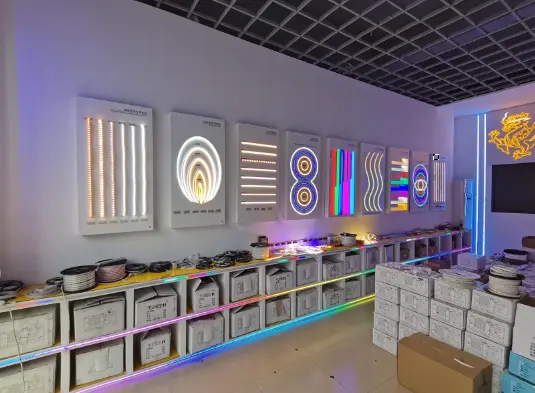
The showroom is Approx. 62 m² with one long wall (Approx. 7.4 m) reserved for the display. Everything a customer needs to touch, dim and compare had to fit that wall.
How the Wall Is Split, and Why
We divided the led strip distributor sample wall into four zones that follow how buyers ask for product, not how a catalogue is organised.
| Zone | What the Buyer Compares | Sample Length per SKU |
|---|---|---|
| 1. COB — dotless family | Density: 320 / 480 / 528 LEDs/m | Approx. 600 mm each |
| 2. SMD — cost-driven family | 2835 vs 5050 chip size and LEDs/m | Approx. 500 mm each |
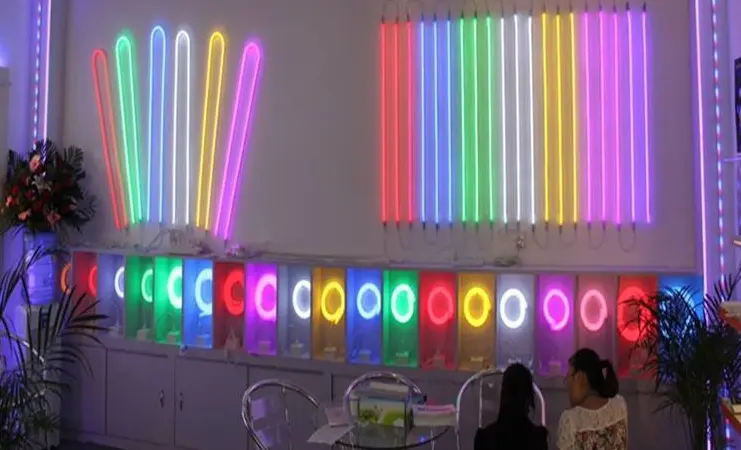
| 3. LED Neon Flex | Warm white, RGB and IP67 outdoor variants | Approx. 800 mm each |
| 4. Addressable | Pixel density and voltage platform | Approx. 500 mm each |
Sample lengths were not chosen for looks. 600 mm is about the shortest length at which the eye reliably judges dot visibility on a COB strip; below that, a 480 LEDs/m sample reads the same as a 320. Neon flex is bent into a shallow “S” so the buyer sees the minimum bend radius.
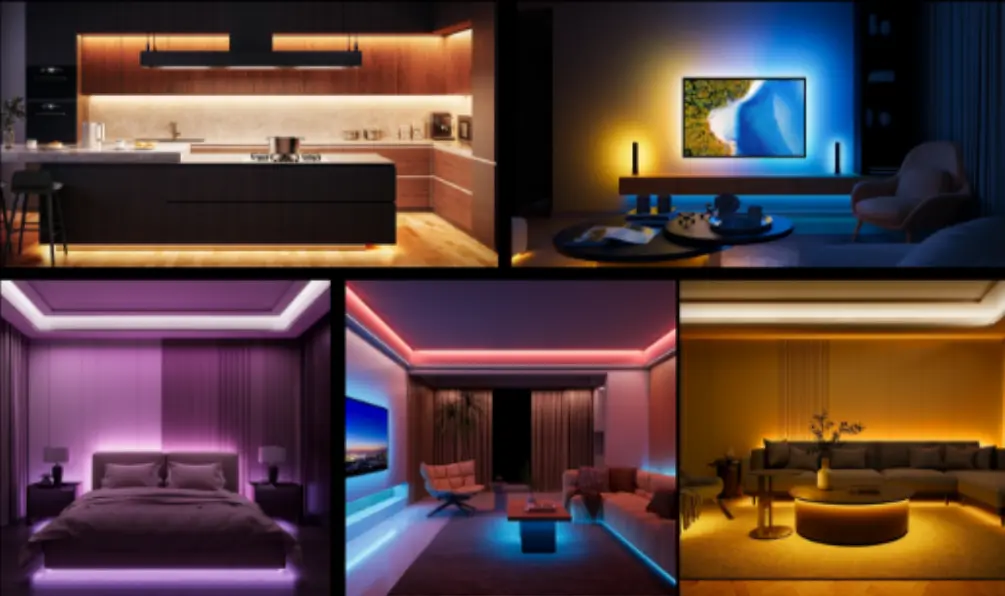
The Sample Kit We Loaded onto the Wall
Thirteen SKUs went onto the wall — volume sellers plus one reference part per family:
- Three COB — ES-COB-320-8MM-12V, ES-COB-480-24V-8MM, ES-COB-528-10MM-24V. Entry, mid and high density, all from one 3000K bin so the customer compares density, not colour.
- Four SMD — ES-2835-60-8MM, ES-2835-120-8MM, ES-5050-60-10MM and ES-5050-120-10MM. Two densities across two chip sizes shows where the price/output curve bends.
- Three neon flex — ES-NEON-SIGN-01 (warm white, IP65), ES-NEON-SIGN-02 (RGB, IP67) and ES-NEON-SIGN-03 (IP67 outdoor). Sealing options rather than sizes, because the first question is always “indoor or outdoor”.
- Three addressable — ES-WS2811-30-12V, ES-WS2812B-60-5V and ES-COB-576-10MM-RGBIC. 30 and 60 pixels per metre on two voltage platforms shows where a chase effect and a smooth wash diverge.
Each sample sits in an aluminium profile with a card underneath: SKU, voltage, CRI, IP, LEDs/m and a QR code. Tier pricing came from our COB LED strip pricing guide, part numbers from our LED strip supplier catalog.
Powering the Wall Without a Rat’s Nest Behind the Plywood
Sample walls fail at the back, not at the front. One driver per zone instead of one per SKU: each zone runs from a single SELV driver per IEC 61140, loaded to Approx. 60% so a sample can be swapped without a rewire. The 5V and 12V samples run from separate adapters.
Every sample also has its own switch, and every zone its own dim wheel. Customers reach for the dim wheel first — they want a strip at 20%, not 100%. The neon flex samples are the only sealed parts on display, rated IP65 and IP67 per IEC 60529, so the outdoor question is answered by pointing.
The Question the Distributor Kept Asking
Halfway through the build he kept returning to one problem: how to stop a customer buying the cheapest SMD when the job needs COB. The answer was not a bigger price sign but two comparison panels above the wall, each framing a single decision:
- Panel A — 500 mm of SMD 2835 at 60 LEDs/m beside 500 mm of COB at 480 LEDs/m, both 3000K, both at 50%. For cove and shelf work the price gap explains itself.
- Panel B — bent neon flex beside an SMD strip forced around the same radius. “We want a curved sign” stops being a debate.
At handover the wall carried Approx. 8 meters of strip across 13 SKUs, with 13 sample switches, four dim wheels and four drivers behind a hinged service panel. Ambient light at the display sits well below the 300 lx task level defined in EN 12464-1, low enough that dim-wheel tests read faithfully.
If You’re Planning Your Own Sample Wall
Four things worth writing into the brief before ordering samples for a led strip distributor sample wall:
- Match CCT bins within each family. Nominal 3000K reels drift by roughly ±150 K, and customers read that as bad manufacturing rather than a colorimetry issue.
- Design for the dim wheel. Buyers decide between 20% and 60% brightness far more often than at full power.
- Give the sales team a comparison panel, not a datasheet.
- Leave Approx. 30% spare driver headroom. Your product mix will change before your wall does.
Senfey is a Chinese LED strip manufacturer established in 2013, based in Shenzhen, running in-house SMT and silicone extrusion lines with output of Approx. 1.2 million metres per month across COB, SMD, addressable and neon flex categories. Explore our full COB LED strip catalog or talk to us about a distributor sample kit.