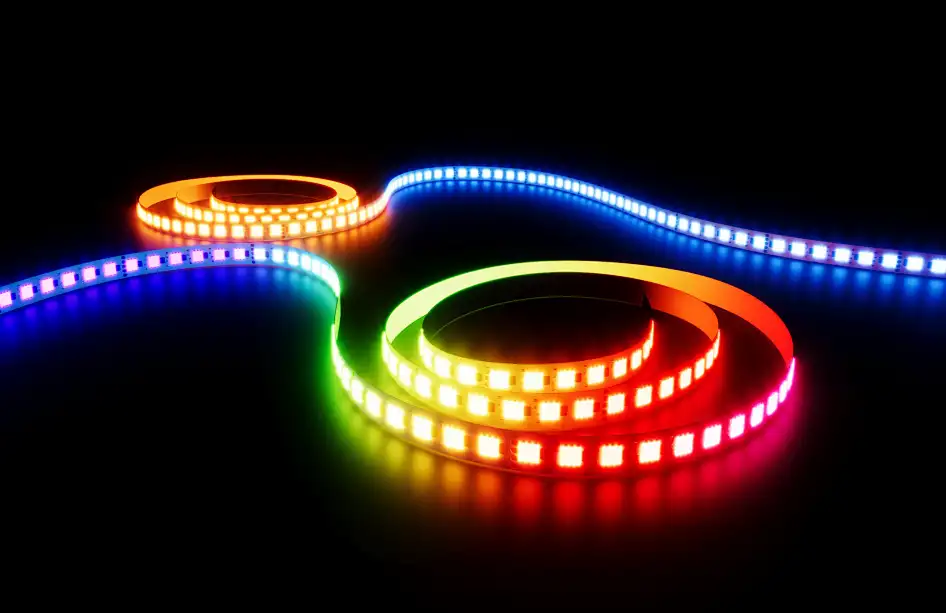
Addressable LED Strip Series

Addressable LED Strip Light

Individually addressable LED strips feature built-in IC chips that allow independent control of every single LED pixel. Create stunning dynamic lighting effects — chasing, rainbow, breathing, music-sync, and more — with WS2812B, WS2815, and SK6812 series programmable LED strips from Senfey.

What is Addressable LED Strip?

An addressable LED strip — also called a pixel LED strip, digital LED strip, or programmable LED strip — is an advanced type of LED tape where each LED (or small group of LEDs) contains an integrated circuit (IC) chip. This IC chip gives every pixel its own unique address on the data line, enabling you to control the color, brightness, and timing of each LED independently.

Unlike standard RGB LED strips that change all LEDs to the same color simultaneously, addressable strips can display different colors on every single pixel at the same time. This is the technology behind mesmerizing rainbow chasing effects, pixel-mapped animations, music-reactive lighting, and complex dynamic patterns used in entertainment, signage, and architectural feature lighting.

  • Individual pixel control — each LED is independently addressable via built-in IC
  • Unlimited color effects: chasing, flowing, breathing, fire, rainbow, custom animations
  • Compatible with Arduino, Raspberry Pi, ESP32, DMX512, Art-Net, and LED controllers
  • Popular IC chips: WS2812B, WS2815, SK6812, WS2811, APA102, SK9822
  • Available in DC 5V, DC 12V, and DC 24V configurations
  • Wide density range: 30, 60, 96, 144 LEDs per meter
  • IP20 to IP67 waterproof ratings for indoor and outdoor use
Addressable LED Strip Pixel Effect Close-up

How Does Addressable LED Strip Work?

Each addressable LED pixel contains a tiny driver IC (such as WS2812B or SK6812) integrated directly into the LED package. A microcontroller sends a serial data signal through the strip — each IC reads its own color data and passes the remaining data downstream to the next pixel.

This daisy-chain data architecture means you only need a single data wire (plus power and ground) to control hundreds or even thousands of LEDs independently. The communication protocols (NZR one-wire for WS28xx, SPI two-wire for APA102) allow refresh rates fast enough for smooth animations and video-mapped content.

  • Single data line controls the entire strip — simple wiring
  • 24-bit color depth (16.7 million colors) per pixel
  • Refresh rate up to 2 KHz (APA102/SK9822) for flicker-free video
  • Signal regeneration at each pixel ensures data integrity over long runs
  • Breakpoint-continue feature available on WS2815 (DC 12V)

What Determines Addressable LED Strip Quality?

Engineering Guide — Why Addressable Strips Vary So Much in Reliability and Performance

Addressable LED strips are more complex than standard single-color strips — each LED contains both an RGB emitter and a driver IC. This integrated design means component quality, PCB construction, and signal integrity all have a compounding effect on the final product's reliability.

The 5 Critical Quality Factors

← Swipe left to see full table →

Component Premium Budget Impact on Project
LED Chip Top-tier wafer (Epistar, Sanan); strict BIN sorting for color consistency Downgraded / edge-of-wafer dies; mixed BINs within the same reel Visible color inconsistency across a single run — unacceptable for continuous facade lines
Driver IC Genuine IC (e.g., WorldSemi WS2812B); high PWM frequency, stable data pass-through Clone / counterfeit IC; signal degradation after 100+ pixels, visible flicker Signal drops on long cascades; random pixel failures after 6–12 months
FPC / PCB Double-sided board; 2–3 oz copper weight; wide power traces Single-sided; 1 oz or thinner copper High voltage drop at distance — tail-end LEDs visibly dimmer; board overheating under full white
Soldering Fully automated reflow; cold solder rate <0.1% Manual rework common; inconsistent joints Dead pixels appear after bending or thermal cycling during installation
Waterproofing Silicone encapsulation (no yellowing); high-adhesion 3M backing tape PU glue (yellows in 6 months); generic adhesive (peels within weeks) Outdoor installations degrade visually within one season; adhesive failure = reinstallation cost

Premium vs. Budget: Lifespan & Consistency

Color Consistency

Premium: CCT deviation ≤100K, brightness deviation ≤5% across the full reel
Budget: Visible warm-to-cool shift and brightness unevenness on the same strip — often called "screen door effect"

Signal Integrity

Premium: Stable cascade up to rated max length; clean color transitions
Budget: Flickering, color glitches, or total signal loss on the last 20–30% of the chain

Thermal Performance

Premium: Full-white @ 60 LEDs/m runs at ≤45°C surface temperature with proper heatsink
Budget: Exceeds 60°C under same conditions — accelerates LED degradation and IC failure

Field Failure Rate

Premium: <0.5% pixel failure within 12 months
Budget: 3–8% pixel failure within 12 months — unacceptable for any permanent installation

Bottom line for project specifiers: A budget addressable strip may cost 30–40% less upfront, but field failure rates 5–10x higher translate directly into reinstallation labor, client complaints, and warranty claims. For any permanent or semi-permanent installation, the total cost of ownership favors premium-grade product.

WS2812B Addressable LED Strip

Most Popular · DC 5V

The WS2812B is the world's most widely used addressable LED strip IC. With a built-in driver chip integrated into each 5050 SMD LED package, the WS2812B delivers 24-bit true color per pixel at DC 5V. Its one-wire NZR protocol is natively supported by Arduino, ESP32, FastLED, and virtually every LED controller on the market — making it the go-to choice for makers, designers, and professional installers alike. Available in 30, 60, 96, and 144 LEDs/m densities on both black and white PCB.

WS2812B LED Strip Front View WS2812B LED Strip Effect Demo WS2812B LED Strip Installation
Technical Specifications

← Swipe left to see full table →

ParameterOptions / Specification
IC ChipWS2812B (built-in)
LED Type5050 RGB SMD
LED Density30 / 60 / 96 / 144 LEDs/m
Pixel Count30 / 60 / 96 / 144 pixels/m (1 LED = 1 pixel)
Power (per meter)9W (30LED) / 18W (60LED) / 28.8W (96LED) / 43.2W (144LED)
VoltageDC 5V
ColorRGB (16.7 million colors, 24-bit)
ProtocolNZR single-wire (800 Kbps)
PCB Width10mm (30/60LED) / 12mm (96/144LED)
PCB ColorWhite / Black
IP RatingIP20 / IP54 / IP65 / IP67
Max Run Length5m per data line (power injection recommended every 1-2m for 144LED)
Cutting Unit1 LED (individually cuttable)
Refresh Rate~400 Hz
Operating Temp-20°C to +60°C
Lifespan50,000 hours
CertificationCE, RoHS
Request Quote for WS2812B →

WS2815 Addressable LED Strip

DC 12V · Breakpoint Resume

The WS2815 is a DC 12V addressable LED strip designed to solve the voltage-drop limitations of 5V strips on long runs. Each pixel contains 3 LEDs in series driven at 12V, which dramatically reduces current draw and allows longer single-run distances without significant brightness loss. The standout feature of WS2815 is its breakpoint-continue technology: if a single LED fails, the remaining pixels continue to work normally — a critical advantage for permanent commercial and architectural installations where reliability is paramount.

WS2815 LED Strip Front View WS2815 Breakpoint Continue Demo WS2815 Project Installation
Technical Specifications

← Swipe left to see full table →

ParameterOptions / Specification
IC ChipWS2815 (built-in, dual-signal)
LED Type5050 RGB SMD (3 LEDs in series per pixel)
LED Density30 / 60 / 96 / 144 LEDs/m
Pixel Count30 / 60 / 96 / 144 pixels/m
Power (per meter)7.2W (30LED) / 14.4W (60LED) / 23W (96LED) / 34.5W (144LED)
VoltageDC 12V
ColorRGB (16.7 million colors, 24-bit)
ProtocolNZR dual-signal line (800 Kbps)
Breakpoint ResumeYes — if one pixel fails, the rest continue working
PCB Width10mm / 12mm
PCB ColorWhite / Black
IP RatingIP20 / IP54 / IP65 / IP67
Max Run Length5m (single feed), longer runs with less voltage drop than DC 5V
Cutting Unit1 pixel
Refresh Rate~400 Hz
Operating Temp-20°C to +60°C
Lifespan50,000 hours
CertificationCE, RoHS
Request Quote for WS2815 →

SK6812 Addressable LED Strip

RGBW · Dedicated White

The SK6812 is a premium addressable LED strip available in both RGB and RGBW versions. The RGBW variant adds a dedicated white LED chip alongside the red, green, and blue channels, producing true, high-CRI white light that pure RGB mixing can never achieve. This makes SK6812 RGBW the ideal choice for projects that require both dynamic color effects and high-quality functional white lighting — such as smart home installations, retail displays, and entertainment venues that switch between ambient white and vivid color modes.

SK6812 RGBW LED Strip Front View SK6812 White vs RGB Demo SK6812 Smart Home Installation
Technical Specifications

← Swipe left to see full table →

ParameterOptions / Specification
IC ChipSK6812 (built-in)
LED Type5050 RGBW SMD / 5050 RGB SMD
LED Density30 / 60 / 96 / 144 LEDs/m
Pixel Count30 / 60 / 96 / 144 pixels/m
Power (per meter)7.2W (30LED) / 14.4W (60LED) / 23W (96LED) / 43.2W (144LED)
VoltageDC 5V
ColorRGBW (32-bit) / RGB (24-bit)
White ChannelWarm White (3000K) / Natural White (4500K) / Cool White (6000K)
ProtocolNZR single-wire (800 Kbps), WS2812B-compatible
PCB Width10mm / 12mm
PCB ColorWhite / Black
IP RatingIP20 / IP54 / IP65 / IP67
Max Run Length5m per data line
Cutting Unit1 pixel
Refresh Rate~400 Hz
Operating Temp-20°C to +60°C
Lifespan50,000 hours
CertificationCE, RoHS
Request Quote for SK6812 →

Addressable IC Comparison: Which Chip is Right for You?

A side-by-side comparison of the most popular addressable LED strip ICs to help you choose the best fit for your project

← Swipe left to see full table →

Parameter WS2812B WS2815 SK6812 WS2811 APA102
VoltageDC 5VDC 12VDC 5VDC 12V / 24VDC 5V
Color ChannelsRGB (24-bit)RGB (24-bit)RGBW (32-bit)RGB (24-bit)RGB (24-bit)
Protocol1-wire NZRDual-signal NZR1-wire NZR1-wire NZR2-wire SPI
Breakpoint ResumeNoYesNoNoNo
Refresh Rate~400 Hz~400 Hz~400 Hz~400 HzUp to 2 KHz+
LEDs per Pixel1111 or 31
Voltage DropSignificantMinimalSignificantMinimalSignificant
Max Density144 LEDs/m144 LEDs/m144 LEDs/m60 LEDs/m144 LEDs/m
True WhiteNoNoYes (W chip)NoNo
EcosystemLargestWS2812B-compatibleWS2812B-compatibleLargeSPI libraries
Best ForDIY, short runsLong runs, commercialSmart home, RGBWSignage, 12VVideo, POV
Price Level$$$$$$$$$

Addressable LED Strip: Protocol & Application Guide

Choosing the Right IC Protocol for Your Project Scale and Control Requirements

Protocol Comparison at a Glance

Not all addressable protocols are equal. The right choice depends on run length, control complexity, and integration requirements.

← Swipe left to see full table →

Parameter WS2812B WS2811 POPULAR WS2815 DMX512 PRO
Signal Type SPI (single wire) SPI (single wire) SPI (dual data line) Differential (RS-485)
Voltage DC 5V DC 12V / 24V DC 12V DC 24V / 48V
Max Run (no power inject) ~5m ~15–20m (24V) ~10m ~50–100m
Breakpoint Resume No — single dead pixel kills the chain No Yes — backup data line bypasses one dead pixel N/A (parallel addressing)
Control Integration Arduino / ESP microcontrollers SPI LED controllers SPI LED controllers DMX consoles, Madrix, Art-Net
Best For DIY, prototyping, maker projects Commercial interiors, KTV, retail accent Outdoor contour, permanent holiday lights Large-scale facade, stage, architectural
Cost Level $ $$ $$ $$$
Why 5V (WS2812B) is rarely used in projects: At 5V, voltage drop is severe — a 5-meter full-white run can lose 30%+ brightness at the tail end. The SPI protocol also lacks error correction, making it unreliable beyond 200–300 pixels in cascade. For any installed project exceeding 5 meters, 12V or 24V protocols are the practical minimum.

Cost Structure Breakdown

Understanding where the cost goes helps evaluate supplier pricing. Based on a typical WS2811 24V 60LEDs/m strip:

LED Chip + Driver IC
LED + IC
45–55%
FPC / PCB Board
PCB
PCB
15–22%
Waterproofing
IP
5–15%
SMT & Assembly
Mfg
5–10%
Connectors & Wire
Wire
2–5%
Passive Components
R/C
3–5%

Application Scenarios

🏢

Building Facade & Contour

Large-scale architectural lighting requiring long runs, professional control consoles, and high reliability. See facade case

Recommended: DMX512, 24V/48V

🎶

Commercial / KTV / Retail

Dynamic ambient lighting for entertainment and retail spaces. Medium run lengths with app or controller-based management.

Recommended: WS2811 24V, 3-LED grouping

🏠

Permanent Outdoor Home Accent

Roofline / eave-mounted permanent holiday lights. Needs weatherproofing, signal redundancy, and Wi-Fi/app control.

Recommended: WS2815 12V or WS2811 24V, IP67

SMD vs. COB: Where Does Addressable Fit?

← Swipe left to see full table →

Parameter SMD Addressable COB (Standard) High-Density SMD (COB-like)
Individual Pixel Control Yes — each LED independently addressable No — entire strip is one zone Yes — at 100–160 LEDs/m
Light Uniformity Visible dots at 30–60 LEDs/m Perfectly dot-free Near dot-free at 144 LEDs/m
Dynamic Effects Chase, rainbow, music-sync, pixel mapping On/off or dimming only Full pixel effects with smooth appearance
Typical Use Facades, accent, entertainment Cove lighting, indirect illumination Premium accent with animation
Price Point $$ $ – $$ $$$
Key takeaway: If your project requires dynamic color effects (chase, fade, music-reactive, pixel mapping), addressable SMD is the only viable technology. COB excels at static uniform lighting but cannot do individual pixel control. For projects that need both smooth appearance and dynamic effects, high-density addressable (144 LEDs/m) bridges the gap — at a premium cost.

How to Choose the Right Addressable LED Strip

Selecting the right addressable strip depends on your voltage system, desired effects, installation length, and budget. Here are the key factors to consider:

  • Voltage (5V vs 12V vs 24V) — Use DC 5V (WS2812B/SK6812) for short runs under 2m or with frequent power injection. Choose DC 12V (WS2815) for runs over 3m to avoid voltage drop and reduce wiring complexity
  • RGB vs RGBW — If you need both dynamic color effects AND clean white light for daily use, SK6812 RGBW is the only option with a dedicated white channel
  • Pixel density — 30 LEDs/m for architectural accent lighting. 60 LEDs/m is the most versatile. 144 LEDs/m for ultra-smooth animations and close-viewing applications
  • Reliability — For permanent outdoor or commercial installations, WS2815's breakpoint-continue feature prevents one dead pixel from killing the rest of the strip
  • Refresh rate — For video mapping, POV displays, or camera-facing installations, choose APA102/SK9822 with 2 KHz+ SPI clock for zero visible flicker
  • Controller compatibility — WS2812B has the widest ecosystem: Arduino, ESP32, Raspberry Pi, WLED, xLights, Madrix, Art-Net
Addressable LED Strip Selection Guide
🎪

Entertainment & Stage

Recommended: WS2812B 60/144 LEDs/m or APA102. High-density pixel strips for stage backdrops, DJ booths, concert lighting, and live event installations with music-sync effects.

🏠

Smart Home & Ambient

Recommended: SK6812 RGBW 60 LEDs/m. Dedicated white channel for daily task lighting, with full RGB color for movie nights and party modes. Works with WLED, Home Assistant.

🏛

Architectural & Facade

Recommended: WS2815 30/60 LEDs/m, IP65/IP67. DC 12V minimizes voltage drop for long building outlines. Breakpoint-continue ensures year-round reliability outdoors. See facade case

🛒

Retail & Signage

Recommended: WS2811 or WS2815 60 LEDs/m. Cost-effective pixel control for channel letter signs, window displays, and in-store feature lighting with smooth color transitions. Pair with SPI controllers for easy setup.

🎮

Gaming & PC Builds

Recommended: WS2812B 60/144 LEDs/m, IP20. Non-waterproof strips for PC case mods, desk underglow, and monitor backlighting. Compatible with Corsair iCUE, Razer Chroma via controllers.

🌆

Outdoor Landscape

Recommended: WS2815 30 LEDs/m, IP67. Silicone-tube waterproof strips for garden paths, pool perimeters, and landscape edge lighting. DC 12V handles long cable runs from the transformer. See landscape case

Frequently Asked Questions About Addressable LED Strips

What is the difference between addressable and non-addressable LED strips?
Non-addressable (analog) RGB strips control all LEDs as one group — every LED shows the same color at the same time. Addressable (digital) LED strips have an IC chip at each pixel, allowing independent color control of every single LED. This enables dynamic effects like rainbow chasing, flowing patterns, pixel animations, and music synchronization that are impossible with non-addressable strips.
Can I cut addressable LED strips?
Yes. Most addressable LED strips (WS2812B, WS2815, SK6812) can be cut at every single LED — look for the copper solder pads and scissor marks between pixels. After cutting, each section works independently. You can also solder wires to reconnect cut sections or add connectors for modular installations.
How many addressable LEDs can I control on one data line?
Technically, protocols like WS2812B support up to 1024+ pixels on a single data line. In practice, 300–600 pixels per data line is recommended. Beyond that, signal degradation and refresh rate slowdowns may occur. For larger installations, use multiple data lines from your controller, each driving its own segment. Power injection is required every 1–2 meters for 5V strips and every 5m for 12V strips.
What controller should I use for addressable LED strips?
For DIY and hobbyist projects, Arduino, ESP8266, or ESP32 with the FastLED or NeoPixel library are the most popular. For smart home integration, an ESP32 running WLED firmware works with Home Assistant, Alexa, and Google Home. For professional installations, dedicated pixel controllers like T-1000S, Madrix, or Art-Net-compatible devices offer DMX512 control with mapping software. Senfey can recommend the right controller based on your pixel count and application.
Why do my addressable LEDs flicker or show wrong colors?
Common causes include: (1) Missing ground connection between controller and strip, (2) data signal wire too long without a level shifter (5V logic required), (3) insufficient power supply causing voltage drop, (4) wrong LED type selected in the firmware/software. Always ensure the controller ground is connected to the strip ground, use a 300–500 ohm resistor on the data line, and add a 1000µF capacitor across the power input terminals.
Can addressable LED strips be used outdoors?
Yes. Choose IP65 (silicone coating), IP67 (silicone tube), or IP68 (fully potted) waterproof versions for outdoor use. For permanent outdoor installations, we recommend WS2815 (DC 12V) for its breakpoint-continue reliability and lower voltage drop over long runs. Pair with a weatherproof power supply and ensure all connections are sealed with waterproof connectors or heat-shrink tubing.
What power supply do I need for addressable LED strips?
Calculate total wattage: multiply the power per meter by the strip length, then add 20% headroom. For example, a 5m roll of WS2812B 60 LEDs/m at 18W/m needs 5 × 18 = 90W, so use a 100–120W 5V power supply. For 12V WS2815, the same formula applies but with lower current. Always use a quality switching power supply with short-circuit and overload protection. Senfey provides matched power supply recommendations with every order.

Ready to Start Your Addressable LED Strip Project?

Tell us your project requirements — pixel count, density, IC type, IP rating, and length. Our engineering team will provide a customized solution with competitive factory-direct pricing within 24 hours. OEM and ODM orders welcome.

Get a Free Quote →

Want to Visit Our Factory?

We welcome online video tours and on-site visits.

Want the Same Solution for Your Project?

Tell us your needs — free quote within 24 hours.

Get a Quote for This Product

Free samples available. Reply within 24 hours.