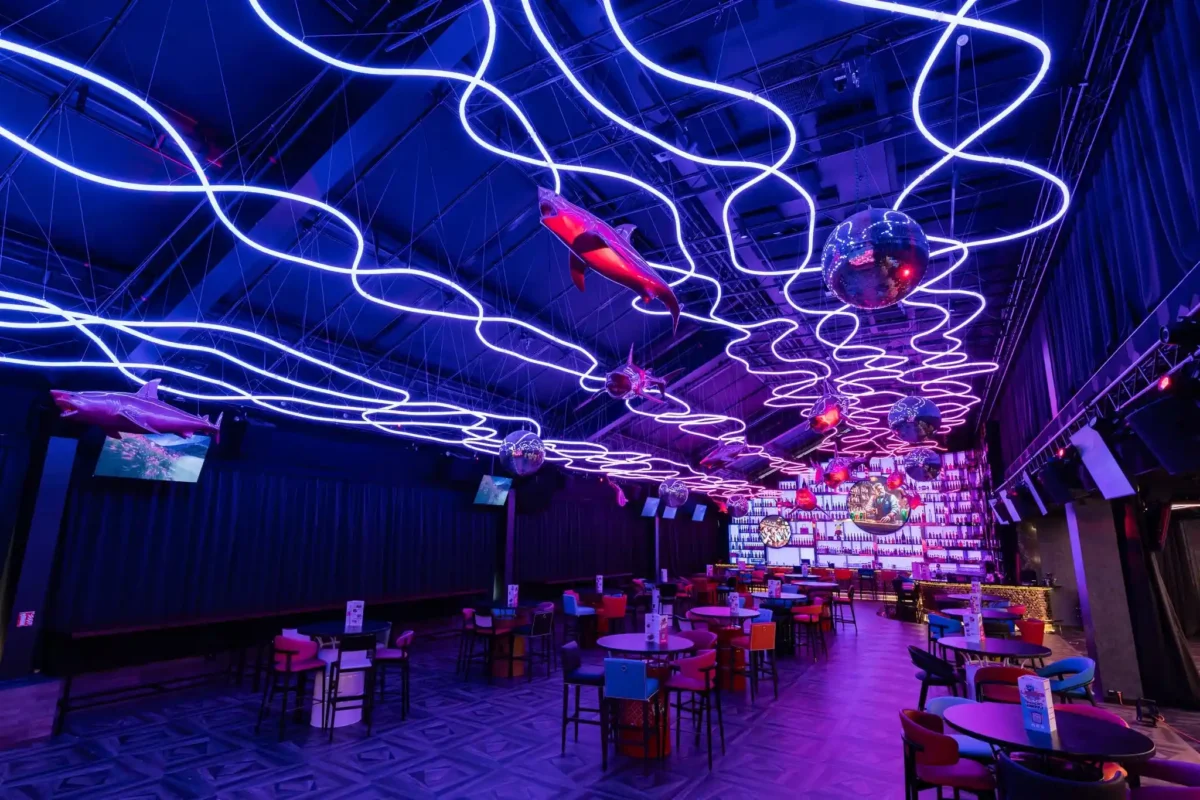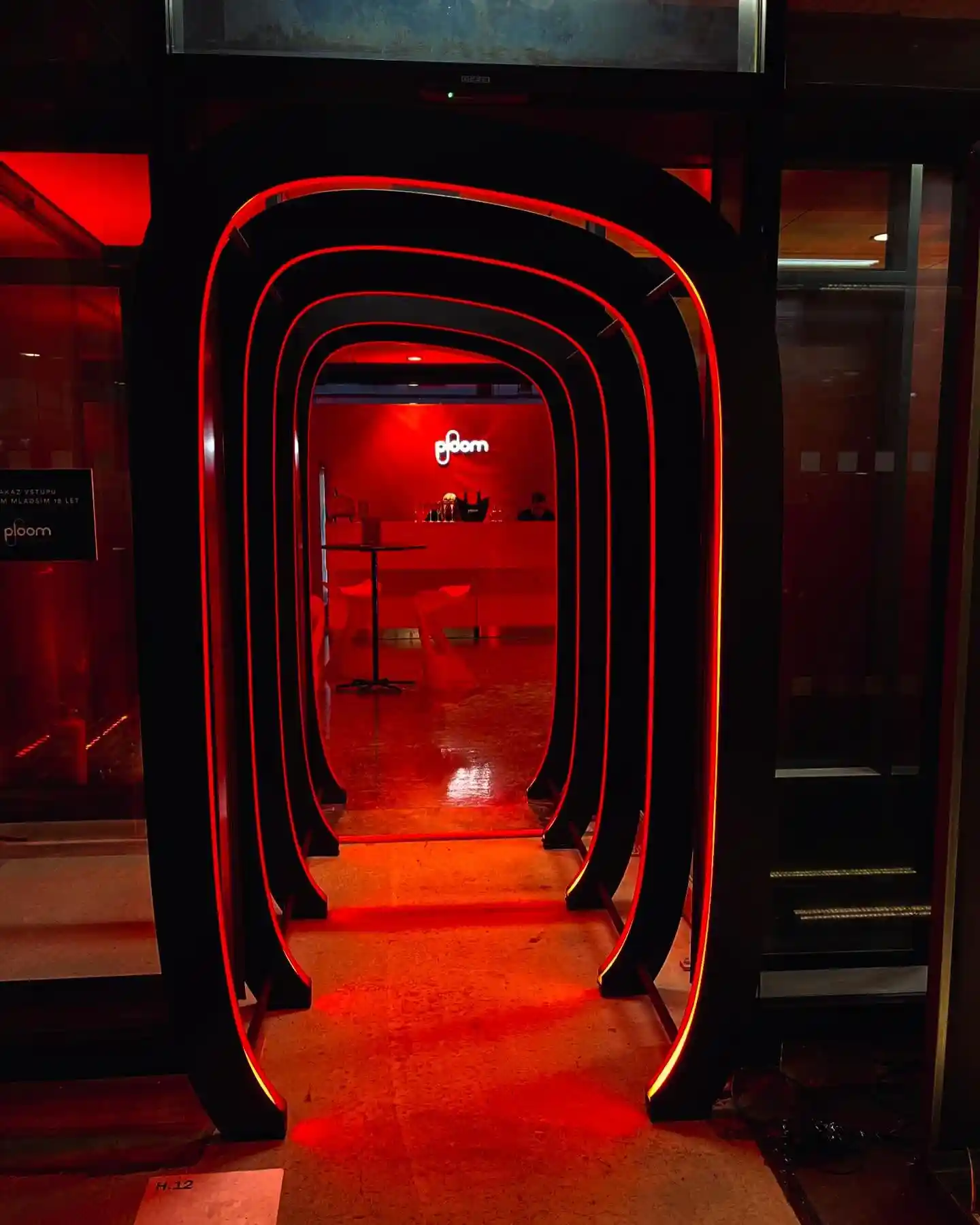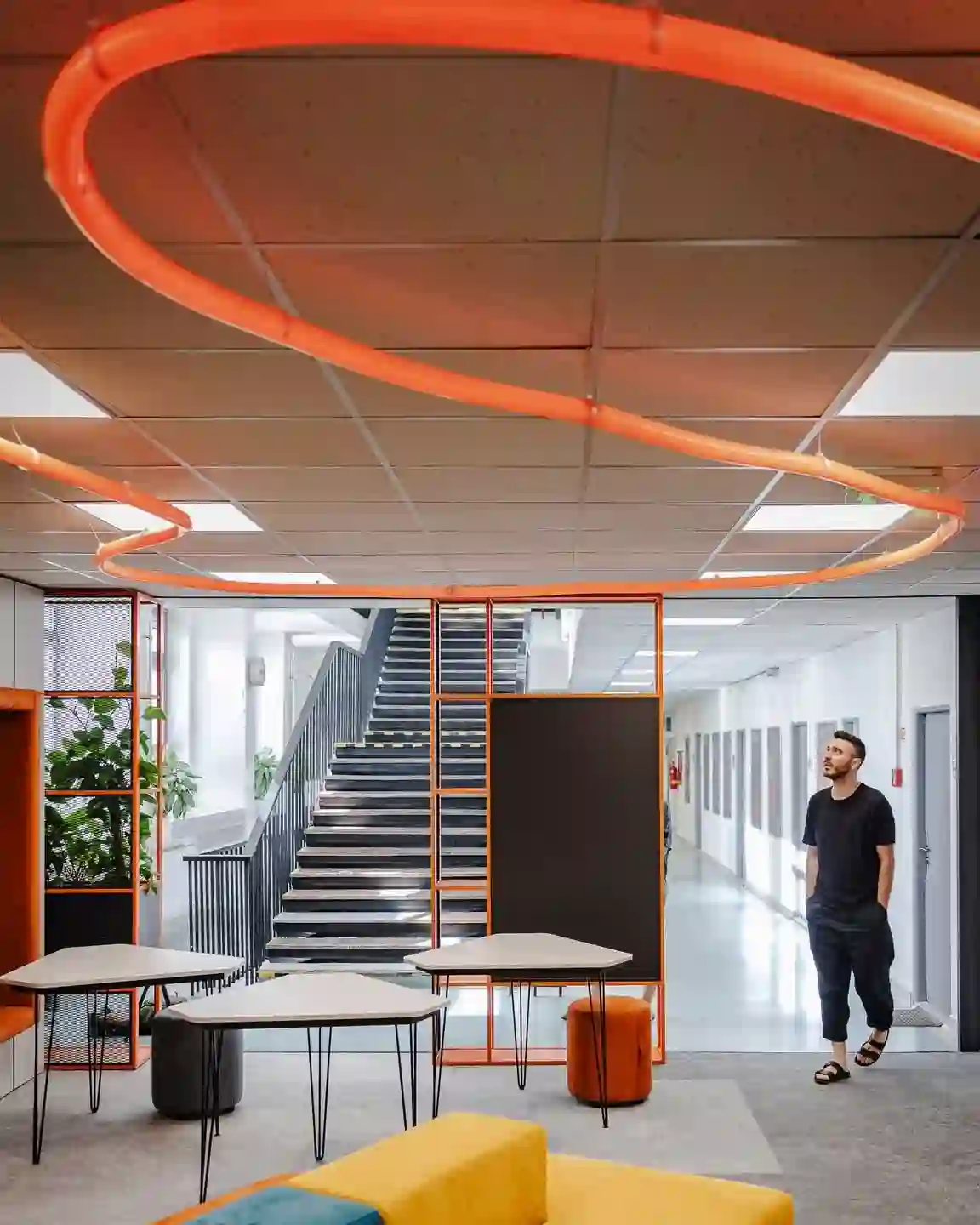
Treating the Facade as a Pixel Grid, Not a Building
This media facade addressable LED strip lighting project covers a 6-storey commercial building in Trondheim, Norway, facing a pedestrian square used for evening markets. The client asked for “dynamic content” and had already priced 4K displays. We proposed a low-resolution pixel canvas instead, sized to the actual viewing distance of the square. Approx. 428 meters went in across 22 vertical lines and 6 horizontal ties, sitting inside our wider architectural linear lighting range.
Pitch came from the square, not the elevation. Viewing distance runs Approx. 40–90 m; minimum resolvable pixel at 40 m is Approx. 60 mm centre-to-centre. We set 100 mm — deliberately coarser than the eye resolves, so content reads as motion rather than a failed image. That gave 22 lines on the existing mullion grid, no new fixings above eye level, Approx. 3,960 mapped pixels.
Products Used
| Zone | SKU | Specs | Approx. Use |
|---|---|---|---|
| Vertical mullion lines (main canvas) | ES-WS2811-60-12V | Addressable RGB, 60 LEDs/m, 12V, 10 mm, CRI 80, IP20 in sealed profile | 352 m / 22 lines |
| Horizontal parapet ties | ES-NEON-SIGN-02 | RGB Silicone Neon Strip, 6×12 mm, 108 LEDs/m, 12V/24V, CRI 80, IP67 | 60 m |
| Entrance highlight | ES-COB-576-10MM-RGBIC | RGB IC COB, 576 LEDs/m, 10 mm, 12V/24V, CRI 90, IP20 soffit-mounted | 16 m |
| Control + power | SP110E + ES-PA-12085A | Bluetooth pixel controller 5V–24V + DC12V 8A 96W adapter | 4 + 12 units |
In media facade addressable LED strip lighting the chipset choice is counter-intuitive: the 60 LEDs/m WS2811 line beat a denser option because coarse pitch is what makes the canvas read as motion at 40 m — denser looks like a broken TV. That tape is IP20, so every vertical sits in a sealed aluminium profile that carries the ingress rating. The RGB neon flex line earns the parapet on two counts — natively IP67 silicone, and able to wrap the 240 mm-radius roof-edge curves a rigid strip cannot follow. The dotless RGBIC COB appears only at the entrance, where pedestrians pass within Approx. 1 m and individual pixels would show.
Splitting the Canvas Into 4 Data Universes
Pushing 3,960 pixels down one data line collapses under refresh contention, so the canvas was partitioned before any strip shipped. Universe A takes the bottom third — 8 lines, Approx. 1,280 pixels — carrying pedestrian-facing content where legibility matters most. Universe B mirrors it across the middle third for the main motion field. Universe C covers the top third plus parapet tie, Approx. 1,000 pixels, on slow ambient scenes. Universe D is the 400-pixel entrance halo, tied to the shopfront addressable strip controller.
All four share one master clock, so a horizontal wipe reads as single motion across the facade rather than four separate boards. Show timing follows the DMX512-A framework per ANSI E1.11, leaving room to bridge into a house DMX desk later.
Two Fixes That Made the 40 m Verticals Behave
WS2811 at 12V is generous on distance, but 40 m of continuous vertical still drops the tail toward pink at full white — measured 11.4% before correction. Two changes fixed it. First, injection every 8 m from a shared 12V bus dropped down a service riser; one bus feeds four lines, so cabling stays inside the envelope and only the sealed profile sees Norwegian coastal weather. Tail drop fell to Approx. 3.1%. Second, a data return loop on every line: the clock resyncs each frame, where single-ended runs drift and the content artist spots it before the client does.
Every outdoor circuit is SELV low-voltage per IEC 61140, and profile ingress protection was verified per IEC 60529 on samples before bulk shipment. Worth reading up on waterproofing for addressable strip before specifying any outdoor pixel job.
Measured Results on the Finished Canvas
- Pixel count mapped: Approx. 3,960 across four universes.
- Voltage drop at the tail of the longest vertical: 11.4% before injection, Approx. 3.1% after.
- Refresh at the far tail: Approx. 380 Hz — no rolling bar on a 240 fps camera.
- Colour deviation between universes at full white: Approx. 3.5%, inside the “one canvas” threshold.
- Coordination rounds with the AV integrator: 4, mostly on the master-clock handoff into the entrance halo. The glazing contractor also moved profile fixing ahead of the cleaning-rail install, saving two re-drilled mullions.
Four Notes if You’re Specifying Something Similar
- Set pixel pitch from viewing distance, not from the building. Coarser is often more powerful than denser, and it costs less.
- Split the canvas into universes early. A single-controller media facade addressable LED strip lighting scheme fails on refresh at any usable scale.
- Keep injection inside the building envelope and let a sealed profile carry the IP rating. Any outdoor injection tap is a five-year-later failure point.
- Reserve dotless RGBIC COB for zones where people pass within a metre.
Senfey supplies media facade addressable LED strip lighting as one kit — strip, controllers, drivers, sealed profiles and pre-tinned data leads, pixel map included. Send your elevation, mullion grid and viewing plan via the Senfey project quotation form and we will return a universe partition and injection layout before quoting.
Senfey is a Chinese LED strip manufacturer based in Shenzhen, producing COB, SMD, addressable and LED Neon Flex strip alongside controllers and power supplies. Our monthly output runs to hundreds of thousands of meters for integrators and developers delivering architectural and media facade lighting projects.