
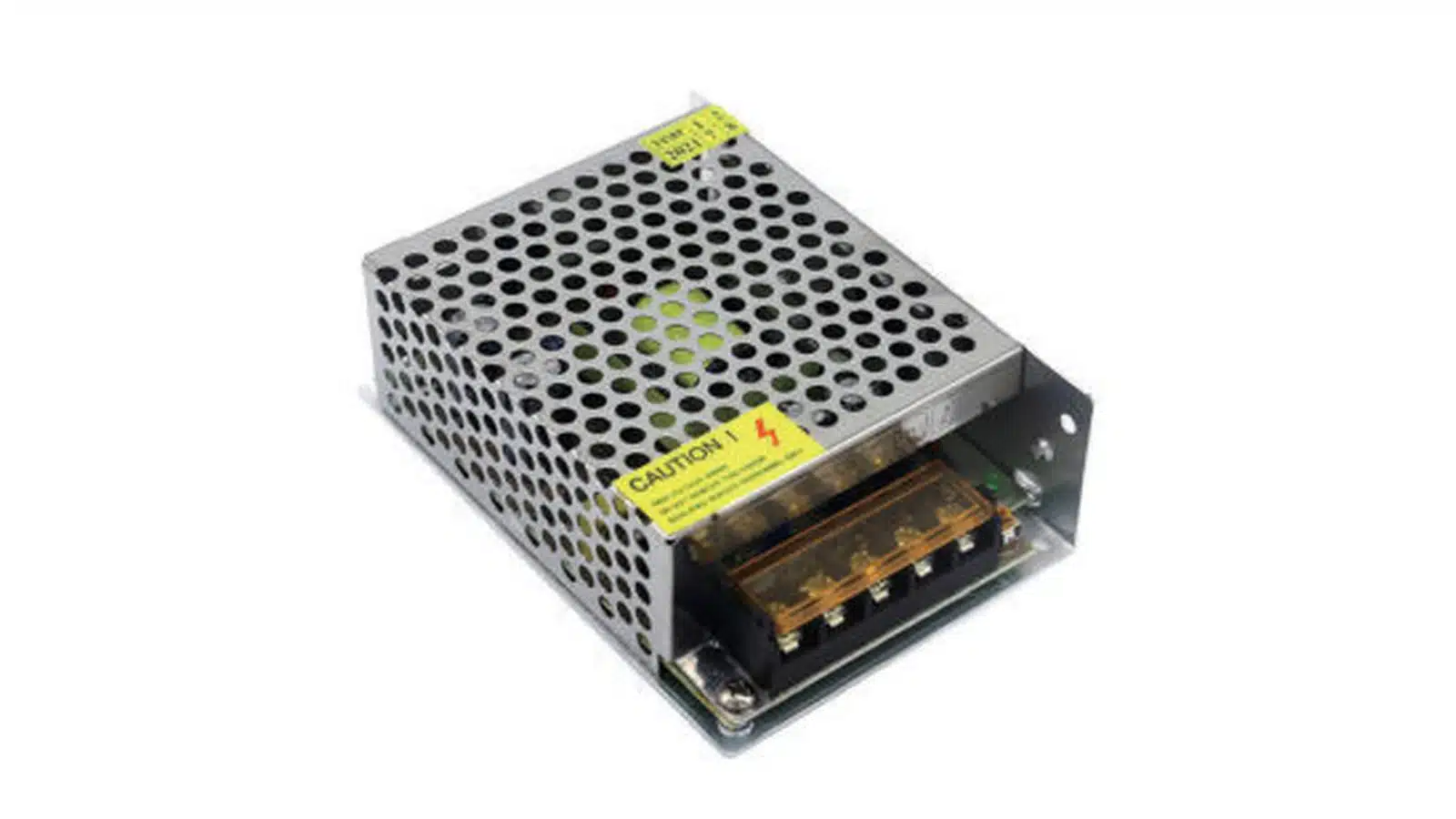
Multiply each run’s rated watts per metre by its length, then add the runs fed by the same supply. Compare that load with the supply’s usable output under the planned installation conditions. Start at the power supply selection page for the main product types.
List the strips served by each supply
For each run, record the exact strip version, rated DC voltage, W/m in the highest intended operating mode, and installed length. Include each separately specified controller or auxiliary DC load when it is supplied by the same unit. Assign loads with a different voltage to the appropriate supply or specified conversion system.

Calculate load per run and per supply
Assume three 24V runs that can turn on together. The values below are illustrative strip loads.
| Run | Length × rated W/m | Strip output load |
|---|---|---|
| Shelf A | 4.0 m × 9.6 W/m | 38.4 W |
| Shelf B | 3.0 m × 12 W/m | 36.0 W |
| Header | 2.5 m × 9.6 W/m | 24.0 W |
| Total | All runs operating together | 98.4 W, or 4.10 A at 24V |
Use the unrounded total when comparing supplies near a limit. If a controller also carries all branch current, check its own rating. Multichannel controllers need an additional check for each output.
Check the supply’s usable output
Need LED strips for your order?
Tell us the strip type or model, key specifications, quantity in metres and destination country. We can share actual product photos, check available CE/RoHS documents for the selected model, and suggest compatible power supplies or controllers.
Read the selected supply’s datasheet for ambient temperature, installation orientation, ventilation and input conditions. The MEAN WELL PWM-40 datasheet shows how a manufacturer presents derating. Waveform Lighting’s calculator illustrates the basic strip load calculation.
As a separate example, if a supplier confirms a 120 W model is limited to 80% under your conditions, its usable output is 96 W. It falls below the 98.4 W strip load. A 150 W model at the same confirmed factor would supply up to 120 W. Use the actual selected model’s limits, including any applicable temperature or mounting correction.
Separate wattage from feed length
Use the strip maker’s feed limits and review voltage drop for each cable and strip route. Splitting the feeds can reduce the load carried by a long section even when the total wattage stays the same. See the 10 m COB strip guide for run-level decisions and RGBW controller sizing if the same feed carries a multi-channel strip.
What to send for a quote
Send the run list, supply location, input market, control requirement and total quantity. Ask Senfey to review the supply load list.
