
Buyers comparing cob led strip vs led strip usually want a verdict, and the honest answer is that the strip is not what decides it. The decision is set by one measurable thing on your drawing: how much space sits between the light source and the surface the viewer actually sees. Get that number and the choice makes itself. Ignore it and a more expensive strip can still look worse than a cheaper one.
COB LED Strip vs LED Strip: What Actually Differs
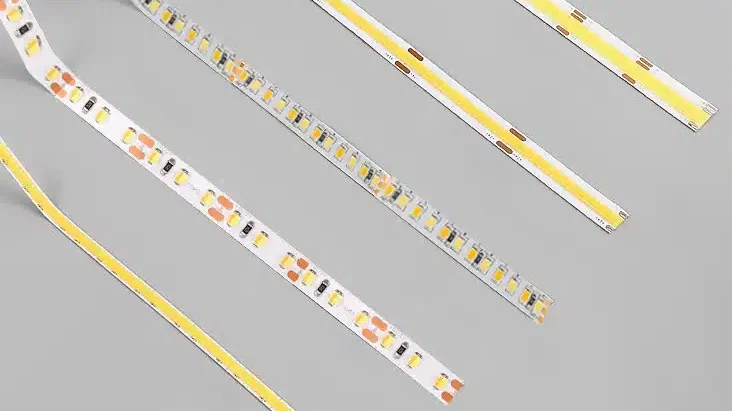
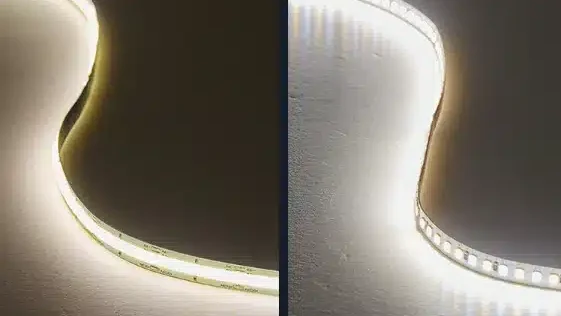
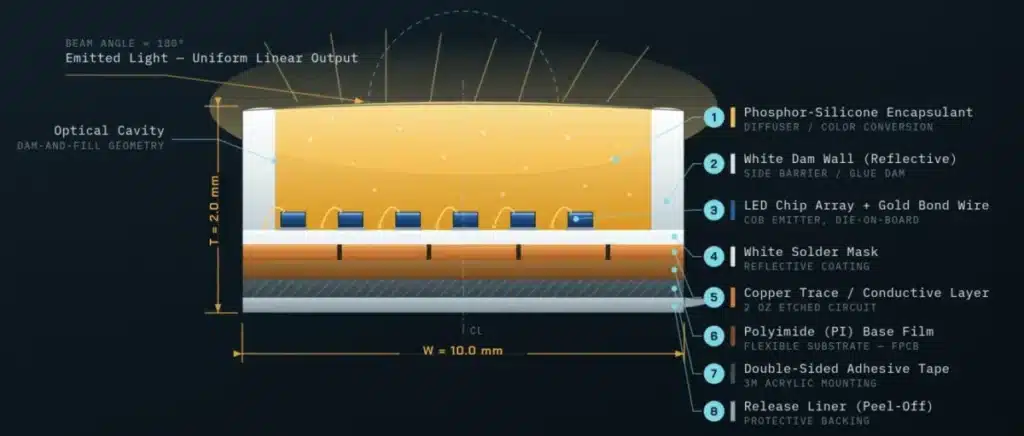
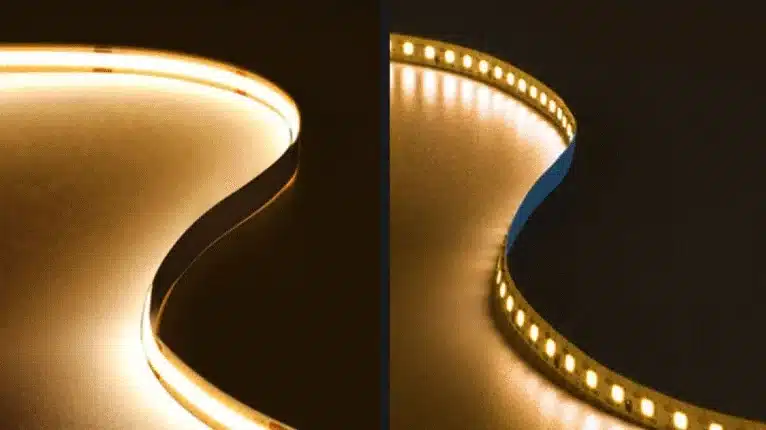
A COB LED strip mounts bare LED chips directly onto the board in a dense line and covers the whole run with one continuous phosphor layer. The emitting surface is effectively unbroken. If you want the construction explained from the ground up first, the COB construction guide covers it before you get to specification.
A traditional strip uses pre-packaged LEDs — 2835, 3528, 5050 and similar — soldered onto the board at fixed intervals. Each package is a discrete point of light with dark board between them. The SMD LED strip range covers those products.
Everything else that gets said about these two categories follows from that one structural fact. Not brightness, not efficiency, not lifespan — those depend on wattage, thermal design, and component grade, and both constructions span a wide range on all three. What genuinely differs is the spacing between light points, and therefore how much help the strip needs from the profile to look like a line rather than a row.
Note the vocabulary problem here too: “LED strip” is a category that includes COB. A COB strip is an LED strip. What buyers mean by this comparison is COB against the discrete-package construction, which is why the more technical COB versus SMD comparison is the better page once you are down to comparing packages, densities, and output figures.
The Number That Decides It: LED Pitch Against Diffuser Depth
LED pitch is the centre-to-centre distance between light points. It comes straight from the density on the datasheet: 120 LEDs/m is a pitch of about 8.3 mm, 240 LEDs/m about 4.2 mm, and a 480 LEDs/m COB strip is near 2 mm.
A row of light points blends into a line once the diffuser sits far enough away from them, and the working rule is that the gap between strip and diffuser needs to be at least the pitch — with roughly double the pitch giving a comfortable margin rather than a marginal result. So a 120 LEDs/m strip needs something like 8 to 16 mm of clear depth behind the diffuser before the dots disappear. A COB strip at 2 mm pitch needs 2 to 4 mm, which almost any profile already provides, and looks acceptable with no diffuser at all.
That converts the whole comparison into a question you can answer from a section drawing:
- Deep profile, or the strip is hidden behind a bulkhead: a discrete-package strip will look smooth, and paying the COB premium buys nothing visible.
- Shallow groove, 10 mm channel, or the strip is directly in view: there is no depth available to blend the dots, so COB is the only construction that can produce a clean line.
- The strip grazes a glossy surface, polished stone, or a mirror: the reflection shows the dot pattern a second time, so the required depth roughly doubles and COB usually wins even in a deep profile.
This is also why the same product can be right on one floor of a building and wrong on the next. The construction has not changed; the available depth has.
Brightness, Efficiency and Where the Heat Goes
Have an LED Lighting Project?
Share your project requirements — our engineering team will configure the complete LED strip system (strips + profiles + controllers + power supplies) and send you a detailed proposal within 24 hours.
COB is not inherently brighter. Output follows wattage and thermal design, and both constructions cover everything from low-level decorative lighting to high-output linear runs. At equal wattage the efficiency difference between good examples of each is small enough that it rarely decides a specification.
Where they genuinely differ is heat distribution. A discrete-package strip creates heat at separated points with cool board between them, so the board itself helps spread it. A COB strip generates heat continuously along its whole length. Same total watts, less bare board to spread them. The practical consequence is the opposite of what buyers often assume: because COB needs less optical help from a profile, people conclude it needs no profile — but it needs the aluminium more, not less, and for thermal reasons rather than visual ones. A COB strip run at full output on double-sided tape inside a plasterboard cove is a heat problem, and heat is what shifts colour and shortens life.
Where output has to hit a defined figure rather than simply look right — office ceilings, workspaces, circulation routes to EN 12464-1 illuminance levels — calculate the lumens needed first, then check which construction delivers it within the profile you have. Working the other way round is how projects end up doubling a run to make up light.
| Comparison Item | COB Construction | Discrete-Package Construction |
|---|---|---|
| LED pitch | Roughly 2–3 mm at typical densities | Roughly 4–8 mm at typical densities |
| Diffuser depth needed | Minimal; works in shallow grooves and direct view | Needs depth at least equal to the pitch to blend |
| Heat distribution | Continuous along the run; profile does thermal work | At separated points; bare board assists spreading |
| Output range | Set by density and wattage, as with any strip | Very wide, including high-output package types |
| Specification breadth | Focused range built around the smooth line | Broadest ecosystem of packages, outputs and variants |
Compare Systems, Not Strips
COB carries a premium per metre. Comparing the two line items on a quotation is still the wrong comparison, because a discrete-package strip that needs 12 mm of diffuser depth is not competing on its own — it brings a deeper profile, a diffuser lens, and the ceiling or joinery space to house them.
On joinery in particular that space is not free. A cabinet maker who can machine a 10 mm groove and drop a COB strip into it avoids a surface-mounted profile, avoids the diffuser, and avoids losing shelf depth. The strip costs more and the assembly frequently costs less. On a concealed cove above a bulkhead, where the profile was in the specification anyway and nobody will ever see the source, the arithmetic reverses and the discrete-package strip is the correct commercial answer.
Two other cost items belong in the same calculation. Service is one: a single failed package on a discrete strip leaves one dark dot in a run, while a fault on a COB strip takes out a visible segment, so the replacement unit is effectively the whole cut section. Voltage planning is the other, and it applies equally to both — a 24V layout reduces the number of power injection points on long runs regardless of which construction sits in the profile.
Installation Differences That Reach the Site
Both constructions need the same electrical planning: matched driver, calculated wattage with headroom, wiring gauge, run length, and power injection points confirmed before anything is ordered. Three differences do change what the installer handles.
Cut Interval
Both types cut at marked points only, but the intervals differ because the series-group layouts differ. Dense COB strips can have a shorter cut unit than a low-density discrete strip at the same voltage, which helps on short joinery sections — but this must be confirmed per model in millimetres, not assumed from the construction type, and confirmed before the joinery is machined rather than after.
Profile and Diffuser Selection
This is where the pitch calculation turns into a purchase order. Specify the profile for the strip you have actually chosen. A deep diffuser profile bought for a discrete strip is wasted depth on a COB run, and a shallow profile bought for COB cannot rescue a discrete strip that was substituted late to save money.
Environment and IP
Protection is a build decision, not a construction one. Both types are available in sealed versions, and both lose their rating at a cut end until it is re-sealed, since an IEC 60529 rating applies to the finished assembly rather than to the cut face. Settle the environment before choosing between COB and discrete packages, because it constrains both.
Which One for Which Application
Applied to the positions that come up most often in commercial work, the depth question gives fairly consistent answers.
| Application | Usual Answer | Why |
|---|---|---|
| Cabinet and joinery grooves | COB | Machined depth is 10 mm or less and the viewer is within arm’s reach |
| Hotel cove above a bulkhead | Either; COB if the light grazes a wall | Concealed sources hide dots, but grazed surfaces reveal them again |
| Retail shelves and display cases | COB, and check CRI separately | Short viewing distance, and merchandise colour is a separate requirement |
| Office and commercial ceilings | Whichever meets the lux target in the available profile | Output requirement leads; appearance follows the profile depth |
| Concealed backlighting and signage trays | Discrete packages | Source is never seen, so the COB premium buys nothing |
| Handrails, stairs and shallow reveals | COB | No depth available to blend a dotted source |
A hotel cove lighting project shows the middle case in practice, where some runs were concealed and others grazed a finished surface, and the specification split accordingly rather than standardising on one product for the whole floor.
A Direct Head-to-Head
Two products from our range make the trade-off concrete. Both are 8 mm boards, both run at 12V or 24V, and both are IP20 for dry concealed positions — so the board width, voltage, and environment are held constant and only the construction changes.
- COB, 320 LEDs/m — CRI 90, pitch near 3 mm. Fits a 10 mm machined groove with clearance either side and reads as a continuous line at close range.
- SMD 2835, 120 LEDs/m — CRI 80, pitch near 8.3 mm. Needs roughly 8 mm or more of diffuser depth to blend, and is the sensible choice where that depth exists or the source is hidden.
The CRI difference between these two is a specification choice rather than a property of either construction, and it matters where materials and merchandise are judged under the light. Request samples of both and view them in the actual profile at the actual distance. Fifteen minutes with a sample settles this comparison more reliably than any datasheet.
Specification Checklist
Whichever construction is chosen, the same items decide whether it works on site.
- Measure the available depth between strip and diffuser, and compare it to the LED pitch.
- Confirm whether the light will graze or reflect off an adjacent surface.
- Calculate the required output before choosing the construction.
- Check PCB width against the groove or profile, with clearance for adhesive.
- Confirm the cut interval in millimetres, per model.
- Settle the IP requirement and installation environment first.
- Confirm the CRI the application actually needs, judged against a sample.
- Match driver, wiring, and power injection to the run length.
- Confirm batch consistency if the same specification will be reordered.
FAQ
What is the difference between COB and a regular LED strip?
COB places bare chips densely under one continuous phosphor layer, so the emitting surface is unbroken. A regular strip uses packaged LEDs at intervals with dark board between them. Every other difference follows from that spacing.
Is COB brighter?
No. Output depends on wattage and thermal design, and both constructions span a wide range. COB is chosen for the appearance of the line, not for lumens.
How do I decide between them without seeing samples?
Compare the LED pitch to the depth available behind the diffuser. If the depth is at least equal to the pitch, a discrete-package strip will blend. If it is less, or the source is in direct view, choose COB.
Can COB replace a discrete-package strip everywhere?
It can, but it should not. In concealed positions with no reflective surface nearby, the premium delivers nothing the client will ever see, and the money is better spent on CRI or on the driver.
Does COB still need an aluminium profile?
Yes, and for a reason people miss. Even where it needs no optical diffusion, the continuous heat along a COB run makes the profile a thermal component. Heat is what shifts colour and shortens life.
Which is better for hotel cove lighting?
It depends on the cove. Fully concealed with a deep return, either will work. If the light grazes a wall or the source is visible from a seated position, COB is the safer specification.
Which is cheaper overall?
COB costs more per metre. Whether the installation costs more depends on the profile, since a discrete strip needing 12 mm of diffuser depth brings a deeper profile and a diffuser with it. Compare assemblies, not strips.

Reference Resources
For broader lighting design and application background, buyers may review these resources:

Request Samples and Project Support
If you are weighing cob led strip vs led strip for a hotel, retail, cabinet, office, or architectural project, the most useful thing to send is a section detail showing the groove or profile depth. With that plus the voltage, run length, and target output, the comparison can be answered against your drawing rather than in general terms.
You can contact Senfey to request samples of both constructions, compare them in your own profile, or get support with specification and power layout.
