
Shenzhen LED Neon Factory · OEM & ODM
LED Neon Flex for Signage and Outdoor Architecture
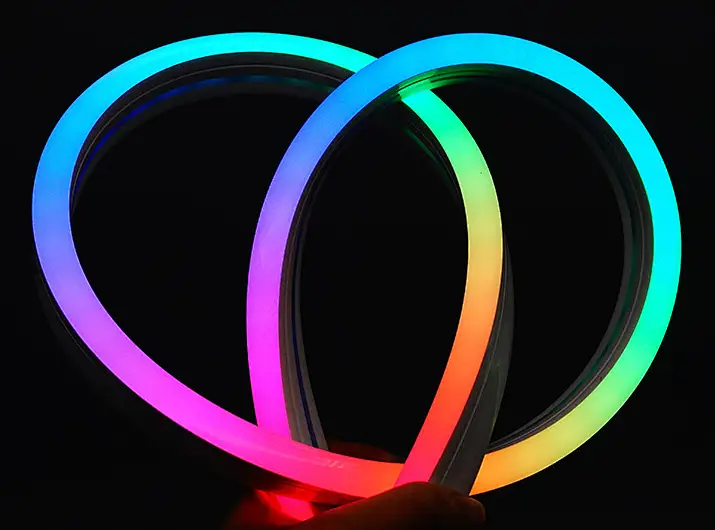
Silicone and PVC LED neon flex for projects where the light itself is the design element — an even glowing line with no visible dots, sealed to IP65 or IP67 as manufactured rather than coated afterwards. Single colour, RGB and addressable RGBIC, at 12V or 24V DC.
- Sealing
- IP65 / IP67outdoor as standard
- Voltage
- 12V / 24Vconstant voltage DC
- Profile
- 6×12 / 8×16millimetres
- Colour
- 3 systemssingle · RGB · RGBIC
The basics
What is LED neon flex?
LED neon flex is a flexible LED strip encased in a translucent silicone or PVC jacket that diffuses the individual LEDs into one continuous glowing line. It replaces glass neon tubing: same visual language, but running on 12V or 24V DC instead of a high-voltage transformer, and without glass or gas. The trade name varies — neon flex, neon rope, neon LED strip lights — while the construction is the same.
The jacket is the whole point. On a conventional strip the LEDs sit exposed, so a channel and diffuser are needed to hide the dots. Here the diffuser is extruded around them at the factory, which removes the dots permanently and seals the strip to IP65 or IP67 in one operation. That is why neon flex is the default for exposed work.
- 1Emitting face — factory-diffused
- 2LED strip sealed inside
- 3Silicone or PVC jacket
- 4Flat mounting base
Four things decide a specification: cross-section in millimetres, bend direction, voltage, and colour system. Cross-section sets how thick the drawn line reads. Bend direction matters more than buyers expect — most neon flex bends on one plane only, so a shape curving the wrong way must be cut and jointed.
Concealed inside a cove or profile, neon flex is the wrong purchase: an SMD LED strip behind a diffuser costs less and nobody sees the difference. Neon flex earns its price only when the line is visible. The full technical treatment is in the LED neon flex guide.
Specifications
LED neon flex types and specifications
Pick by jacket material and colour system first — those two decide cost and lifespan — then confirm the cross-section fits the shape you are drawing. All catalogue neon flex is CRI 80 and sealed to IP65 or IP67 as manufactured.
| Variant | Jacket | Cross-section | Voltage | IP | Colour | Best suited to | Selection guide |
|---|---|---|---|---|---|---|---|
| Silicone single colourES-NEON-SIGN-01 | Silicone | 6×12 mm | 12V | IP65 | Single | Interior signage, feature walls and bar fronts seen at close range | LED neon flex guide |
| Silicone RGBES-NEON-SIGN-02 | Silicone | 6×12 mm | 12V / 24V | IP67 | RGB | Hospitality and retail interiors that change colour by scene or season | RGB colour-changing LED neon |
| PVC outdoorES-NEON-SIGN-03 | PVC | 6 / 8 mm | 12V | IP67 | Single | Cost-led outdoor outlines, perimeters and temporary installations | Waterproof outdoor LED neon flex |
| Addressable RGBICES-NEON-PIXEL-01 | Silicone | 6×12 / 8×16 mm | 12V / 24V | IP67 | RGBIC | Bridges, facades and venues where the line has to move or run gradients | Neon LED strip lights |
| Round rope profilecircular section | PVC | Round | 12V | IP67 | Single / RGB | Wrapped columns, handrails and any run read from every side | LED neon rope light |
| Side-bend for letteringtight-radius work | Silicone | 6×12 mm | 12V / 24V | IP65 | Single / RGB | Channel letters, logos and script where the shape drives the choice | Bendable LED neon flex |
Scroll the table sideways on narrow screens to see every column.
Silicone or PVC decides lifespan
Both seal to IP67, so the datasheet looks similar. Silicone holds up under UV and cold without yellowing or stiffening; PVC is cheaper and acceptable where the installation is not intended to last a decade outdoors.
Check the bend plane before drawing
Most neon flex bends on one plane only. A design curving the other way needs cutting and jointing at each turn, which adds labour and failure points. Send the shape with the enquiry.
Cross-section is a design decision
6 mm reads as a fine drawn line; 8×16 mm reads as a bold tube visible from distance. On facades and bridges the larger section usually wins, because distance swallows the thin one.
Featured products
Four LED neon flex products that cover most briefs
Four SKUs answer most enquiries we quote: silicone single colour for interior signage, silicone RGB where the colour changes, PVC where budget leads outdoors, and addressable RGBIC where the line has to move. All are CRI 80 and sealed as manufactured.
ES-NEON-SIGN-01
Pure Silicone Flexible LED Neon Strip 12V IP65
- Jacket
- Silicone
- Density
- 120 LEDs/m
- Voltage
- 12V
- CRI / IP
- 80 / IP65
The workhorse for interior signage and feature walls seen close up, where an even line matters more than colour control.
View specificationES-NEON-SIGN-02
RGB Silicone LED Neon Strip 6x12mm 12V/24V IP67
- Section
- 6×12 mm
- Density
- 108 LEDs/m
- Voltage
- 12V / 24V
- CRI / IP
- 80 / IP67
One colour at a time across the whole run, set by a standard RGB controller — the usual pick for bars and retail.
View specification
ES-NEON-SIGN-03
PVC LED Neon Strip 6/8mm 120LEDs/m Outdoor IP67
- Section
- 6 / 8 mm
- Density
- 120 LEDs/m
- Voltage
- 12V
- CRI / IP
- 80 / IP67
Same IP67 rating as the silicone at a lower cost per metre — right where the run is long and the lifespan is not a decade.
View specificationES-NEON-PIXEL-01
Smart Addressable Pixel LED Neon Strip RGBIC IP67
- Section
- 6×12 / 8×16 mm
- Density
- 120 LEDs/m
- Voltage
- 12V / 24V
- CRI / IP
- 80 / IP67
Driver ICs inside the jacket, so segments run independently — chases, gradients and music sync on a single run.
View specificationCut length, colour temperature and jacket colour are specified per order, and the catalogue also carries the controllers, dimmers and DC adapters these runs need.
See the full catalogueApplications & projects
Where LED neon flex is specified
Neon flex is bought when the line is meant to be seen. Below is how we specify by space type, followed by projects Senfey has supplied. Sign work has its own constraints, covered in the LED neon signage guide.
Signage and channel letters
Logos, lettering and script where the drawn shape is the product. Bend plane and minimum radius decide whether a letter forms from one length or has to be jointed at each turn.
Typical: silicone · 6×12 mm · 12V · IP65 · single colour
Bars, restaurants and hospitality interiors
Bar fronts, back-bar walls and ceiling features viewed from a metre or two away, where a visible dot would break the effect. RGB is common because the room changes character through the evening.
Typical: silicone RGB · 6×12 mm · 12V/24V · IP67
Building facades and bridges
Long exterior outlines read from across a street or river. Viewing distance swallows a thin section, so the larger 8×16 mm profile usually wins.
Typical: silicone · 8×16 mm · 24V · IP67 · long runs
Entertainment venues and immersive spaces
Where the line has to move rather than just glow. Addressable RGBIC runs chases and gradients along a single length, driven from a controller or a lighting desk.
Typical: addressable RGBIC · 12V/24V · IP67 · DMX or app
Landscape, parks and garden walls
Pathway edges, planter lines and wall grazing exposed to rain, irrigation and frost. IP67 is the baseline, and the mounting method matters as much as the flex.
Typical: silicone or PVC · 6/8 mm · 12V · IP67
Project cases
Salzburg, Austria
Hotel Lobby LED Neon Feature Wall
A lobby feature wall drawn in silicone neon flex, seen at close range by every arriving guest.
Read the case
Bristol, United Kingdom
Channel Letter LED Neon Flex Signage
Lettering formed from neon flex inside channel letters, where the bend radius set the type design.
Read the case
Lyon, France
Building Facade Outline LED Neon Flex Lighting
An exterior outline traced in neon flex, specified for UV exposure and long unbroken runs.
Read the case
Riyadh, Saudi Arabia
Addressable Neon Flex Bridge at KAFD Riyadh
Addressable RGBIC neon flex on a bridge structure, programmed to run gradients along the span.
Read the case
Prague, Czechia
RGB Neon Flex Immersive Venue in Prague
Colour-changing neon flex through an immersive venue, switching scene by scene.
Read the case
Tampere, Finland
Park Pathway Waterproof LED Neon Flex Lighting
Pathway edge lighting in a public park, specified around rain, frost and ground-level impact.
Read the caseWorking to a sector brief rather than a product specification? Senfey publishes dedicated solution pages for entertainment venues, architectural facades and landscape and parks, or browse every published project in the case study library.
Installation, power & control
Installing and controlling LED neon flex
The failures we get asked about are rarely the flex itself. They are cuts made off the marked increment, end caps sealed without adhesive, or a shape drawn against the bend plane. The sequence below avoids the rework.
Set out the shape on the bend plane
Mark the run full size before cutting anything. Confirm every curve turns on the plane the flex bends on and that no radius is tighter than the minimum — this is where bendable LED neon flex selection is decided.
Cut on the increment, then seal both ends
Each length has a repeating circuit and printed cut marks. After cutting, the open end must get an end cap with adhesive sealant — a bare cut face is an open path for water and voids the IP rating.
Size the supply and plan the feed points
Watts per metre times length, plus roughly 20% headroom. Long exterior runs should be 24V and fed from more than one point, or the far end reads visibly dimmer than the near end.
Fix with clips or channel, not adhesive alone
Mounting clips or an aluminium channel carry the weight and keep the line straight where it should be. Outdoors, use a gasketed junction box at every joint and test before closing in.
Choosing the right control method
Control follows the colour system, and the three are not interchangeable. Single-colour flex needs a one-channel dimmer. RGB needs three channels and changes the whole run to one colour at a time. Addressable RGBIC needs a data-capable controller because each segment is driven separately — an ordinary three-channel RGB controller cannot address it, which is the mismatch we correct most often on incoming specifications.
Senfey stocks touch, inline and RF dimmers for single colour, including a 30A unit for heavy circuits, plus 24-key and 44-key IR controllers for standard RGB. Where the run has to move or sync to audio, the flex must be the addressable type from the outset — see the addressable LED strip pillar.
One note on outdoor work: sealing is only as good as the weakest joint, and every joint is made on site. Jointing and mounting exposed runs are covered in the waterproof outdoor LED neon flex guide.
Comparison
LED neon flex vs glass neon, SMD strip and COB strip
Senfey manufactures the LED options in this table, so there is no reason to oversell any one of them. Neon flex wins on a specific brief — a visible line, often outdoors — and loses clearly on others. The criteria below are the ones that actually decide a specification.
| Criterion | LED neon flex | Glass neon tube | SMD strip + diffuser | COB strip |
|---|---|---|---|---|
| Light appearance | Even glowing tube, no dots | Even glowing tube, gas colour | Even only if the diffuser is deep enough | Continuous line, flat profile |
| Supply | 12V or 24V DC | High-voltage transformer | 12V or 24V DC | 12V or 24V DC |
| Sealing | IP65 or IP67 as manufactured | Glass is sealed; fittings are not | Sealed to order, not inherent | Sealed to order, not inherent |
| Handling on site | Cut, bend and clip; no specialist | Made and repaired by a glass bender | Cut and solder, then fit the channel | Cut and solder, then fit the channel |
| Relative cost per metre | Mid — the jacket is included | Highest, and fragile in transit | Lowest of the four | Above SMD, below neon flex |
| Read more | LED neon signage | Neon vs LED | SMD LED strip | COB LED strip |
Scroll the table sideways on narrow screens to see every column.
Choose neon flex when
The line itself is the design — signage, lettering, outlines, facades — or the run is exposed to weather. Sealing as manufactured is the reason it is specified outdoors.
Choose SMD or COB when
The strip is concealed in a cove or profile. Nobody sees which technology it is, so the cheaper board wins. Where COB is the closer call, the COB vs neon flex comparison sets out the trade.
Glass neon still has a place
For heritage restoration and collectors, the gas colour is not reproducible. For new commercial work the maintenance and fragility usually decide it against glass.
Sourcing from the factory
Buying LED neon flex direct from the manufacturer
Senfey manufactures in Shenzhen and sells to sign makers, specifiers, contractors and distributors rather than through retail channels. Because the flex, controllers and drivers come from one place, a bend-radius or channel-count question mid-project is one conversation instead of three.
- Send the artwork with the enquiry
- For signage and lettering, the shape decides the specification. A drawing or even a photograph lets us confirm what the flex can follow, and where a run has to be jointed rather than bent.
- Samples before commitment
- Jacket colour, cross-section and how a colour temperature reads through silicone are hard to judge from a datasheet. Request samples and view them at the real distance.
- OEM and ODM
- Cut-to-length runs, pre-formed letters and shapes, custom jacket and lens colours, private labelling and distributor packaging.
- Matched control and power
- Dimmers, RGB controllers and DC12V adapters up to 96W are quoted alongside the flex, so the colour system and driver capacity are checked before the order goes in.
- One supplier, four technologies
- Neon flex, COB, SMD and addressable are all made in house, so a mixed specification does not mean a mixed supply chain.
- Company background
- Manufacturing scope, facilities and company detail are on the about Senfey page.
Request a quote for LED neon flex
Tell us the total length, the colour system and how the run is shaped, and the reply can name a specific SKU and driver rather than quote a general price per metre.
Prefer email or a message app? Use our contact page.
FAQ
LED neon flex questions from project buyers
The questions that come up most often during specification and quoting, answered with the numbers rather than the marketing.
Is LED neon flex better than traditional glass neon?
For new commercial work, usually yes — it runs on 12V or 24V DC instead of a high-voltage transformer, survives transit, and a damaged section can be replaced without a glass bender. Glass keeps one advantage that cannot be copied: the gas colour itself, which matters in heritage restoration.
The honest comparison, including where glass wins, is in the neon vs LED guide.
Can LED neon flex really be used outdoors without extra sealing?
The flex itself, yes. It is extruded with the jacket around the LEDs and leaves the factory at IP65 or IP67, unlike a strip that has to be sealed to order.
But sealing is only as good as the weakest joint, and every cut end, connector and power entry is made on site. That is where water gets in, not through the jacket. Budget for end caps with sealant and gasketed junction boxes.
How tightly can neon flex be bent?
Each variant has a stated minimum radius, and more importantly a bend plane. Most neon flex bends freely on one plane only. A design that curves the other way has to be cut and jointed at every turn, which adds labour and a failure point at each joint.
Forcing a bend against the plane stresses the jacket and the LED joints inside, and the failure often shows up months later. Send the artwork with the enquiry and we will confirm what the flex can follow.
Should I choose a silicone or a PVC jacket?
Both reach IP67, so the datasheets look almost identical and PVC is cheaper per metre. The difference shows over years, not on paper: silicone stays flexible in cold and resists UV without yellowing, while PVC gradually hardens and discolours in direct sun.
Specify silicone for permanent exterior work and anything a client will judge in five years. PVC suits long budget-led outlines and temporary installations.
What is the difference between RGB and addressable RGBIC neon?
RGB changes the whole run to one colour at a time. RGBIC has driver ICs inside the jacket, so segments are controlled separately, which is what makes chases, gradients and music sync possible on one length.
A three-channel RGB controller cannot drive an RGBIC run, and RGB flex cannot be made addressable later, so the decision has to be made before the order. Options are set out in the RGB colour-changing LED neon guide.
Can neon flex be cut to length on site?
Yes, at the marked increment only. Each length is built from a repeating circuit segment that must stay complete, so cutting between marks kills the segment.
Every cut then needs an end cap and sealant, or the IP rating is gone at that point. Where exact lengths matter, we cut and terminate at the factory instead.
What is the difference between neon flex and neon rope light?
Mostly the cross-section. Flex is normally rectangular, such as 6×12 mm, and emits mainly from one face, which suits lettering and outlines seen from the front. Rope is circular and reads the same from every side, suiting wrapped columns and handrails.
The names are used loosely in the trade, so confirm the section in millimetres rather than relying on the word. Detail is in the LED neon rope light guide.
When is neon flex the wrong product to buy?
When nobody sees the light source. If the run sits inside a cove or behind a diffuser, the jacket is doing nothing you are looking at, and an SMD LED strip or a COB LED strip does the same job for less per metre.
Neon flex earns its price in two situations: the line is visible as a design element, or the run is exposed to weather and inherent sealing is worth paying for.
Still deciding? Send the total length, whether the run is indoors or out, and the tightest curve in the design; the reply can name a specific SKU and controller instead of a price range.
Request a quote