
If you are asking what is a cob led strip, the short answer is that it is a flexible LED strip using chip-on-board technology to create a smoother, more continuous line of light. For B2B buyers, contractors, lighting designers, and distributors, the value is not only appearance. The construction affects product selection, installation detailing, application fit, and long-term consistency across a project.
What Is a COB LED Strip?
A COB LED strip is a flexible linear lighting product where many small LED chips are mounted directly onto the circuit board and covered with a continuous phosphor or diffusion layer. That structure produces a smoother light-emitting surface than strip lights built from discrete LED packages spaced along the board.
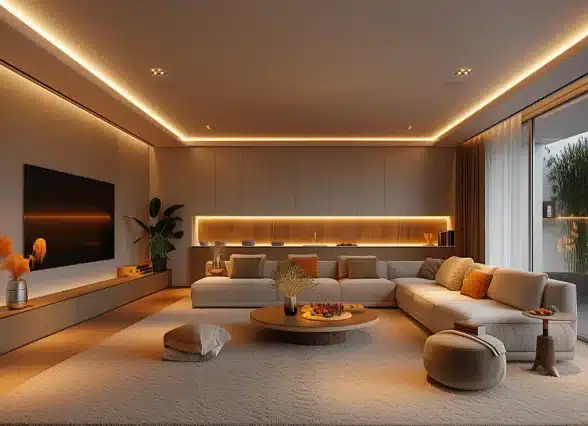
In practice it is specified when a project needs a clean linear effect and reduced dotting in coves, shelves, display cabinets, furniture grooves, hospitality interiors, or architectural details — anywhere the light line is seen rather than merely used.
For procurement teams, COB is not a marketing label. It describes a construction method that changes visual output, achievable density, heat behaviour, voltage planning, cutting interval, and installation requirements. Each of those has a cost or a constraint attached.
What Does COB Mean in LED Lighting?
COB stands for chip on board. In LED lighting it means placing multiple LED chips directly on a substrate or PCB instead of using individually packaged LEDs. The result is a compact source that reads as a continuous line when the density and diffusion layer are designed together.
Chip-on-Board Structure and How It Differs from SMD
In a COB strip the chips sit densely along the board and are then covered by one continuous emitting layer, which closes the gaps between light points. Traditional SMD strips mount individual LED packages at intervals, and depending on density, viewing distance, and diffuser design those points can remain visible. The COB LED strip vs traditional LED strip comparison covers the trade-off in detail, and the wider SMD LED strip category shows where discrete packages remain the sensible choice.

How Is a COB LED Strip Structured?
Have an LED Lighting Project?
Share your project requirements — our engineering team will configure the complete LED strip system (strips + profiles + controllers + power supplies) and send you a detailed proposal within 24 hours.
A COB strip normally combines a flexible PCB, densely mounted chips, a continuous phosphor or diffusion layer, soldering pads, cutting marks, and adhesive backing. Some versions add silicone encapsulation where the environment requires it.
Flexible PCB and Emitting Surface
The PCB carries power and forms the base for the chips. Its width, copper thickness, and layout affect heat dissipation, voltage drop, and whether the strip clears the aluminium profile or machined groove it has to sit in — an 8 mm board in a 10 mm groove leaves working tolerance either side, while a 10 mm board in the same groove does not. Above that sits the continuous emitting surface, which is the feature buyers are describing when they call COB dotless or seamless.
Voltage and Power Input
COB strips come in different voltage options. For most commercial and project installations, 24V COB LED strip is the default consideration because it holds voltage more stably across longer runs and needs fewer power injection points than an equivalent 12V layout.
Where COB Earns Its Cost Premium
The advantages show up in positions where the light line sits close to the viewer or reflects off an adjacent surface. In fully concealed positions with nothing nearby to reveal dotting, the premium is harder to justify — which is itself a useful specification test.
- Smoother linear effect: the continuous emitting layer suppresses visible LED points.
- Cleaner result in profiles: a more even light line inside aluminium channels and coves.
- Flexible installation: workable in cabinets, shelves, ceilings, and decorative grooves.
- Suited to commercial interiors: hotels, shops, restaurants, and offices needing consistency across repeated runs.
- Specification range: voltage, color temperature, CRI, IP rating, and color-control type can all be selected.
None of this makes every COB strip equivalent. Specifications, sample quality, driver matching, and supplier consistency still have to be compared before a bulk order is placed.
COB LED Strip vs Traditional LED Strip: What Is Different?
COB vs SMD — LED Package Structure
Cross-sectional comparison · not to scale
FIG. 1COB — Chip on Board Bare dies bonded directly to the substrate, covered by one continuous phosphor layer
SMD — Surface Mount Device Each die pre-packaged in its own reflector cup, then reflow-soldered to the PCB
| Structure | Die mounting | Phosphor layer | Optical result | Heat path | Repair & failure |
|---|---|---|---|---|---|
| COB | Bare dies bonded straight onto the metal-core board | One continuous layer covering the whole die array | Single uniform light surface, wide beam, no dots | Short — shared aluminium core, few interfaces | Not repairable per die — whole module is replaced |
| SMD | Pre-packaged devices reflow-soldered onto the PCB | Individual dose sealed inside each reflector cup | Array of point sources, directional beam, visible dots | Longer — lead frame + solder joint + FR4 | Single device can be de-soldered and replaced |
The difference is the light source structure. A traditional strip uses individual SMD packages placed along the PCB. A COB strip uses chip-on-board construction under a continuous emitting surface.
| Item | COB LED Strip | Traditional SMD LED Strip |
|---|---|---|
| Light appearance | Smoother and more continuous | May show visible LED points depending on density and diffuser |
| Best use | Close-view linear lighting, coves, shelves, cabinets, display areas | General strip lighting, cost-sensitive projects, higher-output layouts |
| Design focus | Dotless visual effect and uniform line | Flexible specification and broad product availability |
For B2B work the better choice follows from viewing distance, required output, budget, visual standard, profile design, and how the installation will be maintained after handover.
Where Are COB LED Strips Used?
COB strips appear across commercial and architectural work wherever smooth linear lighting matters, and particularly where the light line becomes part of the design rather than a service item.
Hotels, Offices and Retail
Hotels use COB in lobby coves, corridors, guest rooms, lounges, and decorative ceiling lines; a hotel cove lighting COB LED strip project shows how those runs are zoned and powered in practice. The same products carry office ceilings, retail shelves, showcases, reception areas, and shopfitting details, where the specification question shifts from one product to holding a consistent light line across a whole building.
Cabinet, Joinery and Architectural Detailing
Cabinet makers and interior contractors choose COB for wardrobes, kitchens, shelves, and furniture grooves, where the short viewing distance makes dotting immediately obvious. On building details, facade accents, and linear design elements, the result depends as much on the profile, driver, and installation method as on the strip itself, and exterior positions add weather protection and maintenance access to that list.

Turning the Concept into a Specification
Once the construction is understood, specification follows. A professional buyer confirms the environment, intended effect, voltage, power, and installation detail before selecting a model.
Voltage, Color Type and IP Rating
Longer commercial runs generally favour 24V for voltage stability, while short furniture or display applications may use lower voltage. On color, white COB covers most architectural and cabinet work, whereas color-changing COB options apply where the brief calls for brand-color scenes or entertainment lighting. For IP, dry interiors accept IP20, and damp, exterior, or marine positions need a protected build — the waterproof COB LED strip guide covers what changes. All of these ratings follow IEC 60529, so an IP figure quoted without that reference is worth questioning.
CRI, Output and Profile Compatibility
Retail, hospitality, museum, and gallery projects often need higher CRI so that materials and merchandise read correctly under the light. Beyond that, confirm output, wattage, profile compatibility, cutting interval, and heat dissipation before the model is fixed, since changing any one of them late usually means re-specifying the profile as well.
Three Products to Start From
Different COB products fit different needs. These three connect the concept above to real specification choices, and all are IP20 with CRI 90 for dry, concealed positions.
- 320 LEDs/m on an 8 mm board — 12V or 24V, the lighter-density option for furniture details and shorter runs.
- 480 LEDs/m on an 8 mm board — 12V or 24V, the general-purpose choice for hotel coves, cabinets, and commercial linear work.
- 576 LEDs/m RGB on an 8 mm board — 12V or 24V, for color-changing ambience and decorative commercial lighting.
Before bulk purchasing, request samples and confirm the lighting effect, voltage, power supply, installation profile, and application requirements. Where the position is damp or exterior, a waterproof build is specified separately from these.
FAQ
What is a COB LED strip?
A flexible LED strip built with chip-on-board technology. It produces a smoother, more continuous line of light than strips using discrete, individually visible LED packages.
What does COB mean in LED lighting?
Chip on board. It refers to mounting LED chips directly onto the board rather than using separately packaged LEDs.
Are these strips genuinely dotless?
They are often described that way because the continuous emitting layer suppresses the point effect. The result still depends on product quality, viewing distance, profile design, and installation method — a good strip badly mounted can still show banding.
Is COB better than SMD?
Usually for smooth linear lighting and close-view positions. SMD remains suitable elsewhere depending on output requirement, budget, and whether the strip is visible at all.
Can these strips be cut?
Most can be cut at marked points. The interval varies by product design and should be confirmed before installation, because it determines how closely a run can follow an odd-length detail.
Are waterproof versions available?
The products listed here are IP20 for dry, concealed use. Where a project needs damp-area or exterior protection, that build is specified separately, so confirm the IP requirement and environment before ordering.
Is COB suitable for commercial projects?
Yes, across hotel cove lighting, retail displays, cabinets, office ceilings, restaurants, and architectural linear work — which is where most of its volume goes.
Reference Resources
For broader LED lighting and design background, buyers may review these industry resources:
Request Samples and Project Support
If you are choosing COB LED strips for a hotel, retail, cabinet, office, architectural, or wholesale project, prepare your voltage, color temperature, IP requirement, profile size, run length, and installation drawings before making contact.
You can contact Senfey to request samples, discuss custom specifications, or get support with project quotation and product selection.
