
Shenzhen LED Strip Factory · Hospitality Projects
Hotel LED Lighting: Linear Strip Solutions for Hospitality Projects
Specified space by space — lobby, corridor, guest room, spa and exterior — with the CRI, colour temperature, IP build and dimming method fixed per area rather than one strip bought for the whole property. Made in our own factory, supplied direct to hotel groups, contractors and lighting designers.
- Spaces
- Lobby to facadesix zones, six specs
- Colour quality
- CRI 90on COB strip
- Voltage
- 12V / 24Vconstant voltage DC
- Builds
- IP20 · IP65 · IP67indoor, wet and exterior
Project realities
Why hotel LED lighting goes wrong on site
A hotel is not one lighting job. It is a lobby that must photograph well, corridors running hundreds of metres, bedrooms where a guest sleeps a metre from the light, wet rooms and an exposed exterior. Most complaints we are asked to fix trace back to specification.
Rooms that do not match each other
Two hundred rooms lit from strip bought in separate batches will not look identical. Binning tolerance is why, and it shows worst on warm white against pale finishes. Order against one specification, and ask what the tolerance is.
Dotting and glare at close range
A strip seen from three metres in an office is seen from thirty centimetres above a hotel bed. Discrete LEDs read as a row of bright points in a shallow cove — the most common guest-facing defect.
Corridors that fade along their length
Corridor runs are long, and a 12V strip pushed past its limit dims and drifts warm toward the far end. On paper the strip is correct; in the corridor the last ten metres differ, and by then the ceiling is closed.
Fittings nobody can reach again
Anything buried behind plaster, stone or joinery must outlive the refurbishment cycle, and the failure is rarely the strip: it is a driver in an unventilated void or a site-made solder joint. Access panels belong in the drawings.
Spa and bathroom builds under-specified
Steam rooms, shower niches and pool surrounds are too often treated as ordinary indoor zones. IP20 strip in a wet area fails, and the repair means cutting into finished tiling. Specify the IP build at order.
Load that runs all night, every night
Corridors and public areas are lit continuously, so efficacy and dimming schedules hit the operating budget rather than capital cost. This is where retrofit pays back — if the driver actually dims and the system is commissioned.
Why a corridor fades, and the fix
- 1Single feed: the far end sits at the end of 30 m of copper, so it reads dimmer and warmer.
- 2Second feed or a mid-run injection point: same strip, same driver capacity, different cabling.
The pattern behind all six: one strip specification applied to a whole property. Lobby, corridor, guest room, spa and facade have genuinely different requirements for colour rendering, density, IP build and control, and pricing them as one line item produces the problems listed here.
Space by space
LED strip lighting specified per hotel space
Six zones, six specifications. What changes between them is colour rendering, density, colour temperature, IP build and dimming — and getting each right is cheaper than one compromise.
Lobby, reception and feature walls
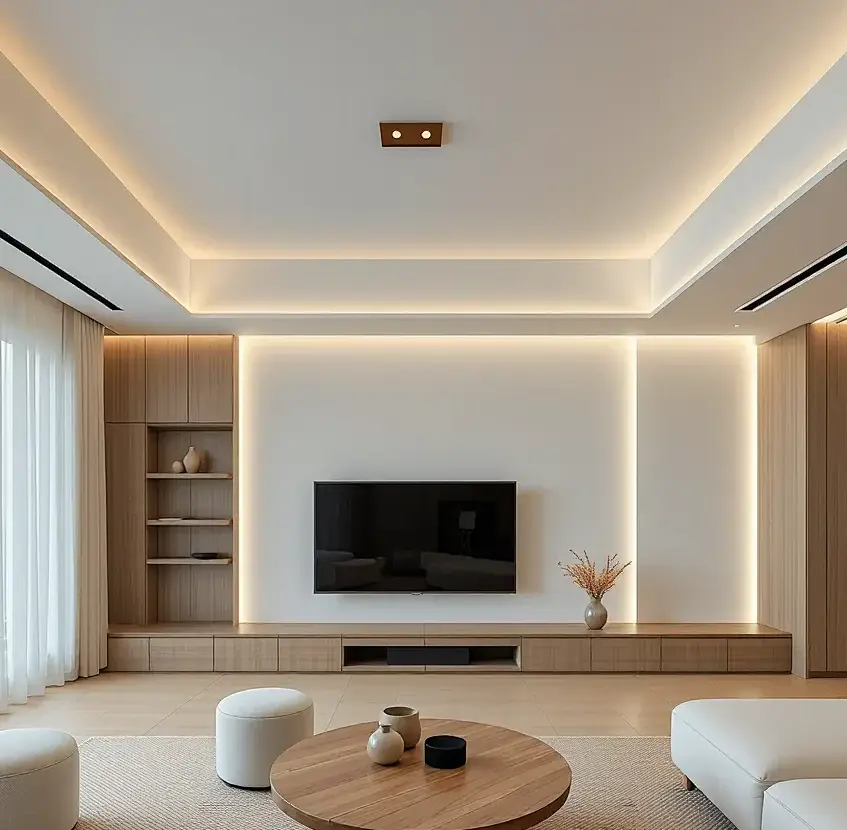
The lobby is the photographed space, judged on quality of light rather than quantity. Coves washing a ceiling need a continuous dotless line, high colour rendering over stone and timber, and a tone that holds when dimmed.
A brand line behind reception is a different product: silicone LED neon flex holds a bent shape and reads as a solid line of colour, which strip in a channel cannot do.
Corridors and public circulation
Corridors are the longest runs in the building and lit continuously, so voltage drop and efficacy both matter. A 24V strip carries roughly twice as far as the same design at 12V before the far end dims, which is why corridors run at 24V, sectioned with driver positions planned early.
Wayfinding is the second job. A low line at skirting or handrail height lets night levels drop without leaving the corridor dark. Detail is in the hotel corridor LED lighting guide.
Guest rooms
Here the strip is closest to the guest, so dotting and glare show immediately. Bedhead, wardrobe and ceiling coves are viewed from under a metre in a shallow recess — exactly where discrete LEDs fail. A dotless COB strip removes the problem at source.
Scene control is what the guest notices: a warm, low bathroom level at night, a brighter setting at the mirror, one switch needing no instructions. Detail is in the hotel guest room LED lighting guide.
Spa, wellness and bathrooms
Wet areas are where under-specification costs most, because the repair means cutting into finished tiling or stone. Steam, splashing and condensation attack the strip and the joints, and the joints fail first. Shower niches, pool surrounds and steam rooms need a sealed build.
Cooler tones suit treatment areas, but the transition matters: a guest moving from a 2700K corridor into a 4000K spa notices the jump. Hold wellness near 3000K and let only the pool zone go cooler.
Restaurant, bar and F&B
Food and drink areas run on two layers: a warm, high-CRI base that makes food look right, and a colour layer on the bar front and shelving. The base must not be the colour layer dimmed down — RGB white is not a usable white.
Bar and club lighting is a discipline of its own, so detail sits with the entertainment venue lighting pillar. Here the question is which circuits are scheduled, and who operates them.
Exterior, entrance and facade
Outside, the envelope gets lit: entrance canopy, terrace edges, building outline and signage that must read from the approach road. Everything here is a weather product, and on a coastal site the connectors and end caps decide its life.
Cable routes and driver enclosures need planning before the facade is finished, and surge protection is worth budgeting on an exposed elevation. Options are in the hotel outdoor LED lighting guide.
Technology selection
Matching the strip technology to each hotel space
Four technologies cover a hotel, and viewing distance and exposure decide between them, not price. COB LED strip has no visible dots, so it belongs anywhere a guest is close to the light: guest rooms, lobby coves, joinery. SMD LED strip is the economical choice for long concealed runs behind a deep cove — corridors and back-of-house.
LED neon flex handles anything shaped or weather-exposed — brand lines, canopies, terrace edges — because the silicone body is diffuser and seal at once. Addressable LED strip is narrower: only where parts of one run must show different things at once, such as a lobby feature wall. It is dimmer per watt and needs content authored.
Voltage follows run length: 12V for short room-level runs, 24V for corridors and exterior elevations, so fewer feed points are needed. Efficacy and dimming schedules move the operating cost, covered in the energy efficient hotel LED lighting guide.
Matched products from the catalogue
COB LED Strip 480LEDs/m 8mm 24V Single Color
ES-COB-480-24V-8MM
The default anywhere a guest sees the light close up. Dotless at any cove depth, CRI 90 over stone and timber, narrow enough for slim joinery.
- Density480 LEDs/m
- Width8 mm
- Voltage12V / 24V
- CRI · IP90 · IP20
SMD 2835 LED Strip 120LEDs/m 8mm
ES-2835-120-8MM
For long concealed runs where the source is never seen directly. Lower cost per metre than COB, and suited to corridor coves with adequate recess depth.
- Density120 LEDs/m
- Width8 mm
- Voltage12V / 24V
- ChipSMD 2835
RGBW SMD 5050 LED Strip 96LEDs/m 24V
ES-5050-96-24V-RGBW
A separate white channel alongside the colour ones, so a bar or function room keeps a usable warm white instead of mixed RGB white.
- Density96 LEDs/m
- ChannelsRGB + W
- Voltage24V
- ChipSMD 5050
PVC LED Neon Strip 6/8mm 120LEDs/m Outdoor
ES-NEON-SIGN-03
An IP67 body that bends and holds its shape, for canopies, terrace edges, outlines and brand features. No separate channel or sealing work on site.
- Density120 LEDs/m
- Size6 / 8 mm
- Voltage12V
- IPIP67
Hospitality projects
Hotel LED strip lighting projects already installed
Six hospitality installations, each a different zone of the same problem. Locations as recorded in our project files.
Verona, ItalyGuest room
Guest room cove lighting with warm white COB LED strip
Ceiling cove, wardrobe and bedhead indirect lighting where the strip is seen from under a metre. Dotless COB, warm white, dimmed at the bedside.
Read the project
Bordeaux, FranceCorridor
Corridor linear lighting with 24V LED strip
Hallway cove and wayfinding edge across a long circulation route, at 24V and sectioned so driver positions stayed accessible after the ceiling closed.
Read the project
Salzburg, AustriaLobby
Lobby LED neon feature wall
A reception wall treated as a graphic element rather than a lit surface: neon flex bent to a fixed shape, with strip behind the joinery carrying the ambient level.
Read the project
Bruges, BelgiumSpa
Spa waterproof LED strip lighting
Ceiling edge, shower niche and relaxation room lighting in a permanently humid zone, drivers kept outside the wet area and no site-made joints inside the sealed lengths.
Read the project
Turin, ItalyRestaurant bar
Restaurant bar RGB LED strip lighting
Bar counter, shelf and mood lighting on circuits separate from the warm white service layer, so the colour scene can change through the evening without touching the tables.
Read the project
Valencia, SpainLobby · corridor
Hotel cove lighting with 24V COB LED strip
Lobby, corridor and guest room coves specified together on one 24V warm white COB build, so colour appearance stays consistent as a guest moves between the three.
Read the projectFurther installations are in the project case library. Adjacent scene types are covered by the commercial building lighting and architectural facade lighting pillars, which share the same corridor, canopy and exterior detailing.
Specification guide
Recommended specification by hotel space
A starting point for a schedule, not a substitute for a lighting design. Confirm colour temperature against the interior finishes and confirm IP build against the actual wet-zone drawings before ordering.
| Space | Recommended product | Voltage | IP | CRI | CCT | Detail |
|---|---|---|---|---|---|---|
| Lobby, reception, F&B | Dotless COB strip, warm white; neon flex for shaped brand features | 24V | IP20 | 90 | 2700–3000K | high CRI COB LED strip |
| Corridors, circulation | 24V SMD or COB strip in aluminium profile, sectioned runs | 24V | IP20 | 80–90 | 3000K | 12V and 24V LED strip lights |
| Guest rooms | Dotless COB strip, warm white or tunable white | 12V / 24V | IP20 | 90 | 2700K | dotless flexible COB strip |
| Spa, pool, bathrooms | Silicone-sealed COB strip or neon flex, no site joints in the wet zone | 24V | IP65 / IP67 | 90 | 3000K | waterproof COB LED strip |
| Exterior, canopy, facade | IP67 neon flex or sealed strip, gasketed junctions, weatherproof driver | 24V | IP67 | 80–90 | 2700–3000K | waterproof outdoor LED neon flex |
Scroll the table sideways on narrow screens to see every column.
Specify one colour temperature per property
Guests notice the change between spaces more than the absolute value. Hold 2700K or 3000K across rooms, corridors and lobby, and reserve variation for the spa.
Dimming is decided by the driver
The strip does not dim; the driver and control protocol do. Fix the dimming method — trailing edge, 0–10V, DALI or the room control system — at the same time as the strip. Options are in the dimmable COB LED strip guide.
Order the property in one batch
Colour consistency depends on the LEDs coming from one production run. Splitting a 200-room order across purchases months apart is the most common cause of variation between floors.
Procurement and factory support
Working with a hotel LED lighting supplier direct
Senfey manufactures in Shenzhen and supplies hotel groups, contractors and lighting designers rather than retail. Because the strip is made here, a question about colour consistency or an IP build is answered by the people running the line.
- Send the drawings, or just the zone list
- Room count, corridor lengths, wet areas and exterior scope are enough to start. A reflected ceiling plan lets us comment on cove depth and driver locations first.
- Samples judged in the actual finish
- Warm white against pale stone reads differently than against dark timber. Request sample lengths in the colour temperatures under consideration and view them on the real material.
- One specification for the whole property
- Once the schedule is fixed, the property is quoted and produced against one specification per zone, so floors do not differ. Tell us the phasing if the site opens in stages.
- Certification for the destination market
- Confirm which certification the project needs and for which components, including drivers. This belongs in the enquiry rather than at shipping.
- OEM, ODM and private labelling
- Cut-to-length runs, custom colour temperature and CRI combinations, IP65 and IP67 builds, connector and lead configurations, private labelling and packaging.
- Four technologies, one supply chain
- COB, SMD, neon flex and pixel strip are all made in house, so a mixed hotel specification does not become four suppliers and four lead times. Detail is in the hotel LED lighting supplier guide, and company background is on the about Senfey page.
Facade project enquiry
Tell us the elements and we reply with a strip, driver, sealed build and IP rating per element, not one price per metre. Prefer email? Use the contact page.
Prefer email or a message app? Use our contact page.
FAQ
Hotel LED lighting questions from project buyers
The questions that come up most often during specification and tender.
Which colour temperature should a hotel specify?
2700K for guest rooms and 3000K for corridors and public areas covers most hospitality briefs. Warmer reads as restful; 4000K and above feels clinical.
Consistency matters more: a guest notices the change between a 2700K room and a 3500K corridor far more than the absolute value. Hold one temperature across the guest journey.
Why do rooms on different floors look slightly different?
Almost always because the strip came from different production batches. LED binning has a tolerance, and warm white against pale finishes is where it shows.
The remedy is procurement, not product: order the property against one specification in as few batches as possible, and state the phasing if floors are handed over in stages.
COB or SMD strip for a hotel?
Decide by viewing distance. Where a guest is close to the light — bedhead, wardrobe, joinery, a shallow lobby cove — a COB LED strip shows no dots and earns its cost per metre.
Where the source is fully concealed behind a deep cove or diffuser — most corridors and back-of-house — SMD does the same job for less. Using both, zone by zone, costs less.
What IP rating do spa and bathroom areas need?
IP65 for splash zones such as a mirror or vanity, IP67 where there is steam, direct water or washdown — steam rooms, shower niches, pool surrounds. Specify it at order, because a sealed strip is manufactured that way, not sealed on site.
The strip is rarely the failure — joints, end caps and driver location are, and all three are decided on site. Keep drivers outside the wet zone and avoid site-made joints.
How long can a corridor run be on one supply?
Less than most schedules assume. Voltage drop makes the far end dim and drift warm; a 24V design carries roughly twice as far as the same strip at 12V before it shows.
Long corridors are therefore sectioned and fed separately, with driver positions planned while the ceiling is open. Detail is in the hotel corridor LED lighting guide.
Can LED strip be dimmed on the room control system?
Yes, but the driver decides, not the strip. Fix the protocol — trailing edge, 0–10V, DALI or the room automation system — alongside the strip, and confirm the driver dims smoothly to the lowest level the scenes use.
The low end is where cheap drivers fail: visible steps, flicker on camera, or a cut-off at ten per cent instead of a fade to a night level.
Is a lighting retrofit worth doing on an operating hotel?
Where the strip runs continuously — corridors, public areas, exterior — operating cost outweighs capital cost, so efficacy and a working dimming schedule are what pay back.
Retrofit also has to survive occupancy: sectioned runs and accessible drivers matter more than in new build. Detail is in the energy efficient hotel LED lighting guide.
Do you supply hotel groups and contractors directly?
Yes. We manufacture in Shenzhen and supply owners, designers, contractors and distributors, including OEM and private-label work. Raise certification for the destination market in the enquiry, since it can affect the driver used.
Procurement and documentation detail is in the hotel LED lighting supplier guide.
Still specifying? Send the zone list, room count and interior finish; the reply can name a strip, driver and IP build per space.
Request a quote