
Shenzhen LED Strip Factory · Landscape & Parks
Landscape LED Strip Lighting for Parks, Gardens and Public Space
Outdoor public lighting is walked past at a metre, watered by irrigation, cleared of snow and never switched off. Specified around sealed builds, low glare and drivers someone can reach — made in our own factory and supplied direct to contractors, landscape architects and municipal suppliers.
- Scope
- Path to plazasix outdoor zones
- Builds
- IP67 · IP68sealed at manufacture
- Aiming
- Downward, lowglare off the eyeline
- Made here
- Neon · COB · SMDone supply chain
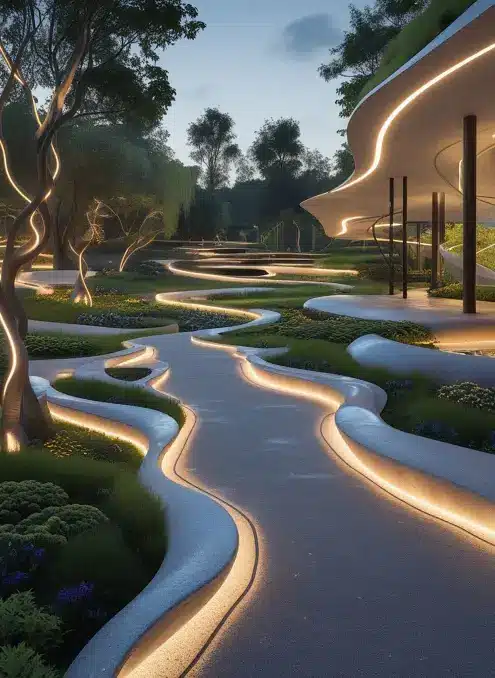
Outdoor realities
Why landscape lighting fails, and it is rarely the tape
A park run is closer to people than any facade run and sits in a wetter, dirtier place than any building. The replacements we get called out to share the same root causes, and nearly all of them were locked in at specification.
IP67 is the floor, not the target
A path edge sits in puddles and an irrigated bed sits in wet soil for hours. Anything buried, submerged or under a sprinkler head needs IP68 and a sealed joint, not a rated tape with a taped end.
Uplighting at eye height blinds people
Landscape light is walked through, so a bright source at a metre is directly in the sightline. Levels should be low and aimed down at the surface, letting the paving do the reflecting.
Mowers, snow ploughs and feet
Maintenance equipment does not know the lighting is there. Runs at ground level need a profile or a recess that takes a strike, and a fixing that survives being stood on.
Distances no facade ever has
A pathway is a hundred metres, not five. Low voltage over that distance means multiple drivers, buried feeder cable and injection points, decided while the trenches are still open.
Curfews and dark-sky conditions
Public schemes near water, trees or housing often carry conditions on upward light and hours of operation. Warmer colour and downward aiming answer most of them; a timeclock answers the rest.
Drivers buried in a planting bed
A driver in a sealed pit under mature planting turns a ten-minute fault into excavation. Enclosures need to be reachable without digging, and labelled for whoever inherits the park.
A 100 m path is not one run
- 1Over a hundred metres one low-voltage feed cannot hold output. The far end is unusable, and no tape fixes it.
- 2Short sections with their own drivers on a buried feeder — a trenching decision, cheap only while the trench is open.
What links all six: the landscape was specified as a length of tape rather than as a buried detail. Sealed build, aiming, mechanical protection, cable route and driver access are the specification on a public outdoor job, and the strip itself is the easy part.
Zone by zone
Six outdoor zones, six different specifications
A park is not lit as one surface. Each zone sets out what it must do after dark, and what that fixes about the sealed build, the aiming and the cable route.
Pathways, walkways and cycle routes
A path is lit so people can read the surface and each other, not so it looks bright from a distance. Low continuous edge light beats pole-mounted spill, because it grazes the paving and reveals level changes and loose edges.
The specification problem is length. A hundred-metre route is several sections, several drivers and a buried feeder, all of it cheap while the trench is open. Outdoor LED neon flex suits path edges because the body is diffuser and seal in one.
Typical: 2700–3000K warm white · CRI 80+ · 24V · IP67 minimum · sectioned every few metres, buried feeder cable, drivers in reachable enclosures, aimed down at the paving
Steps, ramps and level changes
This is the one zone doing a safety job rather than an atmospheric one. Every nosing needs to read as a separate edge, which means light on the tread and the source out of the descending sightline.
Recess it into the riser or under the nosing so nobody looks into it walking down. A dotless COB strip gives a continuous edge rather than a row of dots, which makes the nosing legible.
Typical: 3000K warm white · CRI 90+ · 24V · IP67 in a recessed profile · one run per nosing, source concealed from above, no upward component at eye height
Garden walls, planting and hedges
Grazing a wall from close range makes stone, brick and render look like material rather than a flat panel. The strip sits within a hundred millimetres of the surface and throws light along it, so texture reads as shadow.
Planting beds are the wettest place on site — irrigation runs whether it rained or not — so this is where waterproof COB strip earns its price. Facade-adjacent detail sits with architectural landscape lighting.
Typical: 2700K warm white · CRI 90+ · 24V · IP67, IP68 where irrigated or buried · mounted within 100 mm of the surface, aimed along it, sealed cut ends and glanded joints
Benches, seating and street furniture
Lighting under a bench or planter rim does two things: it makes the object visible as an obstacle and the space feel occupied rather than empty. Concealed under the overhang, the furniture appears to float.
Concealment is also the durability strategy: a run tucked under a seat edge is out of the rain, out of the mower's path and out of reach of anyone picking at it.
Typical: 2700–3000K warm white · 24V · IP67 · recessed under the seat or rim edge, no source visible from a standing eye height, mechanically protected against kicks and cleaning
Water features, pools and canal edges
Water doubles whatever you point at it, so a clean line reads as two and any flicker reads as four. It is the least forgiving place for a joint and the most rewarding for a continuous one.
IP67 stops at the water's edge. Anything at or below the waterline, or within reach of splash and cleaning jets, is an IP68 build with factory-terminated leads — and the driver belongs well away from it.
Typical: 3000K warm white, or RGB for feature water · 24V · IP68 at or below waterline, IP67 above · factory-terminated leads only, driver remote and above flood level
Plazas, wayfinding and feature runs
A plaza is lit to be crossed and to be a place, so the lighting has two jobs: a legible route across it and a reason to stay. Inlaid paving lines do the first, colour-changing feature runs the second.
Anything in the ground plane is walked on, driven over by service vehicles and machine-cleaned, so it needs a rated profile rather than a rated tape. Addressable LED strip lets a plaza change for an event without rewiring.
Typical: warm white for wayfinding, addressable RGB for feature · 24V · IP67 in a trafficked profile, IP68 if flush in paving · scene control on a timeclock, curfew scene after hours
Technology selection
Which LED technology suits which outdoor zone
Outdoor selection is driven by the sealed build first and the light second. LED neon flex is the default for path edges, planter rims and any run that follows a curve, because the extruded body is diffuser and seal in one and takes a bend without a channel. For anything buried or submerged, start from the waterproof LED strip builds rather than adapting a dry-location tape.
COB LED strip is the right answer where people are close — step nosings, seat edges, wall grazing at a metre — because a dotless line reads as an edge instead of a row of dots. SMD LED strip stays the sensible option for concealed runs under furniture and rims where output per pound matters and the source is never seen.
Addressable LED strip is worth the extra control only where a plaza or a bridge has to change for an event, and the waterproof addressable builds are the ones to specify outdoors.
Matched products from the catalogue
PVC LED Neon Strip 6/8mm 120LEDs/m Outdoor
ES-NEON-SIGN-03
The path-edge product: a slim PVC body that holds a curve along a route, in an IP67 build made for permanent outdoor exposure.
- Density120 LEDs/m
- Body6 / 8 mm
- Voltage12V
- IPIP67
COB LED Strip 528LEDs/m 10mm 24V Single Color
ES-COB-528-10MM-24V
The dotless line for anything seen from a metre — step nosings, bench rims, wall grazing — at 24V so a run can cover a flight or a terrace.
- Density528 LEDs/m
- Width10 mm
- Voltage24V
- CRI · IP90 · IP20
SMD 2835 LED Strip 120LEDs/m 8mm
ES-2835-120-8MM
The workhorse for concealed outdoor coves and furniture rims, where the source is hidden and cost per metre decides the length you can afford.
- Density120 LEDs/m
- Width8 mm
- Voltage12V / 24V
- CRI80
Smart Addressable Pixel LED Neon Strip RGBIC
ES-NEON-PIXEL-01
Pixel content in a sealed neon body, so a plaza run or a bridge edge can carry gradients and event scenes without a separate channel and diffuser.
- TypeRGBIC
- ControlAddressable
- Voltage12V / 24V
- IPIP67
Landscape projects
Park, garden and public space projects already installed
Three outdoor public installations across pathway, plaza seating and city-scale landscape work, with locations as recorded in our project files.
Tampere, FinlandPathway
Park pathway waterproof LED neon flex lighting
A continuous edge line along a public route, sectioned so a single fault leaves the rest of the path lit rather than dark.
A Finnish park also sets the hardest test there is: the run is under snow and meltwater for months, then cleared by machine.
Read the project
Faro, PortugalPlaza seating
Public plaza bench LED strip lighting
Concealed under the seat edge so the furniture reads as an object at night and the source is never in anyone's eyeline.
Tucking the run under the overhang is also what keeps it out of the rain and away from cleaning machinery.
Read the project
Dubai, UAEExpo City
Expo City Dubai Al Wasl Plaza landscape LED pathway lighting
City-scale landscape pathway lighting across a public plaza, where run lengths and driver distribution matter more than any single specification.
Gulf conditions add heat and dust to the usual list, so thermal headroom and sealed entries were fixed at order.
Read the projectSpecification guide
Recommended specification by outdoor zone
A starting point for a schedule, not a substitute for one. Final values depend on mounting height, drainage, irrigation, traffic over the run and any curfew conditions on the consent.
| Zone | Colour | CCT | CRI | Voltage | IP | Control | Detail |
|---|---|---|---|---|---|---|---|
| Pathways and cycle routes | Warm white | 2700–3000K | 80+ | 24V | IP67 | Timeclock | Outdoor neon flex |
| Steps, ramps and level changes | Warm white | 3000K | 90+ | 24V | IP67 recessed | Unswitched or timeclock | Dotless COB |
| Garden walls and planting | Warm white | 2700K | 90+ | 24V | IP67 · IP68 if irrigated | Dim or scene | Waterproof COB |
| Benches and street furniture | Warm white | 2700–3000K | 80–90 | 24V | IP67 concealed | Timeclock | Waterproof LED strip |
| Water features and pool edges | Warm white or RGB | 3000K | 80+ | 24V | IP68 at waterline | Scene | LED neon rope light |
| Plazas and wayfinding | Warm white or addressable RGB | 3000K | 80+ | 24V | IP67 trafficked · IP68 flush | DMX or pixel | Waterproof addressable |
- IP is a build, not a coating. A sealed strip is manufactured that way. Sealing an indoor tape on site will pass a handover inspection and fail the first wet season, because water enters at the cut end, the junction and the gland rather than through the tape.
- Design the cable route with the trench, not after it. Landscape runs are measured in hundreds of metres, so driver positions, feeder cable and injection points are decided while the ground is open. Retrofitting a feed under mature planting costs more than the lighting did.
- Assume the maintenance team has changed. Public schemes outlive the contractor, so label the enclosures, keep them reachable without excavation, and specify something still available in five years rather than a one-off build.
Procurement and factory support
Buying landscape LED lighting from the factory direct
Senfey manufactures in Shenzhen and supplies landscape contractors, municipal suppliers, designers and distributors rather than retail, so a question about an IP68 build or a buried joint is answered by the people running the line.
- Send the site plan, or just the lengths
- A layout with run lengths, mounting positions and which zones are irrigated or trafficked is enough to start. Section details let us comment on the recess and the profile.
- Fix the sealed build per zone
- IP67 or IP68, cut-end treatment, junction type and gland entry differ between a path edge and a pool edge. They are decided at order because they are built in, not added later.
- Plan the cable route with the trench
- Driver positions, feeder cable and injection points cost almost nothing while the ground is open, and a great deal once the planting is in.
- Check run length against voltage drop
- Landscape routes are long. Tell us the longest continuous run and how it is fed, and we size the sections and cable rather than leaving a visibly dimmer far end.
- Mechanical protection and access
- Confirm what drives, walks or mows over each run, and where the enclosures sit. Both decide the profile and whether a future fault needs a spanner or a digger.
- OEM, ODM and certification for the market
- Cut-to-length runs, custom colour and CRI, IP65 to IP68 builds, connector and lead configurations, private labelling. Name the destination country on the enquiry, because outdoor driver approvals differ by market: about Senfey.
Landscape project enquiry
Tell us the zones and we reply with a strip, driver, sealed build and IP rating per zone, not one price per metre. Prefer email? Use the contact page.
Site plans, section details and reference images all help — attach them by email. Use our contact page.
FAQ
Landscape lighting questions from contractors and designers
The questions that come up most often while an outdoor scheme is being specified and priced.
Is IP67 enough for a park, or do I need IP68?
IP67 covers most of a park: path edges, wall grazing, seating, anything above grade that gets rained on. IP68 is for runs that sit in water rather than get hit by it — buried in a bed, flush in paving that ponds, at or below a waterline.
Either way, start from a factory-sealed build. Tape sealed on site with heatshrink is the usual cause of a year-two failure.
Can LED strip be buried in a planting bed?
Only as an IP68 build with factory-terminated leads, and even then it is better mounted in something than sitting in soil. Irrigation keeps a bed wet for hours after every cycle, and root growth moves whatever is buried in it.
The usual answer is a sealed run clipped to a hard edge — a kerb, a riser, a planter wall — so it is in the bed visually but not in the ground.
How long can one run be along a pathway?
At 24V a single-feed run of roughly five metres holds up; past that the far end reads dimmer and slightly warmer. A hundred-metre route is therefore many sections fed from several points, not one long strip.
That is a cable and driver layout question, and it is answered while the trench is open. Tell us the longest continuous run at enquiry and we size the sections against it.
What colour temperature suits parks and gardens?
2700K for planting and gardens, because warm light flatters bark, stone and foliage and reads as evening. 3000K for circulation and hard landscape, where a little more clarity helps people read level changes.
Cooler than 3000K outdoors looks institutional, attracts noticeably more insects and is the first thing residents complain about.
How do you meet dark-sky and wildlife conditions?
Three moves cover most conditions: aim everything downward so there is no direct upward component, keep colour temperature warm, and put the whole scheme on an astronomical timeclock with a curfew level after hours.
Low mounting heights help twice over, since a run at ankle level has far less to spill past than a pole or an uplight does.
Will the lighting survive mowing, snow clearing and service vehicles?
Only if the run is mechanically protected rather than just rated. A profile, a recess or a kerb upstand takes the strike; a bare sealed tape clipped to a surface does not, whatever its IP rating says.
Tell us what passes over each run at enquiry — feet, mowers, ploughs, delivery vans — because it changes the profile, not the strip.
Where should the drivers go on an outdoor scheme?
Somewhere reachable without excavation, above any flood level, and labelled. A driver in a sealed pit under mature planting turns a ten-minute swap into a day with a digger.
Public schemes outlive their contractors, so assume the person opening that enclosure in five years has never seen the site before.
Do you supply landscape contractors and municipalities directly?
Yes. We manufacture in Shenzhen and supply landscape contractors, municipal suppliers, designers and distributors, including OEM and private-label work.
Name the country at enquiry — outdoor drivers carry market-specific approvals. Send the zone list through the landscape project enquiry form for a specification per zone rather than one price per metre.
Not covered here? Questions that need drawings — recess depth, drainage, cable routes, traffic loading, curfew wording on the consent — are faster to answer against the site plan.
Request a quote