One Evening at a Neighborhood Bar in Antwerp
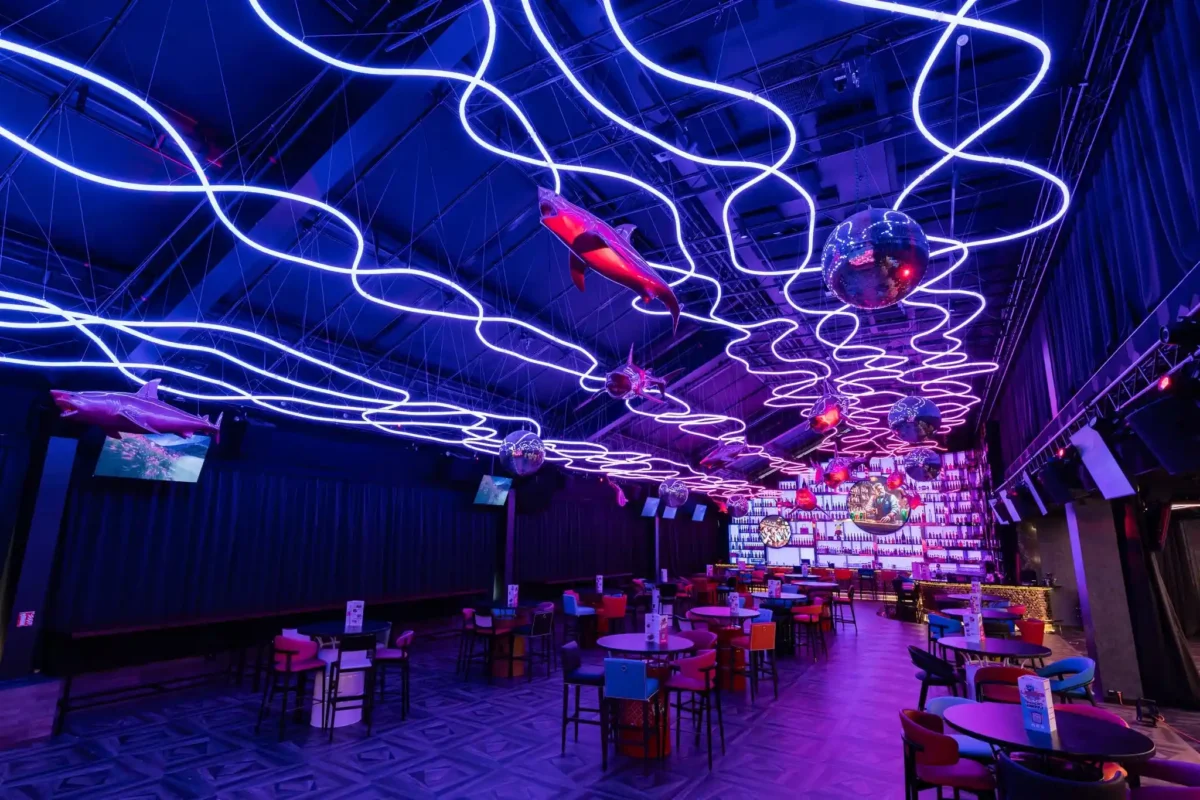
The clearest way to explain this rgb cob led strip restaurant lighting project is to walk through one Friday evening. It is a 90-cover restaurant-and-bar in Antwerp, Belgium — a place that serves lunch, moves into dinner service, then flips into a cocktail bar by eleven. One room, three moods, and the previous install (static warm-white SMD plus a generic RGB controller) could not move between them without looking wrong for at least one shift.
The brief was blunt: three scenes, no bin drift, no visible pixels behind the bar-front acrylic. That pushed the color layer toward an RGB COB LED strip platform, specified by density rather than price.
One Room, Three Scenes Across a Single Evening
18:00 — Lunch to Dinner
Between the last lunch cover and the first dinner booking the room changes without anyone noticing. The RGB layer pulls back to a low warm glow at roughly 60% output while the white downlights stay up over the tables. What sells this scene is not color but the ramp: transitions run over three minutes, slow enough that a seated guest never catches them. Options are set out in the dimmable COB approach we standardized here.
20:30 — Dinner Service
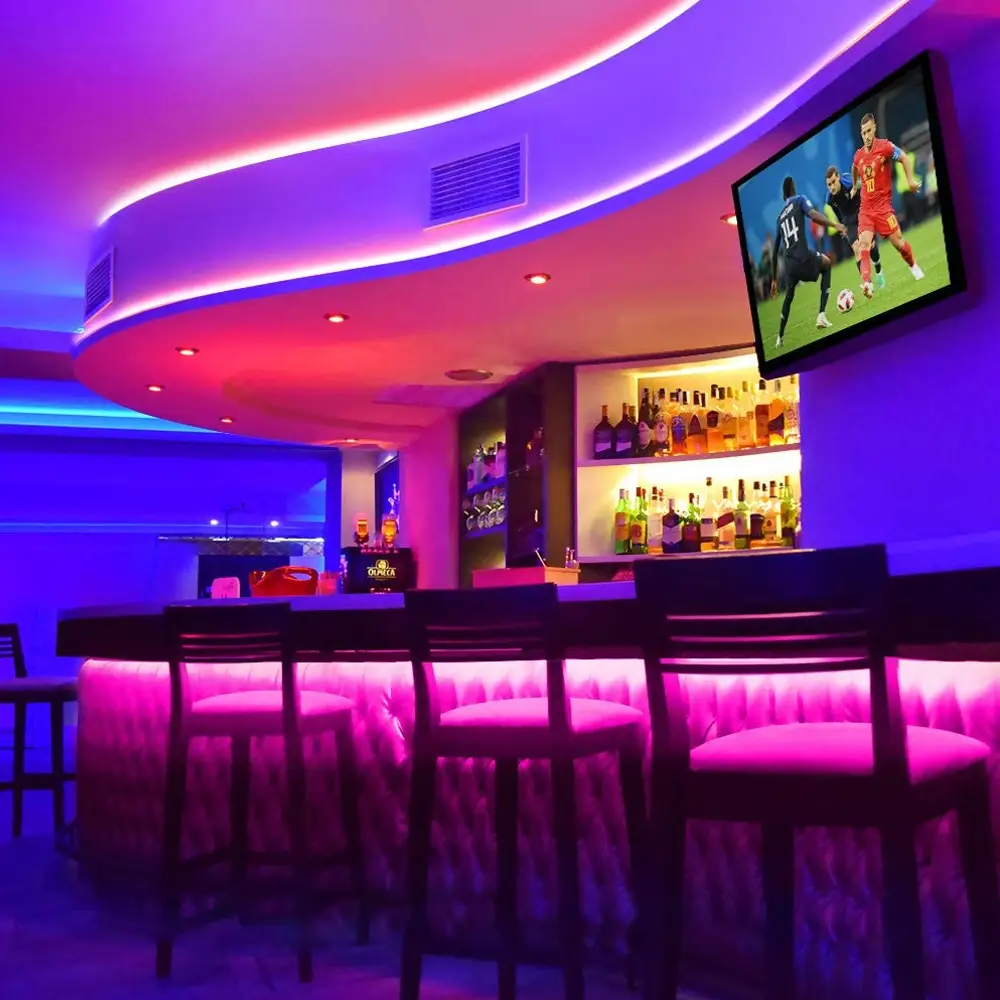
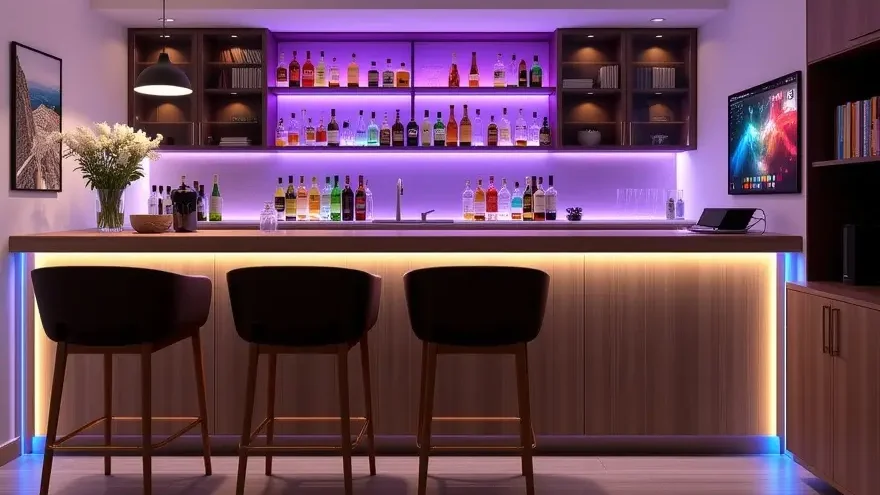
Peak service. The bar front goes to saturated amber, the cove sits low and warm, and the banquette wall-wash drifts between two amber-plum presets on a 15-minute cycle. Density earns its money here: guests sit within arm’s reach of the strip behind clear acrylic, so anything under 810 LEDs/m pixels through. The white layer over the tables stays untouched, keeping plated food reading the same at 20:30 as at noon.
23:00 — Cocktail Bar Mode
The kitchen closes and the room becomes a bar. The perimeter drops out, the white table layer goes to its lowest step, and the bar front and bottle wall carry a slow drift — roughly 45 seconds per color.
Where RGB Stops and White Light Starts
The one thing we pushed back on hardest: the original concept had the RGB channels mixing their own warm white so one system could cover all three shifts. In a restaurant that does not work, and it is worth saying why.
Mixing red, green and blue gives a white with three narrow spectral peaks and large gaps between them; reds and skin tones in those gaps come back muddy. The CRI 90 figure on an RGB datasheet is not a promise about that mixed white either — color rendering is defined against a broad-spectrum reference, which a three-channel mix does not meet. It is also why an RGB scene cannot honestly be called 2200K: there is no white emitter to bin. So tables and the pass stayed on the white layer, and RGB stayed decorative. Where a project needs tunable white and color from one line, that is an RGBW or RGBCW strip — a different product, not a control setting.
What Is Inside the Ceiling and Behind the Bar
Approx. 95 meters of RGB COB carry the accent system across three zones, viewing distance driving every SKU choice.
| Zone | Model | Spec | Approx. Length | Why this SKU |
|---|---|---|---|---|
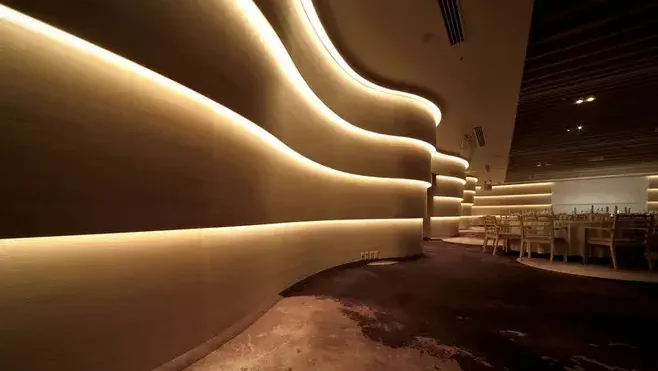
| Perimeter cove (ceiling) | ES-COB-576-8MM-RGB | RGB COB · 576 LEDs/m · 8 mm · 12V/24V · IP20 | Approx. 32 m | Seen from across the room at 2.6 m ceiling height, where 576 LEDs/m reads as a continuous line; the 8 mm PCB fits the existing gap. |
| Bar-front glow (behind clear acrylic) | the 810 LEDs/m 12V reference | RGB COB · 810 LEDs/m · 10 mm · 12V · IP20 | Approx. 28 m | Viewed at 500–800 mm through clear acrylic, which hides nothing — the highest density here. 12V works only because the bar front is wired as short segments. |
| Wall-wash behind banquettes & back-bar bottle wall | the 840 LEDs/m 24V reference | RGB COB · 840 LEDs/m · 10 mm · 24V · IP20 | Approx. 35 m | 24V carries the 11 m banquette run without mid-line injection — the reason this zone is not on 12V. |
| Accessories | 12V and 24V constant-voltage drivers · aluminum profile · frosted PC diffuser on the cove, clear at the bar front · ES-LC-RGB-016 44-key IR controllers, one per zone | |||
Two honest notes on control. We do not supply a DMX or tablet scene stack, so scenes are stored presets recalled per zone on IR controllers, not one cue list — the manager presses three buttons, not one. The bottle-wall drift is a controller fade program, not pixel animation; per-pixel sequencing needs an RGBIC strip on a pixel controller, which the venue decided against. One addition not on the brief: after the previous install crashed on a Friday night, a hardwired switch at the pass forces every zone to plain warm output whatever the controller does.
Because guests view the bar front at 500–800 mm, we checked the blue channel at full output against the risk-group method in IEC 62471 — blue governs that assessment, not amber — and it sits in the exempt group. All zones are IP20 dry interiors under IEC 60529, with every supply in the SELV band of IEC 61140.
If Your Venue Runs Three Shifts a Day
- Never let RGB mix the white you eat under. Keep a real white layer over tables and the pass; let RGB do mood only. A CRI number on an RGB datasheet does not describe its mixed white.
- Set density from viewing distance, not room size. Ceiling coves are forgiving; anything within arm’s reach behind clear acrylic wants 810 LEDs/m or more.
- Pick voltage from run length. An 11 m wall-wash belongs on 24V; 12V is fine where a zone breaks into short segments.
- Ask how many buttons a scene change takes. Preset IR control is reliable and cheap, but per-zone. One-touch cues across a room need a control layer budgeted from the start.
- Build a hardware fallback. One switch forcing a safe warm preset saves the night when a controller misbehaves.
Planning similar rgb cob led strip restaurant lighting? Send us your floor plan and scene wishlist and we’ll draft a matched list against your service timeline, marking which zones need their own white layer.
About Senfey
Senfey is a Chinese LED strip manufacturer founded in 2010, running a Shenzhen factory of roughly 12,000 m² with a monthly output above 250,000 meters. Our catalog covers COB, SMD, LED Neon Flex, addressable strips, controllers and power supplies. Browse Senfey’s COB LED strip catalog for RGB and RGBW references.