
For an LED strip reorder, identify the previous accepted version and compare it with the current offer. Check the specification revision, light requirements, dimensions, connections and accessories before approving changes. A repeated model name is a useful reference, but the accepted specification is the purchasing baseline.
On this page
Recover the accepted version before asking for the same product
Send the previous order number and line, supplier model, your SKU and the accepted datasheet or drawing revision. Add labels, sample approval and any changes agreed after the original quotation.
Use the final accepted record, not an early sales proposal. A customised lead, connector or label may have been agreed separately and may not appear in the catalogue description. If no initial approval exists, the sample approval checklist identifies what to establish now.

Which LED strip specifications should remain consistent?
| Group | Compare with the earlier order | Why the difference matters |
|---|---|---|
| Light | Colour/CCT, CRI, output and any agreed colour tolerance. | Customer expectation and appearance alongside existing material. |
| Electrical | Voltage, rated W/m, feed/run information and product construction. | Existing power and wiring arrangements need review if the load or requirements change. |
| Mechanical | Finished dimensions, cut interval, leads and connector details. | Fit, usable section lengths and assembly work. |
| Control | Strip type, channel requirements or data protocol, and accessory models. | Required dimming/colour functions and the retained equipment. |
| Supply identity | Model/revision, label content, reel format and specified references. | Receiving stock correctly and linking it to the right version. |
The SMD and COB ranges help identify a family. Compare the actual selected versions rather than approving a broad product category again.
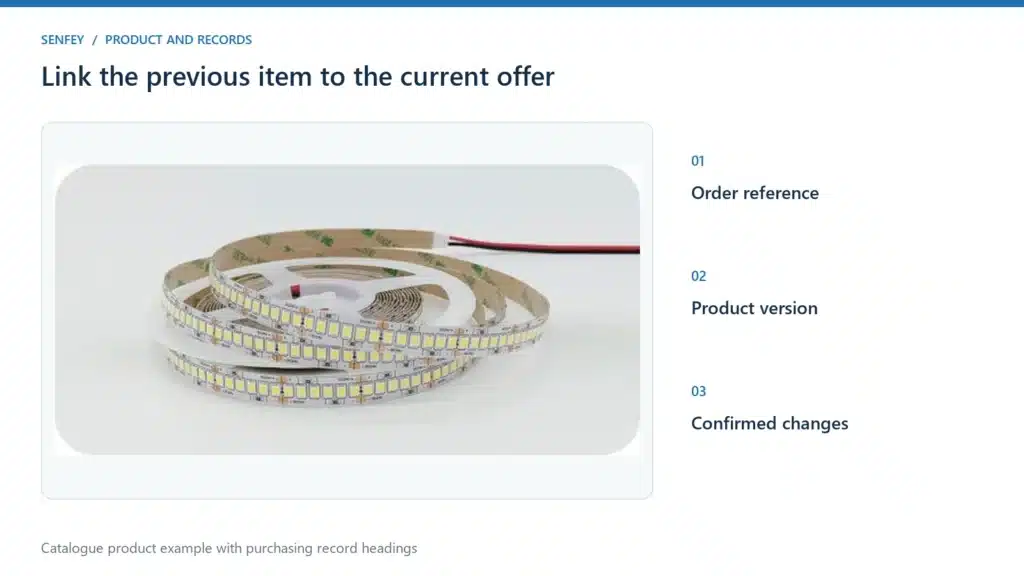
Decide which changes require another review
Need LED strips for your order?
Tell us the strip type or model, key specifications, quantity in metres and destination country. We can share actual product photos, check available CE/RoHS documents for the selected model, and suggest compatible power supplies or controllers.
Ask the supplier to list differences from the accepted specification. Use the affected requirement to decide the next action:
- Width, covering, cut interval or connector change: review fit, termination and assembly details.
- W/m or electrical construction change: review the supply/load arrangement and applicable product instructions.
- Light specification change: review the required optical data and representative assembled appearance.
- Controller or protocol change: review required functions with the proposed equipment.
- Label or carton change only: review artwork and receiving requirements; record the accepted revision.
Identify whether a drawing, document, revised sample or further measurement is needed. Close each relevant change before accepting the affected line. New power/control accessories need their own model references.
Handle old labels and incomplete specifications
Provide the order date, available labels, photos and known specifications. Ask whether the supplier can identify the old version. Mark discrepancies between the label and datasheet for resolution.
Where the old version cannot be established, agree a new specification and review the proposed sample. Calling it “same as before” does not solve a missing baseline. Traceability and batch codes should be requested according to what is available for that product; do not create a missing code or infer one from appearance.
A compact repeat-order request
Please quote [quantity/unit] of [supplier model/version], from previous order [number/line], to [destination]. Our accepted specification is [revision], with [sample/label references] attached.
Please list changes to the product, accessories or packing, confirm the current offered version, and identify any point needing renewed approval. Quote the present packing and delivery arrangements.
For mixed orders, keep each product version on its own line. Use the purchase order guide for metre/reel conversions and accessory quantities.
Retain a usable record for the next order
Save the current PO and quotation with the accepted specification, approved changes and sample reference. On receipt, add the labels and production references actually supplied. Preserve earlier revisions so the file shows which version belongs to each shipment.
For phased projects, state whether new material will be visible next to earlier material. Agree the required colour/appearance assessment and tolerances rather than relying solely on a nominal CCT label or an old sample.
Review broader supply continuity through the supplier buying guide.
Repeat-order questions
Do I need a new sample for every reorder?
Decide from the changes and their consequences. An unchanged, well-documented item differs from a revised construction or accessory combination requiring review.
Can I request the same production batch?
Ask whether it is available for the required quantity. Do not assume earlier batch stock remains available.
Does the same model guarantee identical appearance?
The model identifies the product. For appearance-critical work, specify the colour requirements, tolerances and review conditions relevant to the application.
Send your LED strip reorder enquiry
Share the previous order/model, accepted specification, labels and required quantity. Highlight retained accessories and any appearance or assembly requirements.
Check your repeat-order requirement