
A useful LED strip range for distributors covers recurring customer applications with a manageable number of SKUs. Select the light type and installation format first, then choose the voltage, colour, output and accessories for each stocked version. Keep occasional project specifications available to quote rather than stocking every catalogue option.
On this page
Build the range around your customers' installations
Separate cabinet and furniture buyers, electrical installers, decorative-lighting retailers and project contractors. Their priorities differ: connector fit, immediate availability, a continuous light line, colour control or project documentation. Review enquiries and orders by application before choosing individual reels.
A practical first shortlist contains a core white-light offer, accessories for those exact products and specialist lines supported by actual enquiries. Identify the problem each SKU solves; two near-identical versions need a clear reason to occupy separate stock positions.
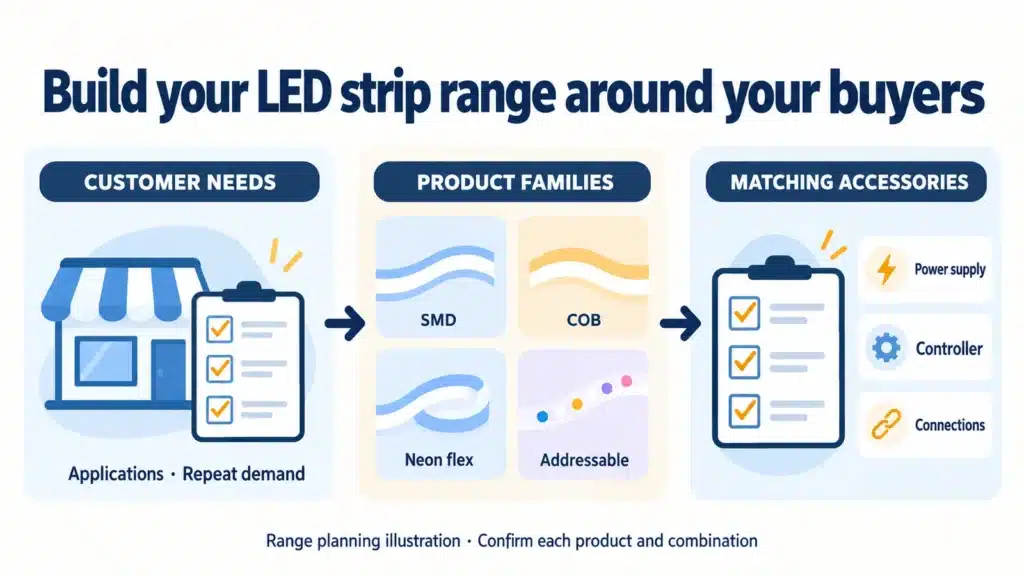
Which LED strip families belong in a wholesale range?
| Family | Buyer application | Selection priority |
|---|---|---|
| SMD LED strip | Cabinets, coves and general linear-lighting supply. | Output per metre, density, board width and appearance behind the intended diffuser. |
| COB LED strip | Details where buyers want a continuous-looking light line. | Finished width, cut interval, output and the assembled lighting effect. |
| LED neon flex | Visible outlines, signs and curved lighting details. | Cross-section, bend direction/radius, mounting and the selected protection construction. |
| Addressable LED strip | Pixel effects, animated signs and controlled installations. | Protocol, controllable segment size, power arrangement and controller support. |
These families organise the range; they do not require equal stock allocations. A furniture distributor may need depth in narrow white strips, while an effects supplier needs control expertise and fewer conventional white-light options.
Control SKU count before adding more specifications
Need LED strips for your order?
Tell us the strip type or model, key specifications, quantity in metres and destination country. We can share actual product photos, check available CE/RoHS documents for the selected model, and suggest compatible power supplies or controllers.
Every stocked combination is a separate SKU. Offering two voltages, three colour temperatures and two protection constructions creates 12 combinations before adding widths or output levels. This arithmetic illustrates inventory complexity, not a recommended product mix.
Give each selected SKU a compact specification:
- Light: fixed white, tunable white, RGB/RGBW or addressable; CCT, CRI and output data where relevant.
- Electrical: voltage, rated W/m and the product-specific feed/run limits.
- Mechanical: PCB and finished width, cut interval, leads and connector details.
- Supply: protection construction, reel length, supplier model and packing reference.
Use the supplier model plus your warehouse code. “Warm-white COB” is a category description; it cannot distinguish the versions needed for purchasing and replenishment.
Offer complete purchasing options, with defined accessory models
Build an accessory list around the strips you actually sell. Fixed-white, tunable-white and RGB products require different control arrangements; addressable strips also require supported data protocols. Identify the power supply, controller and connector by model rather than describing all accessories as interchangeable.
Confirm the rated conditions and intended connected load through the LED strip power supply guide. Present the selected items as individually priced lines or a defined package, with clear included quantities. Our accessories and power supply range is the starting point for a matching enquiry.
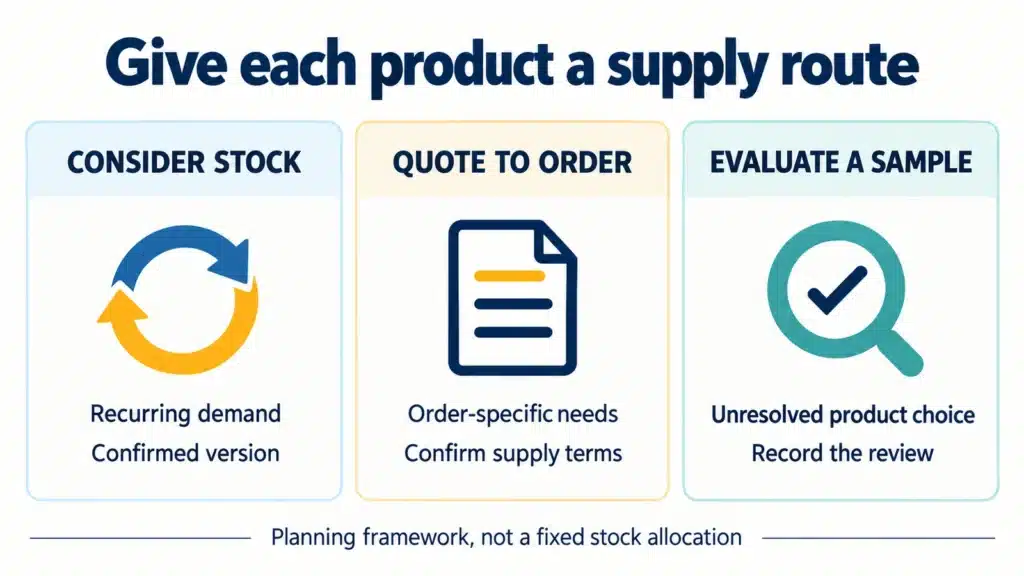
Decide which products to stock and which to quote
| Route | Use it when | Commercial check |
|---|---|---|
| Core stock | Repeat demand is concentrated in an identified specification. | Demand rate, supplier replenishment time and cash tied up in inventory. |
| Quote to order | Specifications vary by project or enquiries are infrequent. | Current MOQ, lead time, packing and customer acceptance. |
| Sample/display only | The product needs demonstration or demand is unproven. | Sample cost, the version demonstrated and the next buying decision. |
Review stock by exact SKU. A useful starting measure is average demand during the replenishment period, with a buffer chosen for your demand variability. Avoid treating a large supplier catalogue as evidence that every option deserves local stock.
Check representative samples before expanding the range
Compare the shortlisted strip in the profile, diffuser and control arrangement your customers use. Check fit, light appearance, dimming behaviour, connections and label clarity. Collect the matching datasheet and sample reference before adding the item to your catalogue.
Expand when quotations or repeat enquiries identify a gap. Review supplier selection separately with the LED strip supplier buying guide.
Distributor range questions
Should I start with COB, SMD or both?
Choose by customer application and the specifications they repeatedly request. Where both constructions are candidates, compare the assembled light effect and total accessory requirements before stocking both.
How many SKUs should the first order contain?
Use the smallest range that covers your recurring applications. Set quantities from demand and replenishment requirements; a universal SKU count or first-order quantity would ignore your market.
Do specialist products need to be stocked?
They can remain quote-to-order items until demand supports inventory. Keep a sample and complete specification where demonstration helps sales.
Plan your wholesale LED strip range
Send the applications you supply, required specifications, estimated quantities and destination. Include the accessories you want quoted alongside the strips.
Discuss your wholesale range