Site Log — Notes from a Manchester Office Fit-Out
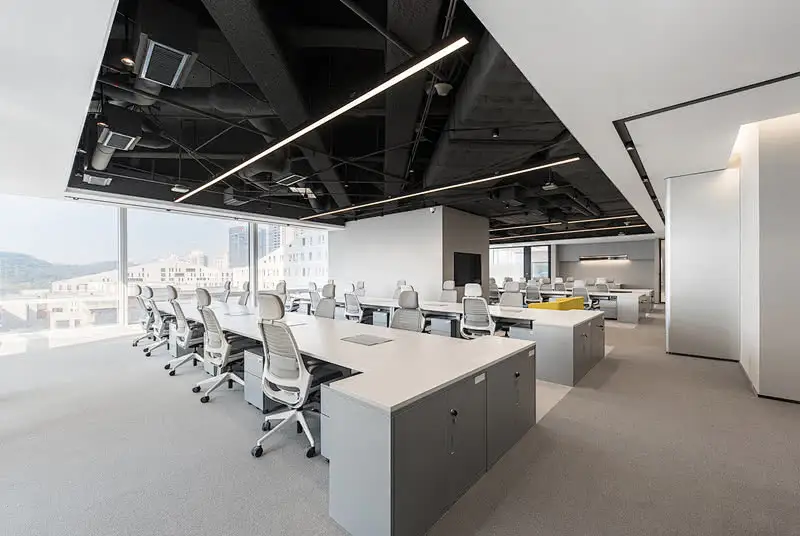
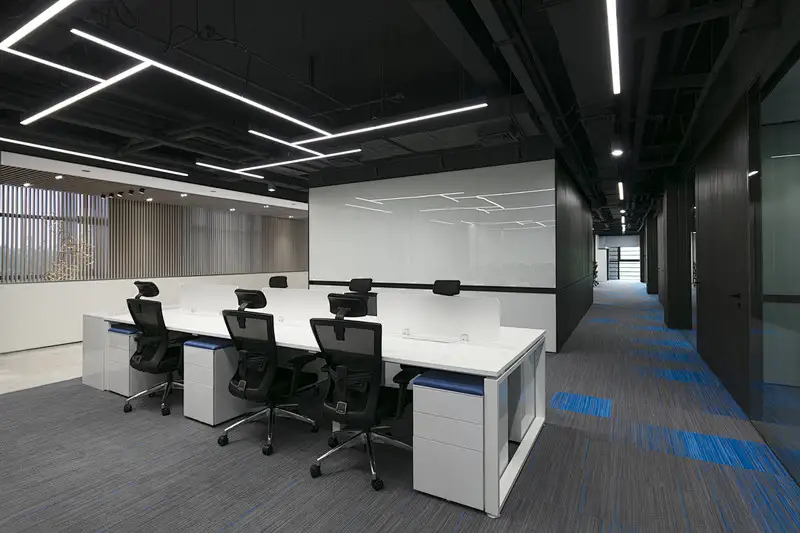
This office linear ceiling cob led strip project is written up from the MEP contractor’s site log, not a design brief, because the decisions that mattered were made on the floor. The job: a 1,400 m² open-plan refit for a professional-services tenant on the fifth floor of a converted mill in Manchester, UK. The ceiling is the building — exposed brick soffit, no void, nowhere to hide a fitting or a driver — and the outgoing T5 troffers were disliked for one nameable reason: glare on laptop screens.
The ask was a continuous indirect line washing the brick, 4000K, no visible fittings, no color drift between wings — pointing at a 24V COB LED strip platform, specified by run length rather than price.
Three Decisions Made on the Floor
Day 1 — What the Tape Measure Decided
Nothing was ordered until the floor was walked. One number set the platform: the longest uninterrupted run is 24.6 m west, 21.4 m east. No strip at any voltage feeds 24.6 m from one end, so injection was mandatory before voltage was discussed. Two options went up — 528 LEDs/m, four zones per wing, injection every 5 m; or 320 LEDs/m, fewer feeds, longer segments fed both ends.
The contractor took the denser option because of the brick, for reasons set out below. Density cuts both ways: 528 LEDs/m draws more current per meter, hence its 5 m injection interval rather than 8. Both were 24V — at the same watts per meter a 12V run loses roughly four times the percentage drop, so 24V does not remove injection, it halves it.
Day 4 — The Connector Argument
The electricians wanted to solder every joint — their default from commercial work. We pushed for clip-on connectors on speed (four minutes a soldered joint against forty seconds a clip) and serviceability: the tenant is already discussing glass meeting boxes, and a clipped zone splits without a hot-work permit. The compromise, now our template — solder at driver terminations, clips in line.
Day 12 — The End-of-Line Voltage Log
The electrician logged end-of-line voltage at all eight zones at full output against a 5% ceiling, measured from each injection point to the end of its segment. Range: 3.1% to 4.4%; east wing similar on Day 14. The log reads “no visible falloff mid-segment to end-of-segment, checked at eye level from the desk plane” — the test that counts, since a few percent reads as nothing, ten as a gradient.
Why Indirect Light Alone Cannot Be the Task Layer
The original scheme had the indirect line as the only light in the room — strip up, troffers out, done. On a brick soffit that does not work. Indirect light pays a reflectance tax first, and where plaster returns most of what hits it, exposed brick absorbs a large share on the first bounce. What arrives at the working plane is an ambient level, nothing near the 500 lx EN 12464-1 sets for office reading and screen work — and that standard governs this space, unlike a residential job, so the shortfall was a compliance gap.
What indirect COB is good at is the other half of that standard: it lights ceiling and walls, where the troffers gave almost nothing, with no direct view of a bright source — the glare complaint that started the project. So the strip stayed as the ambient and glare-control layer, and a tenant-procured task layer over the desks returned to the package.
What Actually Went Into the Ceiling
Approx. 320 meters across three references, every 4000K run on a single PO to hold one bin across the wings.
| Zone | Model | Spec | Approx. Length | Why this SKU |
|---|---|---|---|---|
| Long open-plan runs (west + east wings) | the 528 LEDs/m 24V reference | COB · 528 LEDs/m · 10 mm · 24V · IP20 · CRI 90 · 4000K | Approx. 220 m | The density an indirect bounce off dark brick needs; 24V only, suiting the long runs. |
| Breakout and meeting-room coves | the 320 LEDs/m 8mm reference | COB · 320 LEDs/m · 8 mm · 12V/24V · IP20 · CRI 90 · 4000K | Approx. 60 m | Segments under 5 m, and the 8 mm PCB seats in the narrow cove profile already routed. |
| Back-office valances (hidden emission) | ES-2835-60-8MM | SMD 2835 · 60 LEDs/m · 8 mm · 12V/24V · IP20 · CRI 80 · 4000K | Approx. 40 m | Behind an opaque baffle, so dotless emission buys nothing and CRI 80 costs nothing here. |
| Accessories | 24V constant-voltage drivers, contractor-supplied · aluminum profile · frosted PC diffuser · clip-on connectors in line, soldered terminations at driver ends | |||
One honest note: we did not supply the drivers. Each zone pulls several hundred watts, and our power-supply line is DC12V adapters topping out at 96 W — wrong shelf for this load and voltage. We specified the 24V drivers and their positions; the contractor sourced them, sized per the driver and power-supply guidance. With no ceiling void they went into the two service risers, the only spaces already on the maintenance access list. All zones are IP20 dry interior under IEC 60529 and the strip circuits sit in the SELV band of IEC 61140; the driver primaries do not, hence the riser door.
What a MEP Contractor Should Write Into the Next Tender
- Specify the injection interval, not just strip length. “24V COB, run continuous” invites an underquoted sub-bid.
- Ask what the soffit is made of before committing to indirect. Brick, dark timber and raw concrete absorb far more than plaster, and no density recovers that.
- Name who buys the drivers. Strip and driver suppliers are often different companies; unsaid, it lands on the electrician.
- Clips in line, solder only at terminations — and log end-of-line voltage at handover. A written 3.1%–4.4% record gets read.
Planning a similar office linear ceiling cob led strip package? Send us your ceiling plan and driver-access constraints and we’ll draft a zone-and-injection schedule against your run lengths, flagging where a task layer is needed.
About Senfey
Senfey is a Chinese LED strip manufacturer founded in 2010, running a Shenzhen factory of roughly 12,000 m² with monthly output above 250,000 meters. Our catalog covers COB, SMD, LED Neon Flex, addressable strips, controllers and power supplies. Browse Senfey’s COB LED strip catalog for 24V long-run references.