
Shenzhen LED Strip Factory · Commercial Projects
Commercial LED Lighting: Linear Strip Systems for Offices, Malls and Retail
Specified space by space — open-plan office, meeting room, mall circulation, shopfloor, display case and exterior canopy — with CRI, colour temperature, IP build and dimming protocol fixed per area instead of one strip bought for the whole building. Made in our own factory, supplied direct to developers, contractors and lighting designers.
- Spaces
- Office to facadesix zones, six specs
- Colour quality
- CRI 90+up to 97 for retail
- Voltage
- 12V / 24Vconstant voltage DC
- Builds
- IP20 · IP65 · IP67indoor, damp and exterior
Project realities
Why commercial LED lighting goes wrong on site
An office tower, a mall and a shopfloor are three lighting problems sharing one budget line. Most complaints we are asked to fix are not product failures but specification decisions made before anyone looked at the ceiling detail.
Ceiling lines that break at the joints
A commercial ceiling is read as one geometric line across a floorplate. Every reel end, driver break and profile join is a visible dark gap unless run lengths and feed points are set out on drawing.
Merchandise that looks wrong under the light
CRI 80 is adequate for circulation and back-of-house, and clearly not for garments, cosmetics, food or timber. Reds dull first, and retail returns follow a strip chosen on price per metre.
Long runs that fade toward the far end
Office and mall runs are measured in tens of metres, and a 12V strip pushed past its limit dims along its length. On the schedule it is correct; in the finished bay the last section is visibly weaker.
Dimming that fails at commissioning
Occupancy sensing, daylight linking and DALI scenes are decided by the driver, not the strip. A fitting that steps, flickers or cuts off at ten per cent fails a handover.
Output that drops in the second year
Commercial lighting runs twelve hours a day or longer. Over-driven strip in a sealed profile with nowhere to dump heat loses lumens and shifts colour before the warranty is up.
Load nobody costed over the lease
At that duty cycle, efficacy in lumens per watt and a commissioned dimming schedule matter more to the service charge than the fitting's capital cost. This is where a retrofit pays back.
Where a ceiling line breaks
- 1Cut to reel length, every joint is an unplanned dark point, and a long sightline shows all four.
- 2Set out to the structural grid, the same joints read as part of the ceiling, not as faults.
The pattern behind all six: one strip specification applied to an entire building. An open-plan office, a mall concourse, a display case and an external canopy have genuinely different requirements for colour rendering, density, IP build and control, and pricing them as one line item produces the problems above.
Space by space
LED strip lighting specified per commercial space
Six zones, six specifications. What changes is colour rendering, density, colour temperature, IP build and control protocol — and getting each right costs less than one building-wide compromise.
Open-plan office and workstations
Workplace lighting is governed by task illuminance and glare, not atmosphere. Continuous runs in ceiling coves, suspended profiles or slot details distribute evenly across a floorplate without the scalloping spotlights leave.
Neutral white reads as alert without going clinical, and the driver answers to the building management system — occupancy sensing and daylight linking are where the spec tightens. Detail is in the commercial office LED lighting guide.
Meeting rooms, boardrooms and video calls
A meeting room serves a presentation, a workshop and a camera, so it is scene-driven rather than set at one level. Tunable white runs the same room cooler for focused work, warmer for a client session.
Video conferencing is the forgotten constraint. Faces need soft, high-CRI light from the front, not a downlight overhead, and any flicker a camera can see shows on the call — making the driver's flicker performance a specification item.
Retail shopfloor, shelving and display
Retail is where colour rendering is directly commercial. Under CRI 80 a red garment reads brown and produce reads grey, so shelf edges, display cases and vitrines carry the highest specification in the building.
Fitting matters as much as spec: the strip must disappear into a shelf edge or joinery reveal and run cool enough not to affect stock in a closed case. Detail is in the retail store LED lighting guide.
Mall concourse, atrium and circulation
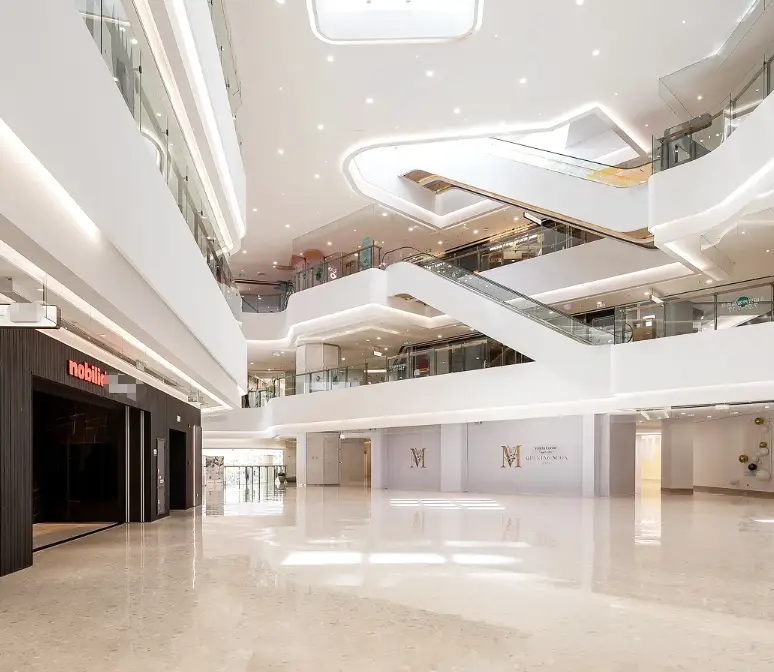
Mall lighting is architecture. Long geometric lines follow the balcony edge, void and soffit, read end to end across an atrium — so a break, an output shift or a mismatched section is obvious in a way it never is at a desk.
These are the longest runs on the project, which makes 24V, sectioned feeds and planned driver access non-negotiable. Options are in the commercial LED strip lights guide.
Mixed-use lobbies, cores and back-of-house
A mixed-use building runs one lobby for several tenants, so entrance, lift core and signage carry the brand while stairs, plant rooms and service corridors only have to be reliable and cheap.
Splitting the spec here recovers budget: high-CRI dotless strip where a visitor stands close to the light, plain SMD behind a deep cove or back-of-house. Shaped brand elements use LED neon flex, which holds a bend that strip in a channel cannot. Zoning options are in the commercial LED lighting solutions guide.
Exterior canopy, signage and entrance
Outside, the line of the building gets lit: canopy soffits, colonnades, parking structures and signage that must read from the road. Everything here is a weather product, and on a coastal site the connectors and end caps decide its life span.
Cable routes, gasketed junctions and driver enclosures must be resolved before the facade closes, and surge protection is worth budgeting on tall elevations. See the commercial outdoor LED strip lighting guide.
Technology selection
Matching the strip technology to each commercial space
Four technologies cover a commercial building, and viewing distance, colour rendering and exposure decide between them rather than price per metre. COB LED strip emits one continuous line with no visible dots, which is what an architectural ceiling run and a shelf edge both need. SMD LED strip is economical where the source sits deep behind a cove — cores, plant areas, back-of-house.
LED neon flex handles anything shaped or weather-exposed — canopy soffits, colonnades, signage, brand elements — because the silicone body is diffuser and seal in one part. Addressable LED strip has a narrow role here: only where one run must show different content along its length, such as a feature wall or a pop-up install. Expect lower output per watt and a commissioning line item for the content itself.
Voltage follows run length: 12V only for short local runs, 24V at floorplate or atrium scale so fewer feed points are needed. Efficacy and a commissioned dimming schedule move the operating cost over a lease.
Matched products from the catalogue
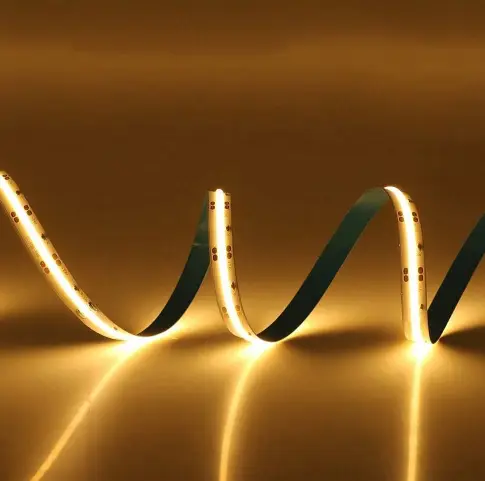
COB LED Strip 528LEDs/m 10mm 24V
COB-528-10MM-24V
The default for continuous architectural runs. Dotless at any cove depth, at 24V for long floorplate and atrium lines with fewer feed points.
- Density528 LEDs/m
- Width10 mm
- Voltage24V
- BuildCOB · IP20
COB LED Strip 480LEDs/m 8mm 24V Single Color
ES-COB-480-24V-8MM
Narrow enough to hide in a shelf edge, vitrine or reveal, with the colour rendering merchandise and food display need at close range.
- Density480 LEDs/m
- Width8 mm
- Voltage12V / 24V
- CRI · IP90 · IP20
SMD 2835 LED Strip 240LEDs/m 10mm
ES-2835-240-10MM
High output at a lower cost per metre for concealed coves, service corridors and stair cores where the source is never seen directly.
- Density240 LEDs/m
- Width10 mm
- Voltage12V / 24V
- ChipSMD 2835
PVC LED Neon Strip 6/8mm 120LEDs/m Outdoor
ES-NEON-SIGN-03
An IP67 body that bends and holds its shape, for canopy soffits, colonnades, outlines and lettering. No channel or on-site sealing work.
- Density120 LEDs/m
- Size6 / 8 mm
- Voltage12V
- IPIP67
Commercial projects
Commercial LED strip lighting projects already installed
Six installations across office, retail and mall work, each a different zone of the same problem. Locations as recorded in our project files.
Utrecht, NetherlandsOffice
Office cove lighting with dimmable 24V LED strip
Perimeter cove and ceiling slot runs across an open-plan floor, at 24V and dimmed on the building control system with daylight linking commissioned per zone.
Read the project
Graz, AustriaMeeting room
Conference room tunable white LED strip lighting
One room running cooler for focused work and warmer for client sessions on the same fittings, with a flicker-free driver so it holds up on camera.
Read the project
Freiburg, GermanyRetail
Retail shelf high CRI LED strip lighting
Shelf-edge and gondola lighting where colour accuracy decides whether stock looks like itself. Narrow high-CRI strip, concealed in the shelf profile.
Read the project
Nantes, FranceSupermarket
Supermarket refrigerated display LED strip lighting
Chilled cabinet lighting, where the strip must hold output at low ambient temperature and survive condensation in a sealed case.
Read the project
Poznań, PolandMall
Mall linear ceiling lighting with 24V LED strip
Concourse and balcony-edge lines read end to end across an atrium, sectioned at 24V and ordered on one batch so no join or output change shows.
Read the project
Cork, IrelandExterior
Commercial outdoor canopy LED strip lighting
Entrance canopy soffit on an exposed site, with sealed lengths, gasketed junctions and the driver enclosure resolved before the soffit closed.
Read the projectFurther installations are in the project case library. Adjacent scene types are covered by the hotel and hospitality lighting and architectural facade lighting pillars, which share the same long-run and exterior detailing.
Specification guide
Recommended specification by commercial space
A starting point for a schedule, not a substitute for a lighting design. Confirm illuminance against the applicable workplace standard, and the control protocol with whoever commissions the building management system, before ordering.
| Space | Recommended product | Voltage | IP | CRI | CCT | Detail |
|---|---|---|---|---|---|---|
| Open-plan office, workstations | 24V COB or SMD strip in low-glare aluminium profile, DALI or 0–10V driver | 24V | IP20 | 90 | 3500–4000K | COB LED strip width guide |
| Meeting and boardrooms | Tunable white COB strip, flicker-free driver, scene control at the room | 24V | IP20 | 90 | 2700–6500K | dimmable COB LED strip |
| Retail shopfloor, shelving, display | Narrow dotless COB strip, 8 mm or less, sealed build in chilled cases | 24V | IP20 / IP65 | 90–97 | 3000–4000K | high CRI COB LED strip |
| Mall concourse, atrium, circulation | 24V COB strip in continuous profile, sectioned runs on one batch | 24V | IP20 | 80–90 | 3000–4000K | 12V and 24V LED strip lights |
| Exterior canopy, signage, parking | IP67 sealed strip or neon flex, gasketed junctions, weatherproof driver | 24V | IP67 | 80–90 | 3000K | waterproof outdoor LED neon flex |
Scroll the table sideways on narrow screens to see every column.
Split the CRI, not the whole building
CRI 90 and above where a person or product is close to the light — desks, shelves, display cases. CRI 80 is adequate in cores, plant rooms and deep coves, and that split is where the budget is recovered.
The driver decides the control
The strip does not dim; the driver and protocol do. Fix DALI, 0–10V, DMX or the building management interface alongside the strip, and confirm smooth performance at the lowest level the scenes use.
Order a floorplate in one batch
Colour consistency across a continuous ceiling line depends on the LEDs coming from one production run. Splitting a phased fit-out across purchases months apart is the most common cause of visible variation between bays.
Procurement and factory support
Buying commercial LED strip from the factory direct
Senfey manufactures in Shenzhen and supplies developers, fit-out contractors, designers and distributors rather than retail. Because the strip is made here, a question about batch consistency or a sealed build is answered by the people running the line.
- Send the drawings, or just the zone list
- Floor areas, run lengths, wet or chilled zones and exterior scope are enough to start. A reflected ceiling plan lets us comment on profile depth and driver position.
- Samples judged in the actual finish
- Neutral white on plasterboard reads differently than on timber or dark stone. Request sample lengths in the temperatures under consideration and view them on the real finish.
- Confirm the control protocol early
- DALI, 0–10V, DMX or a building management interface changes the driver, and sometimes the strip. Naming it early avoids a swap at commissioning.
- One specification per zone, one batch per floorplate
- Once the schedule is fixed, the project is produced against one specification per zone so bays and floors match. Tell us the phasing if handover is staged.
- Certification for the destination market
- Confirm which certification the project requires and for which components, drivers included — at enquiry, not at shipping.
- OEM, ODM and four technologies in one supply chain
- Cut-to-length runs, custom CRI and colour temperature combinations, IP65 and IP67 builds, connector and lead configurations, private labelling. COB, SMD, neon flex and pixel strip are all made in house, so a mixed specification does not become four suppliers. Background is on the about Senfey page.
Request a commercial project quote
Send the zones, areas and control system, and the reply names a strip, driver and IP build per space rather than one price per metre.
Prefer email or a message app? Use our contact page.
FAQ
Commercial LED lighting questions from project buyers
The questions that come up most often during specification and tender.
Which colour temperature suits an office or a mall?
3500K to 4000K for workplaces, where neutral white reads as alert without going clinical, and 3000K to 4000K in malls and lobbies depending on the finishes.
Consistency matters more than the figure. Hold one temperature along any continuous ceiling line, and change it only at a deliberate boundary.
What CRI does a commercial project actually need?
Split it by zone. CRI 90 and above where a person or product is close to the light — desks, meeting rooms, shelf edges, display cases, food counters — since under CRI 80 reds dull and produce greys.
CRI 80 is adequate in cores, plant rooms and deep coves, and that split recovers the budget. See high CRI COB LED strip for the retail end.
COB or SMD strip for a commercial building?
Decide by viewing distance. Where the light is seen close up — a shallow ceiling slot, a shelf edge, a reception reveal — COB LED strip shows no dots and earns its cost per metre.
Where the source sits deep behind a cove or diffuser, SMD does the same job for less. Using both, zone by zone, costs less than either alone.
How long can a continuous run be on one supply?
Less than most schedules assume. Voltage drop makes the far end dim and drift, and a 24V design carries roughly twice as far as the same strip at 12V before it shows.
Long office and mall runs are therefore sectioned and fed separately, with driver access planned while the ceiling is open. See the commercial LED strip lights guide.
Can LED strip work on DALI and a building management system?
Yes — the capability sits in the driver, not in the tape. Fix the protocol — DALI, 0–10V, DMX or the building management interface — alongside the strip, and confirm it dims smoothly to the lowest scene level.
The low end is where cheap drivers fail: visible steps, flicker on camera, or a cut-off at ten per cent instead of a fade. That fails a handover, not just an eye test.
What IP rating do exterior and chilled areas need?
IP65 for splash and condensation zones such as a refrigerated case, IP67 where there is direct weather or washdown — canopy soffits, colonnades, parking structures.
Sealing happens on the production line, so the rating has to be on the order, not added later. The strip is rarely the failure; joints, end caps and driver location are, and all three are decided on site. See the commercial outdoor LED strip lighting guide.
Is a lighting retrofit worth doing on an occupied building?
Where lighting runs twelve hours a day or longer — offices, malls, exterior — operating cost outweighs capital cost, so efficacy and a commissioned dimming schedule are what pay back.
Retrofit also has to survive occupancy, so sectioned runs and accessible drivers matter more than in new build. See the commercial LED lighting solutions guide.
Do you supply developers, contractors and retail rollouts directly?
Yes. We manufacture in Shenzhen and supply developers, designers, contractors and distributors, including OEM and private-label work for multi-site rollouts.
Raise certification for the destination market in the enquiry, since it can affect the driver. Send the zone list through the project enquiry form for a specification per space rather than one price per metre.
Not covered here? Questions that need drawings — profile depth, target illuminance, control topology, phasing — are quicker to answer against the plan. Send it over and the reply names a strip, driver and IP build per zone.
Request a quote