Where a Yacht Actually Needs Waterproofing — and Where It Doesn’t
This yacht led strip waterproof cob project covers the interior lighting refit of a mid-size motor yacht refurbished at a shipyard cluster near Genoa, Italy. The saloon, master and VIP cabins, galley and deck-house were originally lit with a mix of 12V IP20 SMD tape and halogen downlights. During annual service the marine interior contractor found soft solder joints, tarnished copper pads and two hotspots inside the saloon cove — enough to justify a full re-strip.
The contractor’s opening brief asked for an IP67 strip in every zone. We pushed back on three of the four. A yacht interior is not wet in the pool-and-shower sense: the saloon, cabins and galley coves all sit inside closed joinery within an air-conditioned envelope, and a sealed jacket there buys nothing while costing lumen output and bend radius. What those zones actually needed was to be kept out of the condensation path — not a higher IP number. Only the semi-open deck-house perimeter, which does see occasional wash-down spray, got a genuinely waterproof product. Approx. 180 meters were supplied in total, and the reasoning behind the split is the same one we set out in our waterproof COB LED strip guidance.
How the Loops Were Split Across the Hull
Because the hull is metallic and cabin lengths vary between 3 m and 8 m, the layout was drawn as short loops rather than one continuous run. Each interior loop starts at a constant-voltage driver housed inside a ventilated locker, feeds tinned-copper injection cable through existing conduit, and terminates at quick connectors at both ends of every section. Injection points were placed at Approx. 4.5 m intervals — measured on-site, not taken from a datasheet — so end-to-end voltage drop stayed under 5% at full load.
One constraint shaped the wiring more than anything else: the interior zones run 24V, but the IP67 neon reference used on the deck-house is a 12V product. That zone therefore got its own 12V driver and shorter feed segments rather than being forced onto the 24V bus. It is an inconvenience worth accepting — mixing a 12V product onto a 24V line is the kind of shortcut that fails six months later. Both supplies sit in the SELV band, keeping the installation inside the protective-measure class described in IEC 61140 rather than the higher-risk category a 230V AC run would fall into on a floating hull.
The joinery team pre-milled 12 mm-wide aluminum profile channels into the teak veneer before the marine electrician ran cabling, and we reviewed a 1 m mock-up section with the owner for white-bin approval before scaling to the full run.
Four Zones, Two Protection Classes
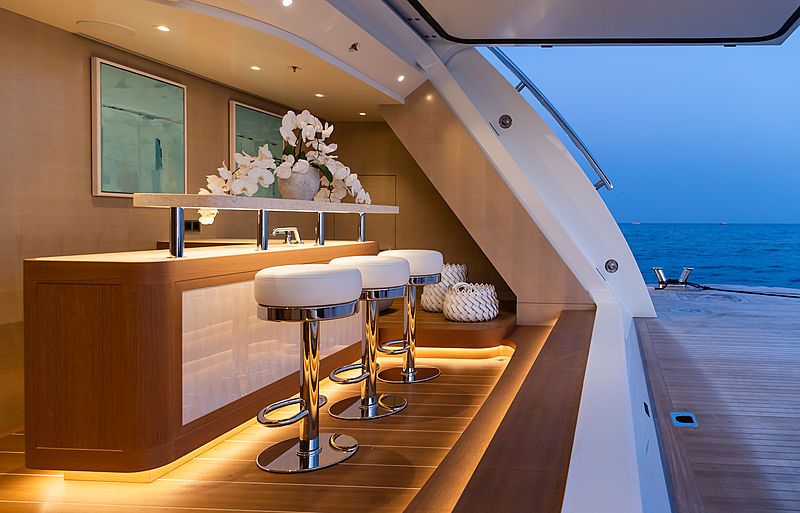
Three interior zones use IP20 COB at CRI 90; the exposed zone uses IP67 neon at CRI 80. Color temperature was tuned per zone rather than forced onto one bin.
| Zone | Model | Spec | Approx. Length | Why this spec |
|---|---|---|---|---|
| Saloon indirect cove & bulkhead wash | the 480 LEDs/m 8mm reference | COB · 480 LEDs/m · 8 mm · 12V/24V · IP20 · CRI 90 · 3000K | Approx. 55 m | Dotless emission at close viewing angle; mounted on the inboard joinery face, clear of the cold hull boundary where condensation forms. |
| Master + VIP cabin cove | ES-COB-320-8MM-12V | COB · 320 LEDs/m · 8 mm · 12V/24V · IP20 · CRI 90 · 2700K | Approx. 45 m | Warmer bin for teak and textile finishes; 320 LEDs/m keeps heat low in short enclosed segments. |
| Galley + corridor | ES-COB-528-10MM-24V | COB · 528 LEDs/m · 10 mm · 24V · IP20 · CRI 90 · 4000K | Approx. 40 m | Neutral white for food-prep clarity; the 10 mm PCB tolerates repeated 24V injection cleanly along the corridor. |
| Deck-house / semi-open indirect | the IP67 neon reference we specified instead | PVC LED Neon Strip · 120 LEDs/m · 6/8 mm · 12V · IP67 · CRI 80 | Approx. 40 m | The only zone with real spray exposure. A one-piece extruded jacket has no seams to fail, which matters more here than the CRI 90 the interior zones get. |
| Accessories | 12V and 24V constant-voltage drivers · tinned-copper injection cable · marine aluminum profile · frosted PC diffuser · sealed quick connectors | |||
A note on the IP numbers, because marine specifications get this wrong often: IP67 describes temporary immersion, while wash-down spray is an IPX5/IPX6 jetting condition — different test axes under IEC 60529. IP67 covers the deck-house comfortably. IP68, which the original brief asked for, describes continuous submersion and has no bearing on a cove above the waterline. The three CRI 90 interior zones share one white bin, drawn from the 24V lineup, so the saloon-to-cabin transition reads as a warmth shift rather than a quality drop — the practical side of the color-consistency work published by CIE.
Two Failure Modes We Had to Design Out
Two problems dominated the first hull survey and shaped every downstream decision.
| # | Failure mode observed | How we designed it out |
|---|---|---|
| 1 | Condensation trapped behind the previous profile caused pad tarnish and intermittent flicker in the saloon cove after roughly 14 months at sea. The strip had been fixed directly to the cold hull-side face of the cove. | Relocated the run to the inboard joinery face with a 6 mm vapor gap and drainage relief every 1.5 m, so warm cabin air never condenses on the PCB. No IP change was needed — the moisture path was the fault, not the strip’s rating. |
| 2 | Two long cabin runs (about 6.8 m each) showed visible dimming at the far end under the original 12V feed. | Re-drawn on 24V with mid-run injection; measured end-of-line drop under 5% at full brightness across every interior loop. |
Both fixes were decided at design time rather than patched during commissioning — which is the only reason the deck-house zone was caught as a genuine IP case while the other three were not.
If You’re Speccing a Similar Yacht Interior
- Set an IP floor per zone, not per boat. Paying for a sealed jacket inside dry joinery is wasted budget; fix the condensation path instead.
- Trace where moisture actually forms. On a metal hull that is the cold outboard face. Mount inboard, leave a vapor gap, and an IP20 strip will outlast a sealed one installed badly.
- Don’t mix voltages on one bus. If the waterproof reference for your exposed zone is 12V, give it a dedicated driver.
- Accept CRI 80 where nobody compares color. A deck-house perimeter is decorative; save the CRI 90 budget for the saloon and cabins.
Ready to spec a yacht led strip waterproof cob package that puts the sealed product only where it earns its cost? Request a marine lighting quotation and we’ll mark up your GA drawings zone by zone.
About Senfey
Senfey is a Chinese LED strip manufacturer founded in 2010, running a Shenzhen factory of roughly 12,000 m² with a monthly output above 250,000 meters. Our catalog covers COB, SMD, LED Neon Flex, addressable strips, controllers and power supplies. Browse Senfey’s COB LED strip catalog for the full pillar range.
Why a Yacht Refit Needs More Than IP20 Cove Tape
This yacht led strip waterproof cob project covers the interior lighting refit of a mid-size motor yacht refurbished at a shipyard cluster near Genoa, Italy. The saloon, master and VIP cabins, galley and deck-house were originally lit with a mix of 12V IP20 SMD tape and halogen downlights. During annual service the marine interior contractor found soft joints, tarnished copper pads and two hotspots inside the saloon cove — enough to justify a full re-strip with a 24V waterproof COB strip system across every wet-adjacent zone.
Yacht interiors are not “wet” in the pool-and-shower sense, but almost every cove sits inside 60–80% RH, condensation cycles and occasional wash-down spray along the deck-house perimeter. The refit brief asked for IP67 as a baseline, IP68 where spray is realistic, CRI 90 warm-to-neutral white and a marine-safe 24V SELV supply. Approx. 180 meters of waterproof COB LED strip were supplied across four zones.
How the 24V Loop Was Split Across the Hull
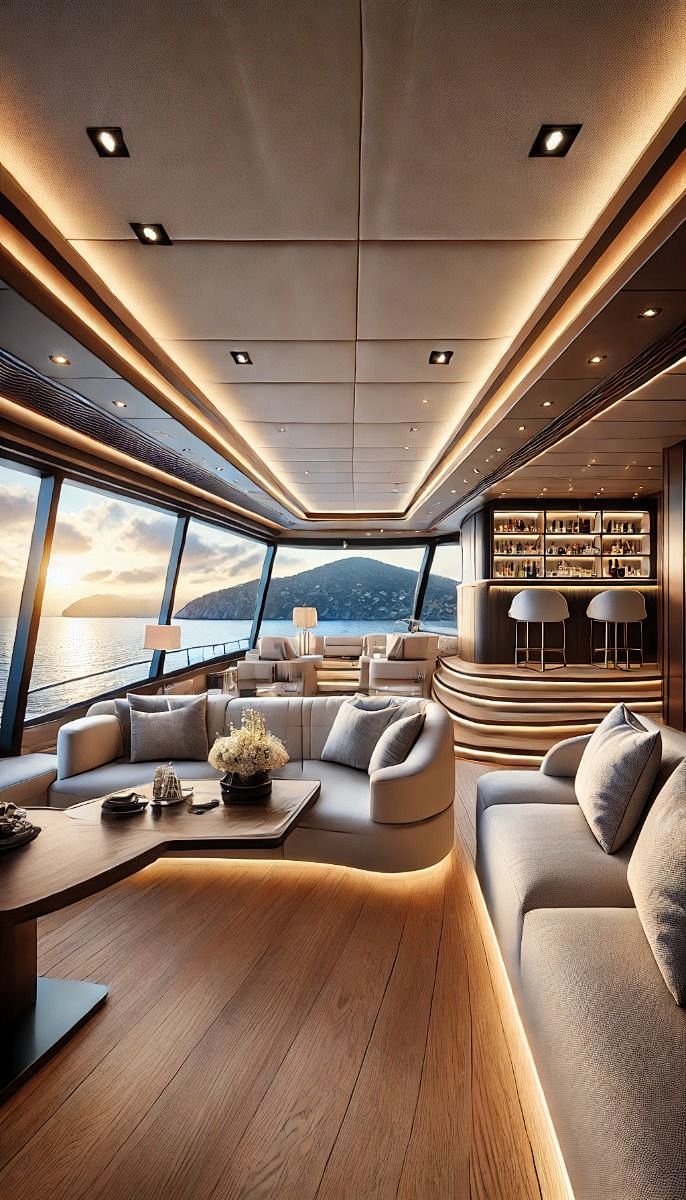
Because the hull is metallic and cabin lengths vary between 3 m and 8 m, the layout was drawn as short 24V loops rather than one continuous run. Each loop starts at a marine-grade constant-voltage driver housed inside a ventilated locker, feeds tinned-copper injection cables through the existing conduit, and terminates at IP67 quick connectors at both ends of every strip section. Injection points were placed at approx. 4.5 m intervals — measured on-site, not from a datasheet — so that end-to-end voltage drop stayed under 5% at full load.
The joinery team pre-milled 12 mm-wide aluminum profile channels into the teak veneer before the marine electrician ran cabling, and Senfey engineers reviewed a 1 m mock-up section with the owner for color-temperature bin approval before scaling to the full run. SELV 24V (per IEC 61140) also removes the shock-risk category a 230V AC solution would trigger on a floating hull — which mattered when the electrician handed the system back to the yard’s classification surveyor.
Products Used
Four zone specifications share the same core — 24V waterproof COB, CRI 90, dotless emission, and IP protection rated to the IP Code. Color temperature was tuned per zone rather than forced onto one bin.
| Zone | Spec | Approx. Length | Why this spec |
|---|---|---|---|
| Saloon indirect cove & bulkhead wash | 24V waterproof COB · IP67 · CRI 90 · 480 LEDs/m · 3000K | Approx. 55 m | Dotless emission at close viewing angle; IP67 handles condensation at the hull-to-headliner boundary. |
| Master + VIP cabin cove | 24V waterproof COB · IP67 · CRI 90 · 320 LEDs/m · 2700K | Approx. 45 m | Warm bin for teak and textile finishes; 320 LEDs/m keeps heat low in short enclosed segments. |
| Galley + corridor | 24V waterproof COB · IP67 · CRI 90 · 480 LEDs/m · 4000K | Approx. 40 m | Neutral white for food-prep clarity; a sealed jacket wipes clean of oil and salt residue. |
| Deck-house / semi-open indirect | 24V waterproof COB · IP68 · CRI 90 · 480 LEDs/m · 3000K | Approx. 40 m | Occasional wash-down spray requires IP68 protection per IEC 60529. |
| Accessories | Marine-grade 24V constant-voltage LED driver + tinned-copper injection cable + marine aluminum profile + frosted PC diffuser + IP67 quick connectors | — | Hidden supply, glare control, and serviceable termination. |
The two 480 LEDs/m variants come from the 24V lineup at CRI 90 dotless bins; marine electricians can cross-check every zone against our full product index before the yard issues the PO.
Two Failure Modes We Had to Design Out
Two problems dominated the first hull survey and shaped every downstream decision on this waterproof COB strip system.
| # | Failure mode observed | How we designed it out |
|---|---|---|
| 1 | Condensation trapped inside the previous IP20 profile caused pad tarnish and intermittent flicker in the saloon cove after roughly 14 months at sea. | Switched to a fully potted IP67 COB with tinned-copper pads, mounted in a marine aluminum profile with drainage relief every 1.5 m. |
| 2 | Two long cabin runs (about 6.8 m each) showed visible dimming at the far end under the original 12V feed. | Re-drawn on 24V with mid-run power injection; measured end-of-line drop < 5% at full brightness across every loop. See our high-CRI range for the CRI 90 bin used here. |
Both fixes are standard practice for a 24V waterproof COB installation on a floating structure — the point is that they were decided at design time, not patched during commissioning.
If You’re Speccing a Similar Yacht Interior
For anyone speccing yacht interior COB lighting on a similar refit, four points sit at the top of our checklist:
- Set an IP floor per zone, not per boat. IP67 is enough for dry-adjacent coves; only push to IP68 where wash-down spray is realistic.
- Split loops by cabin length. Anything over 5 m gets 24V with mid-run injection; short cabin coves can stay on a single feed.
- Pick color temperature per function. 2700K for owner spaces, 3000K for saloons, 4000K where the galley needs task clarity — one CRI 90 platform, three bins.
- Terminate with marine-grade hardware. Tinned copper, IP67 quick connectors and drainage-relieved profiles are what actually survive an annual salt cycle.
Ready to spec a similar yacht led strip waterproof cob package for your next refit? Request a marine lighting quotation and we’ll draft the zone-by-zone COB list against your GA drawings.
About Senfey
Senfey is a Chinese LED strip manufacturer founded in 2010, operating a Shenzhen factory of roughly 12,000 m² with a monthly output above 250,000 meters. We specialise in COB, SMD, LED Neon Flex, addressable strips, controllers and marine-grade power supplies. Explore Senfey’s COB LED strip catalog for the full pillar range.