The House and the One Hard Rule
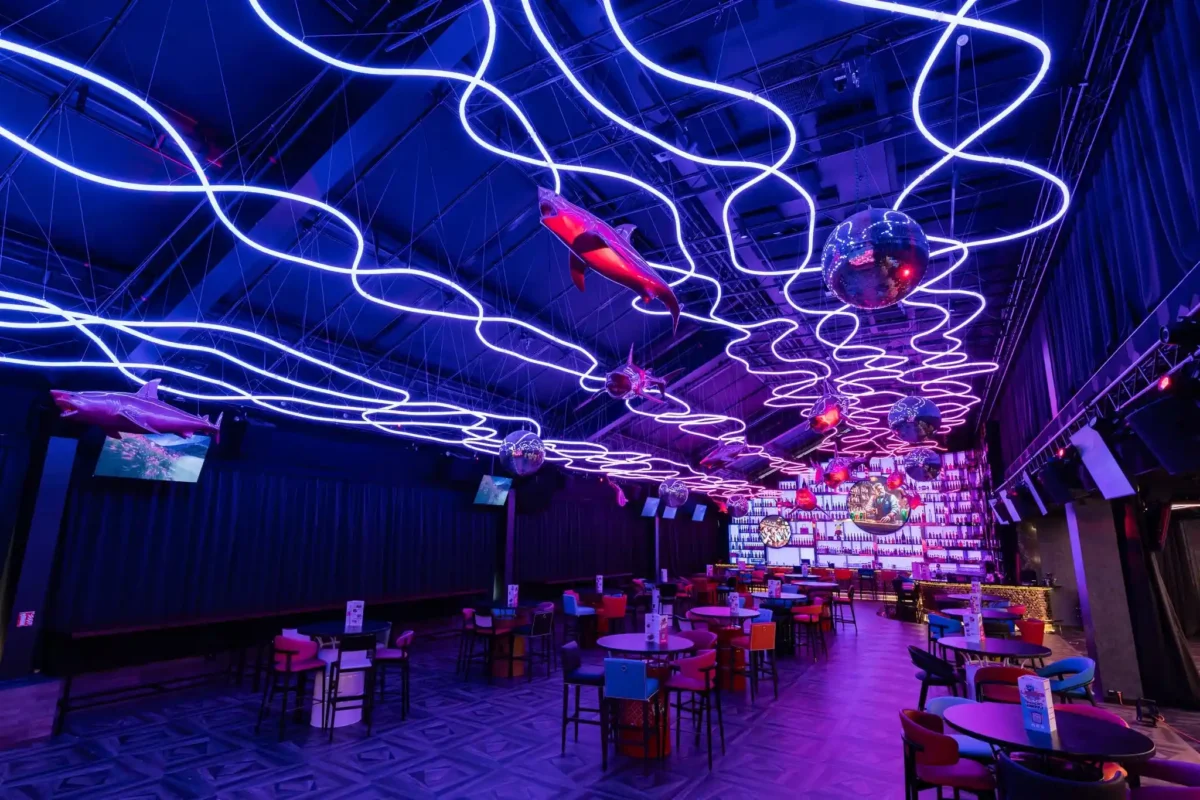
This smart home addressable LED strip lighting project covers a 260 m² private villa in Braga, Portugal — media room, gaming room and a first-floor lounge. The owner already ran KNX for HVAC and blinds, and the ask was to make the pixel layer speak the same language: scenes triggered from the existing wall panels, never a phone app. Approx. 68 meters of addressable strip went in, sitting inside our broader smart home LED strip range.
On paper this looks like “buy strip, buy controller, done”. In practice it is a four-layer stack with a different failure mode at each level. The interface stayed as-is — one KNX 4-button glass panel per room, nothing new on the wall. Scenes live in the KNX server; pixel show files live on the controller, one SP110E per room holding 8 pre-loaded shows, with Bluetooth used only for on-site programming.
Products Used
| Zone | SKU | Specs | Approx. Use |
|---|---|---|---|
| Lounge ceiling reveal (dotless) | ES-COB-576-10MM-RGBIC | RGB IC Addressable COB, 576 LEDs/m, 12V/24V, 10 mm, CRI 90, IP20 | 18 m |
| Media room bias-light + cove | ES-WS2811-60-12V | Addressable RGB, 60 LEDs/m, 12V, 10 mm, CRI 80, IP20 | 26 m |
| Gaming room accent bars | ES-WS2812B-60-5V | Addressable RGB, 60 LEDs/m, 5V, 10 mm, CRI 80, IP20 | 14 m |
| Corridor sync tail | ES-WS2811-60-12V | Same SKU as media room, chained on the same clock | 10 m |
| Control | SP110E ×3 | Bluetooth pixel controller, 5V–24V, IP20 | 3 units |
The RGB IC COB line earns the lounge reveal because the owner’s sightline sits Approx. 0.7 m below it — individual pixels would be obvious from the sofa, and dotless RGBIC gives per-pixel control without showing the diodes. The 12V WS2811 covers the longer media and corridor runs where voltage drop dominates. The 5V WS2812B appears only on the gaming bars, all under 3 m, because 5V loses headroom fast with distance; each 5V zone runs from its own supply, never the 12V rail.
One Day in the House, on the Same Four Buttons
The owner presses a button, the KNX server picks the scene, and a gateway forwards the scene index — not raw pixel data — to that controller. Button 1 ramps the lounge cove to soft white around 3000K, no colour pixels active. Button 2 drops the media room to Approx. 2% output with a neutral bias-light behind the screen. Button 3 plays a saved chase in the gaming room, swappable over the LAN. Button 4 syncs all three rooms to one clock, so the corridor reads as one scene.
That gateway choice is the whole reliability story. Streaming live pixel data drops frames the moment Wi-Fi gets busy; sending one scene index and letting each controller play locally survives any router hiccup. On this kind of job the home automation layer decides whether smart home addressable LED strip lighting still works in year three.
Three Boring Decisions That Made It Reliable
Nothing glamorous keeps a system alive to year three. First, power injection every 5 m on the 12V WS2811 runs: measured RGB deviation after injection was Approx. 2.8%, where before it the corridor tail turned visibly pink at full white. Second, a common-anode check on the diagram before a single metre was cut — RGBIC COB and WS2811 share the +12V rail here, and getting that wrong is the most common reason pixel strip fails.
All circuits are SELV low-voltage per IEC 61140, and the sync clock follows the DMX512-A framework in ANSI E1.11 so a future DMX overlay bridges in without re-pulling data. The bias-light zone was checked against IEC 62471, since that strip faces a seated viewer for hours. Wiring detail sits in our addressable strip controller guide.
What We Actually Handed Over
- Total pixels mapped across three rooms: Approx. 3,120.
- Latency from KNX button press to first pixel change: Approx. 180 ms.
- RGB deviation end-to-end after injection: Approx. 2.8%.
- Scene files stored locally: 8 per room, no cloud dependency.
- Commissioning rounds with the KNX integrator: 3, mostly re-mapping scene numbers onto the SP110E playlist order. The integrator asked us to lock that order before final panel labelling, which saved relabelling three panels.
- Owner training on the wall panels: 15 minutes, because nothing on the panels changed physically.
Four Notes if You’re Specifying a Similar Villa
- Send scene indexes over the network, not live pixel data. Local playback beats streaming.
- Pick chipset by run length: 12V WS2811 above 4 m, 5V WS2812B below 3 m, dotless RGBIC COB anywhere seated eyes can see the source.
- Verify common-anode versus common-cathode on paper, and keep each voltage domain on its own supply, before cutting strip.
- Keep smart home addressable LED strip lighting on the wall panels the household already uses. People drop phones; they do not drop wall panels.
Senfey supplies smart home addressable LED strip lighting as one kit — strip, controller, driver, aluminium channel and pre-terminated leads, with the pixel map ready for your automation vendor. Send your room plan and wall-panel type through the Senfey contact form for a per-room controller layout with scene indexes assigned.
Senfey is a Chinese LED strip manufacturer based in Shenzhen, producing COB, SMD, addressable and LED Neon Flex strip alongside controllers and power supplies. Our monthly output runs to hundreds of thousands of meters for integrators and designers delivering smart residential development lighting projects.