The Brief, on One Page
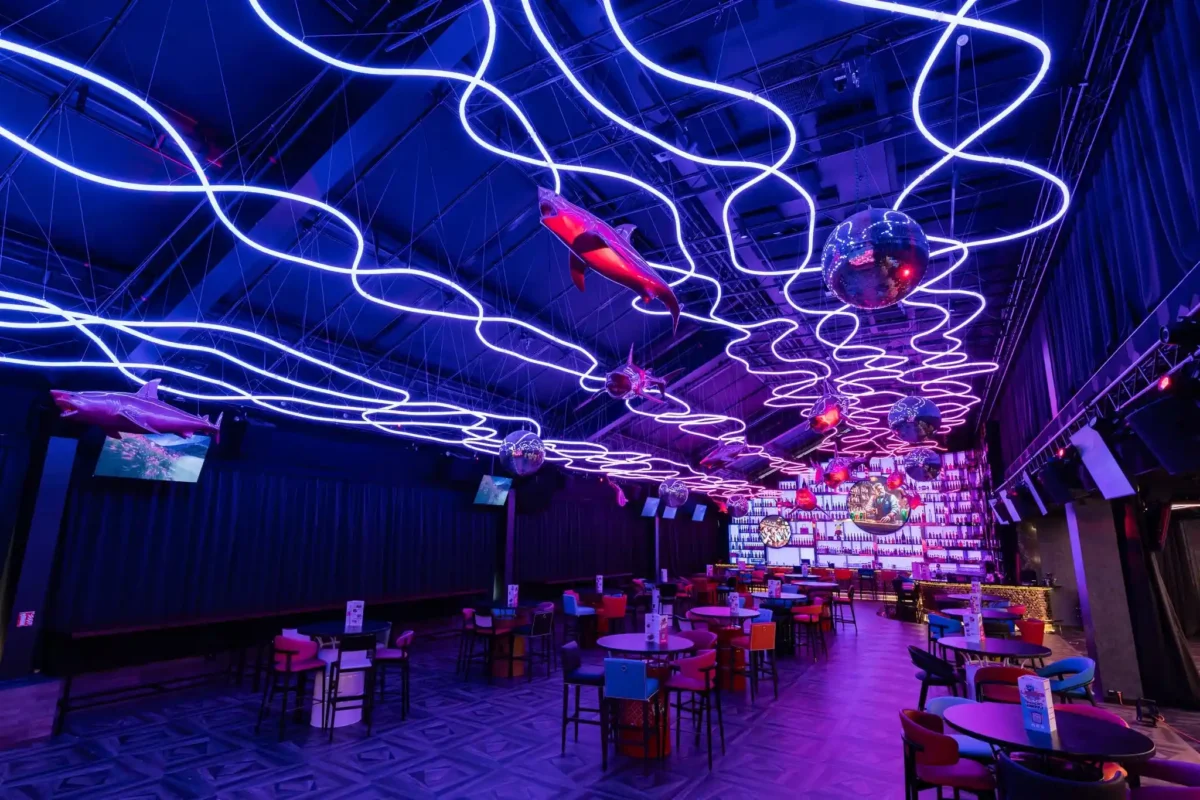
A 220 m² basement nightclub in Verona, Italy. Two dance floors, one DJ booth. The ask was a pixel-mapped ceiling, a haloed booth and a corridor pulsing on the same beat clock, all re-patchable by the venue’s own sound engineer in a single night. This nightclub addressable LED strip lighting job sits inside our broader club LED lighting work. Budget mattered; retrofit-safe wiring mattered more.
Why Two Addressable Protocols, Not One
Most nightclub addressable LED strip lighting projects pick a single chipset and live with the compromise. Here we mixed two on purpose:
- WS2811 at 12V on every run over 4 m. The 12V rail chains further before voltage drop turns tail pixels pink, which suits the ceiling grid.
- WS2812B at 5V only on short accent bars under 3 m at the booth. Finer pixel pitch, but 5V is unforgiving over distance, so each bar runs from its own 5V supply and never touches the 12V rail.
Both are single-wire TTL data at roughly 800 kbit/s, so one addressable LED strip controller family covers the whole venue without a protocol converter. Show timing was built to the DMX512-A framework in ANSI E1.11, so when the venue later adds a DMX desk the cue list bridges in without re-pulling data.
Products Used
| Zone | SKU | Specs | Approx. Use |
|---|---|---|---|
| Ceiling pixel grid | ES-WS2811-60-12V | Addressable RGB, 60 LEDs/m, 12V, 10 mm, CRI 80, IP20 | 84 m |
| DJ booth halo | ES-COB-720-12MM-RGBIC | RGB IC Addressable COB, 720 LEDs/m, 12V/24V, 12 mm, CRI 90, IP20 | 18 m |
| Booth accent bars | ES-WS2812B-60-5V | Addressable RGB, 60 LEDs/m, 5V, 10 mm, CRI 80, IP20 | 12 m |
| Control | SP110E ×3 | Bluetooth pixel controller, 5V–24V, IP20, one per zone | 3 units |
The 720 LEDs/m RGBIC COB earned the DJ booth because guests stand within Approx. 0.4 m of it, where a discrete pixel strip looks like a row of diodes; dotless COB gives the same per-pixel show with nothing visible to stare at. The ceiling grid stayed on the WS2811 12V line because at ceiling height a discrete pixel look is the point. Three controllers rather than one is deliberate: each zone keeps its own data line and pixel map, so a fault on the accent bars cannot take the ceiling down mid-set, and the engineer can re-patch one zone without reloading the others.
Power Injection: Where the Project Almost Went Wrong
The first draft fed 84 m of WS2811 from one end. On paper the driver coped. In practice the tail shifted from full white to warm pink at Approx. 60% brightness — a textbook 12V rail drop:
- Segmented the 84 m into 6 sub-runs of 14 m.
- Dropped an injection tap every 7 m on 1.5 mm² parallel feeders back to the common bus.
- Re-measured: full white held within Approx. 3% RGB deviation end-to-end.
All secondary circuits are 12V or 5V SELV low-voltage per IEC 61140, with the 5V accent bars on separate supplies from the 12V zones. Because guests can reach the booth halo, exposure was verified as Risk Group 0 under IEC 62471 at standing distance.
The Handover, in Numbers
- Pixels mapped across three zones: Approx. 3,480. The ceiling grid is 60 LEDs/m but groups three LEDs per driver IC, so it addresses Approx. 20 pixels/m, not 60 — worth checking before anyone quotes a pixel count off strip density alone.
- PWM refresh measured at the tail: Approx. 400 Hz.
- Scene presets pre-loaded per controller: 8, keyed to house genres, stored locally with no network dependency.
- Temperature during a full 4-hour show: Approx. 32 °C at ceiling level, Approx. 44 °C on the strip case.
- Coordination rounds with the AV integrator: 3, mostly re-timing the pixel show to a dedicated beat clock rather than the club’s audio output, which drifted whenever the DJ changed decks.
Four Things Worth Copying on a Similar Club
- Do not run WS2812B beyond 3 m at 5V. You will spend the budget chasing colour drift.
- Inject power every 5–8 m on any 12V WS2811 run, even when the driver says it is fine on paper.
- Use a dotless RGBIC COB anywhere guests get within 0.5 m of the source. The show reads better and the strip stays invisible.
- Split nightclub addressable LED strip lighting across one controller per zone, and pre-programme scenes on site with the venue’s sound engineer. One evening in the room saves a month of tickets after opening.
Senfey ships nightclub addressable LED strip lighting as one kit — pixel strip, controllers, drivers, aluminum channel and pre-tinned data leads, with the pixel map ready for your AV vendor. Send your ceiling plan and booth outline through the Senfey contact form and we will return a wiring layout with injection points already marked.
Senfey is a Chinese LED strip manufacturer based in Shenzhen, producing COB, SMD, addressable LED strip and LED Neon Flex alongside controllers and power supplies. Our monthly output runs to hundreds of thousands of meters for integrators delivering entertainment venue lighting projects.