A Townhouse Staircase and Three Disagreements
Every stair handrail cob led strip lighting project we quote ends in the same argument: the designer wants the visual result, the contractor wants something that still works after five years of shoes, solvents and grandchildren on the balustrade. This one is a three-storey refurb in Ghent, Belgium — curved timber-and-steel stair, brass handrail, 42 steps to the loft — and three disagreements decided the spec.
The brief asked for a continuous glow along the handrail plus a soft wash under each tread nose, CRI 90 warm white. Channel fit drove the platform, so this started at the thin COB LED strip width guide, not at a wattage.
Where the Handrail Curve Broke the First Spec
The stair turns twice on itself, tightest curve roughly 180 mm inner radius in plan, and the designer wanted one unbroken ribbon through both. The first spec put the channel on the underside of the rail, and that is where it failed — not on the radius, on the direction of the bend.
A flexible COB strip bends in one axis only: it curls toward or away from its emitting face, the way a tape measure rolls. Ask it to curve sideways, in the plane of its own PCB, and it buckles and the copper cracks. A handrail on a curved stair turns in plan, so a strip lying face-down under it is asked for exactly that edgewise bend. Strips built for it exist on S-shape PCBs; we do not make one, and said so before quoting.
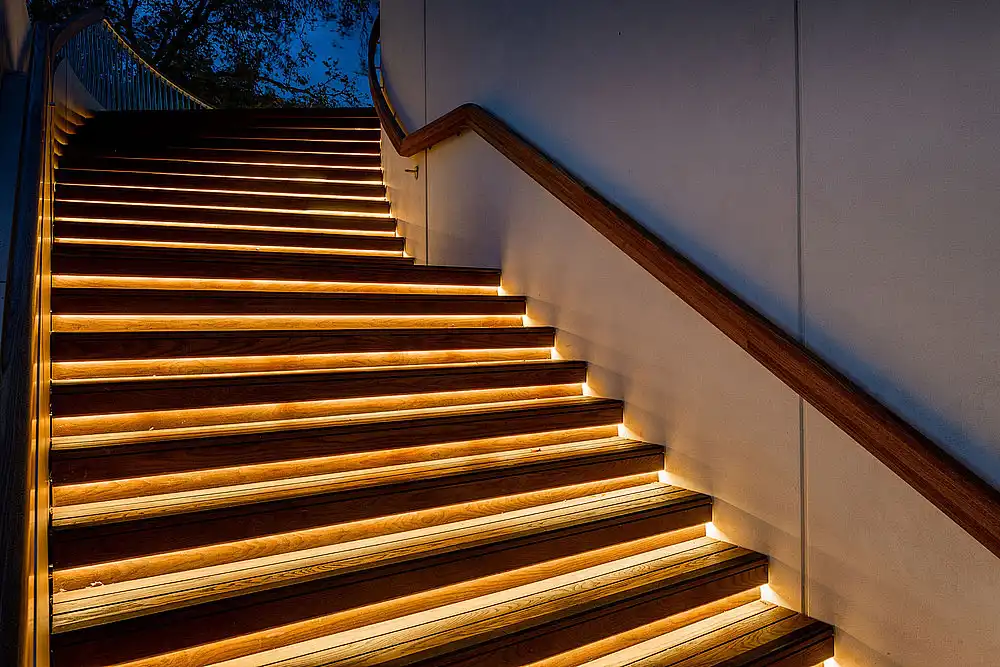
The fix was geometry, not product. The channel moved to the rail’s inboard face, which puts the plan curve on the easy axis — 180 mm stops being a difficult number — and the run went in continuous, no joints on either curve. The light now grazes down the balustrade rather than straight down, pulling the source out of the descending sight line.
Cuts fell only at storey breaks, on the interval voltage sets — roughly 50 mm at 24V against 25 mm at 12V, per the cutting and bending guidance. Cutting is not how you negotiate a curve.
Ankle-Height Glare and the Cleaning Setting
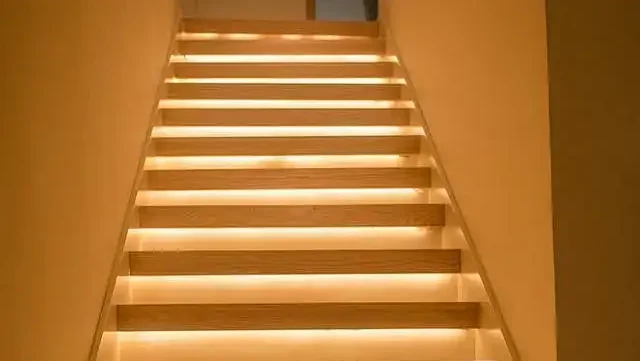
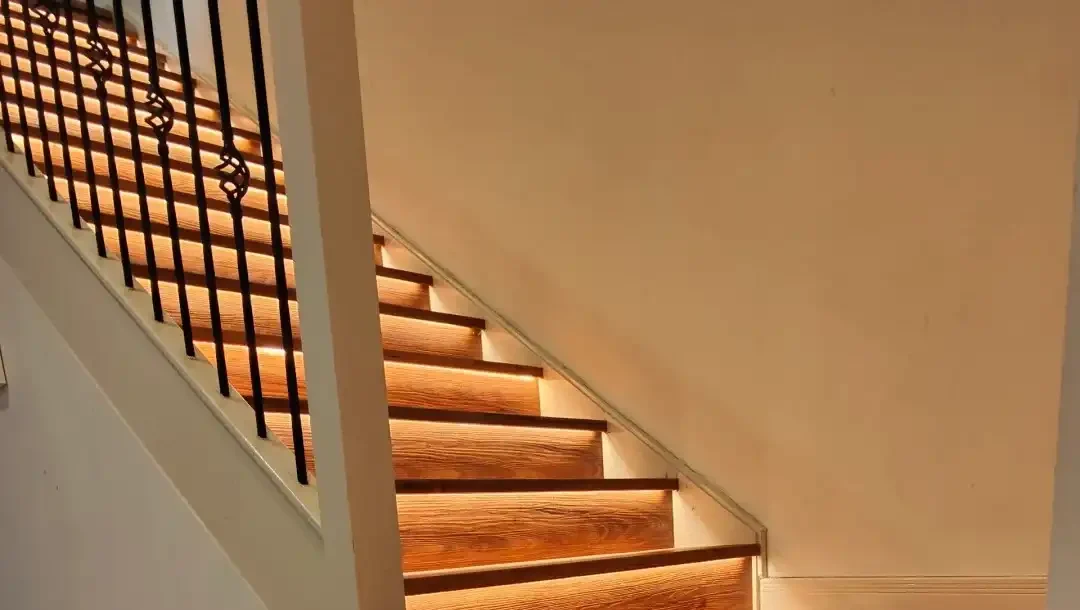
The tread-nose wash was the second argument. The designer’s reference photo showed crisp light spilling across each tread. The contractor’s objection: the client’s parents use the stair at night, and a bright source at ankle level is how somebody misjudges a step.
Width does not fix that, though the first spec assumed it would. Glare at a nose is set by the cut-off angle — how deep the strip sits, what lip shields it — and by output. Our narrowest COB is 8 mm; 3 mm and 5 mm strips exist as a category but not in our range, so the noses run the same 8 mm platform recessed behind the edge, dimmed to roughly 15% at night.
One correction on standards. The first spec justified its levels with EN 12464-1, which covers indoor work places and does not govern a private dwelling — it has no residential circulation category to cite. Step levels came from IES guidance, and close-range view of the nose was checked against IEC 62471, where blue content governs, not warm appearance.
What Went Into the Brass Channel, and Where the Drivers Went
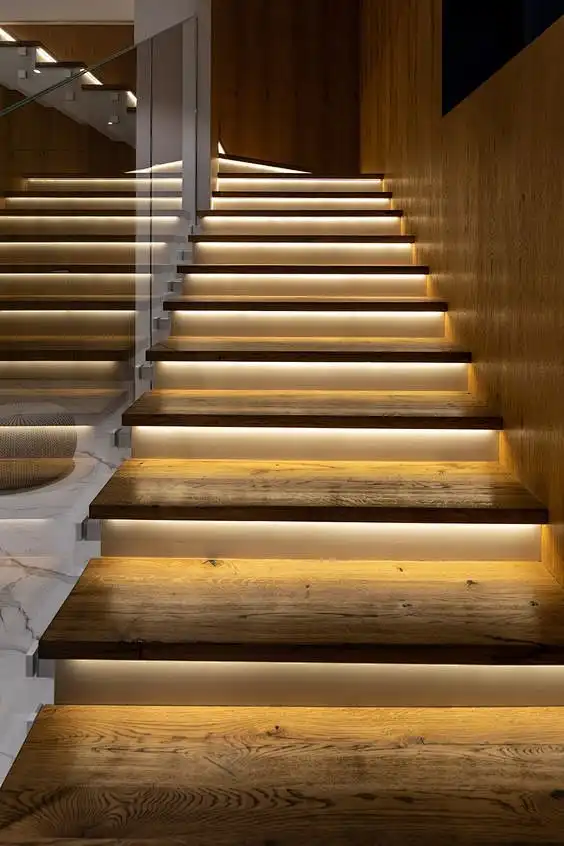
Approx. 34 meters of 8 mm COB, both zones on one 3000K bin from a single PO, both standard stock in our product index.
| Zone | Model | Spec | Approx. Length | Why this spec |
|---|---|---|---|---|
| Handrail, inboard face, continuous curved run | ES-COB-480-24V-8MM | COB · 480 LEDs/m · 8 mm · 12V/24V · IP20 · CRI 90 · 3000K | Approx. 22 m | The densest 8 mm reference we make; seen at hand distance through a diffuser, dotless emission matters most here. |
| Tread-nose wash, 42 steps | ES-COB-320-8MM-12V | COB · 320 LEDs/m · 8 mm · 12V/24V · IP20 · CRI 90 · 3000K | Approx. 12 m | Less output per meter suits a wash held near 15%, and the 8 mm PCB seats in the same routed channel. |
| Accessories | 24V constant-voltage drivers, contractor-supplied · brass extrusion and frosted PC diffuser from the stair fabricator · pluggable connectors at each storey break · RF single-color dimmer per storey | |||
The third disagreement was the drivers: the designer wanted them buried in the balustrade base plates, the contractor wanted the basement. The client sided with the contractor once the question was put as a Christmas Eve service call. Three feeds run up the existing pipe chase, one per storey, each landing on a pluggable connector in a balustrade post.
Both runs are 24V: the references support either, and at equal watts per meter a 12V run loses roughly four times the percentage drop, which an 11 m storey loop settles. That puts the drivers off our shelf — our line is DC12V adapters topping out at 96 W — so we specified them and the contractor bought them, with the brass extrusion, diffuser and connectors, since we list no channel. Strip circuits are 24V SELV under IEC 61140, IP20 throughout under IEC 60529; the driver primaries are neither.
If You’re Designing a Similar Stair
- Check which way the strip has to bend, not just the radius. An edgewise curve needs an S-shape PCB or a channel on a different face of the rail.
- Control nose glare with recess depth and a shielding lip, then dim it. Strip width does nothing for cut-off angle.
- Do not quote EN 12464-1 on a private house. It governs work places, and a client’s lawyer can read it.
- Put drivers where an electrician reaches them, and name who buys them. Base-plate drivers are a future service call.
Planning a similar stair handrail cob led strip lighting run? Send us your stair drawings and curve radii and we’ll mark which sections need the inboard channel.
About Senfey
Senfey is a Chinese LED strip manufacturer founded in 2010, running a Shenzhen factory of roughly 12,000 m² with monthly output above 250,000 meters. Our catalog covers COB, SMD, LED Neon Flex, addressable strips, controllers and power supplies. Browse Senfey’s COB LED strip catalog for 8 mm references.