
Retail buyers no longer compare lighting on lumens alone. The right LED strip for retail store projects must hit color accuracy, dimming smoothness, IP rating, and certification targets while staying compatible with the fixture millwork. This guide is built for B2B specifiers — lighting designers, electrical contractors, distributors, and visual merchandising teams — sourcing strip and Neon Flex for chain rollouts, flagship stores, and kiosk programs. Inside: the specifications that actually matter, an application-zone playbook, control compatibility, regional certification checklists, real project imagery, and the most common installation mistakes Senfey customers correct on site.
Why LED Strip Lighting Defines Modern Retail Interiors
Foot traffic and dwell time in physical retail correlate tightly with how merchandise is presented under light. Conventional spotlights still cover general illumination, but linear LED strip has become the default tool for the secondary and accent layers — shelf edges, display niches, cove perimeters, cash-wrap rims, window outlines, and brand-color washes. Three structural shifts are driving this:
- Tighter fixture millwork. Slim shelf reveals of 4 to 10 mm only fit COB or narrow SMD strip with high lumen density.
- Color-critical merchandise. Apparel, cosmetics, jewelry, and packaged food require CRI ≥ 90 and R9 ≥ 50 to render skin tones, fabric, and saturated colors accurately.
- Brand consistency across rollouts. Multi-site retailers need bin-controlled CCT and lot-to-lot color stability so two stores in different cities look identical.
For most LED strip for retail store deployments, a project mix of high-CRI white linear strip plus selective RGBW or tunable-white sections gives the broadest creative range without inflating BOM cost. The same logic Senfey applies to hotel and office lighting projects scales directly into retail, with tighter color-rendering tolerances.
Core Specifications for Retail LED Strip
Five specifications carry approximately 80% of the technical decision when sourcing LED strip for retail store fitouts. Lock these before discussing price.
1. Lumen Output and Efficacy
Target 800–1500 lm/m for shelf and display work; 400–700 lm/m for cove and outline; 1800+ lm/m for high-bay or backlit applications. Efficacy of 150 lm/W or better keeps power-supply sizing and heat manageable across a multi-zone install.
2. Color Temperature (CCT)
Apparel and cosmetics typically use 3000K–3500K for warmth; cool-merchandise environments — sportswear, electronics, supermarkets — often shift to 4000K. Bin tolerance should be ≤ 3 SDCM for chain-store consistency. Specify the bin in writing on every PO.
3. CRI and R9
CRI ≥ 90 is the retail baseline. Where product color matters most — cosmetics counters, denim walls, butcher displays — specify CRI 95 with R9 ≥ 80 explicitly. R9 alone exposes whether reds render naturally; many low-cost strips quote CRI 90 but R9 below 20.
4. IP Rating
Indoor sales floor: IP20 is acceptable but IP54 silicone-coated strip extends life by limiting dust ingress. Outdoor signage, storefront outline, refrigerated displays, fitting-room niches near washbasins: IP65 minimum, IP67 for direct splash.
5. PCB Width, Bend Radius and Cut Interval
5 mm and 8 mm PCBs fit tight reveals; 10 mm is standard. COB strip handles tight bends (≥ 20 mm radius) without hot-spotting, which matters for curved kiosks and column wraps. Where wider 10 mm PCBs and higher lumens are needed, see our SMD LED strip range.
| Spec | Display / Shelf | Cove / Outline | Storefront / Outdoor | Kiosk / Accent |
|---|---|---|---|---|
| Lumens / m | 800–1500 | 400–700 | 1000–1800 | 600–1200 |
| CCT | 3000–4000K, ≤3 SDCM | 3000K | 3000–6500K | RGBW or tunable |
| CRI / R9 | ≥90 / ≥50 | ≥80 | ≥80 | ≥90 white / RGB n/a |
| IP Rating | IP20–IP54 | IP20 | IP65–IP67 | IP54 |
| PCB | COB or SMD 2835 / 8 mm | SMD 2835 / 10 mm | Neon Flex / IP67 SMD | COB 8 mm or RGBW |
Application Zones in a Retail Store
Have an LED Lighting Project?
Share your project requirements — our engineering team will configure the complete LED strip system (strips + profiles + controllers + power supplies) and send you a detailed proposal within 24 hours.
Shelf and Gondola Lighting
Linear strip under each shelf eliminates the shadows cast by ceiling spots. Use 8 mm COB at 800–1200 lm/m, recessed in a 10 × 10 mm aluminum channel with diffuser to hide LED dots.
Display Window and Storefront LED Strip Lighting
Window backlight uses high-output IP65 strip mounted to a reflective backboard, 200–300 mm behind the front glass to avoid hot-spots on shoppers. For storefront LED strip lighting on the building edge or signage box, Neon Flex (8 × 16 mm or 10 × 20 mm) delivers a clean continuous line visible from the street and survives weather, vandalism, and seasonal cleaning — see our Łódź restaurant signage rollout for a comparable storefront execution.
Cove and Ceiling Perimeter
A continuous cove at 400–700 lm/m raises perceived ceiling height and softens the harsh shadows from track lighting. Standard SMD 2835 in a 17 × 14 mm cove profile is the cost-anchor specification.
Cash Wrap and Cantilever Counter Rim
Under-counter rim lighting on cantilevered cash desks creates the “floating” effect that elevates a basic counter into a brand statement. Use 5 mm or 8 mm COB strip with a frosted micro-channel; the project gallery in the case section demonstrates this detail.
Fitting Room and Mirror Lighting
Vertical strips flanking the mirror at face height, 3000K–3500K, CRI ≥ 95, diffused — this is the single biggest dwell-time multiplier in apparel retail. Avoid downward-only lighting that ages skin tones.
High CRI LED Strip for Retail Display
Color rendering is where cheap strip damages retail sales. A high CRI LED strip for retail display means CRI ≥ 95 with R9 ≥ 80, ideally with R12 (saturated blue) and R13 (skin tone) also specified. Why this matters by category:
- Cosmetics and beauty: R9 below 50 makes lipsticks and foundations look muddy on the shelf and wrong on the customer.
- Apparel and textiles: Low R9 desaturates reds, oranges, and pinks — exactly the colors that drive impulse buys.
- Fresh food and bakery: Meat, produce, and baked goods typically require CRI 95 with R9 ≥ 80 to look appetizing; some chains specify 2700K to enhance warmth.
- Jewelry and watches: Spec CRI 97 with TM-30 Rf ≥ 90 and Rg 95–105 to render metallic finishes correctly.
When sourcing a high CRI LED strip for retail, ask the supplier for the LM-80 report, SDCM bin certificate, and an R-value spectrum (R1–R15), not just a marketing CRI number. The same Ra99 / R9 > It will transfers directly to color-critical retail displays.
LED Strip for Retail Kiosk Lighting
Kiosk and pop-up retail compresses a full store identity into 10–40 m² of floor space. Lighting carries an outsized share of the brand impression because architectural detail is limited. Effective LED strip for retail kiosk lighting typically combines three layers:
- Wall outline / silhouette: Neon Flex or rim strip traces the kiosk envelope, often in a brand accent color, to make the structure read from across a mall atrium — see our Ploom Tokyo pop-up neon arch for a flagship example.
- Display podium under-glow: Recessed COB or RGBW strip lifts product podiums off the floor and draws the eye to hero SKUs.
- Cantilever counter rim: A continuous under-edge line on the service counter conveys premium build quality and disguises the joint between the counter top and base.
Heat dissipation deserves extra attention in kiosks: enclosed millwork without ventilation can push strip junction temperatures above the LM-80 derating point, shortening life. Aluminum channel — sourced together with the matching drivers and accessories — is mandatory, not optional, for any kiosk running more than 6 hours per day. For brand-color accent layers, RGBW addressable LED strip offers full white-channel output plus saturated color, avoiding the muddy whites typical of pure RGB strip.
Dimming and Control Systems
Retail control choices fall into four practical buckets:
- Triac / leading-edge: Simplest retrofit, but flickers below 10% on cheap strip. Specify dimmable LED driver explicitly.
- 0–10V: The contractor-friendly standard for chain rollouts. Smooth 1–100% dimming with most commercial drivers.
- DALI / DALI-2: Required for addressable scenes — opening, peak, evening, closing. Standard on flagship and department-store specifications.
- Casambi / Bluetooth Mesh: Wireless mesh with phone control, ideal for kiosks, pop-ups, and renovations where rewiring is impossible.
For RGBW or tunable-white strip, confirm the controller supports the strip’s PWM frequency (≥ 2 kHz, ideally ≥ 5 kHz) to avoid camera flicker — increasingly important now that customers film in-store content.
Certification Requirements by Region
- European Union: CE marking, EMC (EN 55015, EN 61547), LVD (EN IEC 61347-1, EN 62031), RoHS, REACH. ErP energy-efficiency labeling for completed luminaires.
- United Kingdom: UKCA in addition to or replacing CE, plus Plug-in Safety regulations for any external power supply.
- United States and Canada: UL 2108 or UL 8750 for LED strip components, FCC Part 15 Class B for EMC, Title 24 / Energy Star for California and federal procurement.
- Australia and New Zealand: SAA / RCM mark, AS/NZS 60598, MEPS for power supplies.
- Middle East: SASO for Saudi Arabia, ESMA for UAE.
- Universal: LM-80 (LED package lifetime), TM-21 (lifetime projection), LM-79 (luminaire photometric report), IES files for lighting design software.
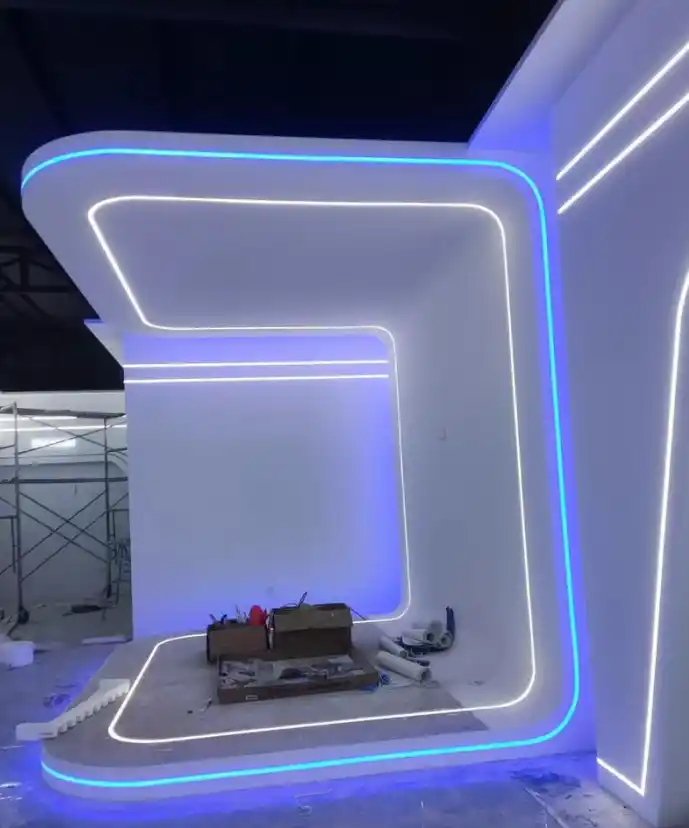
Real Project Case — Bangkok Retail Kiosk with Sci-Fi Lighting Detail
A recent kiosk rollout in Bangkok used Senfey COB strip and IP54 RGBW strip to produce a three-layer “sci-fi” lighting identity. The wall outline silhouette traces the back panel of the kiosk in a continuous cool-white line; recessed accent strip lifts the display podium off the floor; and a cantilever counter rim line wraps the service desk, making it appear to float. All three layers run from a single Casambi controller so the operator switches between opening, daytime, and evening scenes from a phone.
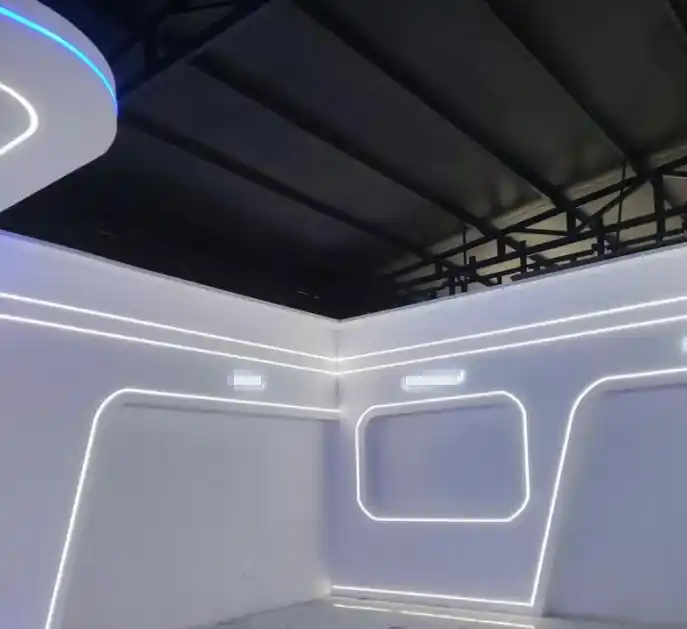
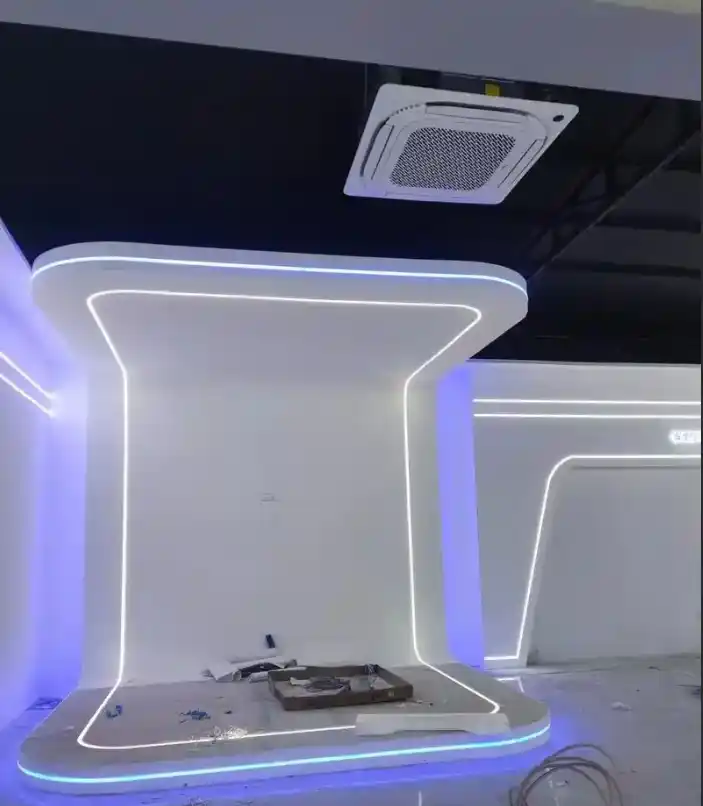
Approximate spec: 8 mm COB 3000K CRI 95 for white layers, IP54 RGBW 5050 for accent color, all mounted in 10 × 10 mm aluminum channel with frosted PMMA diffuser. Inspiration reference only — specifications can be adapted to each project’s millwork and brief. Explore further executions in our commercial retail case portfolio.
Common Installation Mistakes in Retail LED Strip Projects
- Skipping aluminum channel. Direct adhesive to MDF or laminate runs strip 20–30°C hotter and roughly halves lifetime.
- Exceeding max single-run length. 5 m for 24V SMD, 10 m for 24V high-density COB, otherwise voltage drop dims the far end visibly.
- Mixing CCT or CRI bins across one wall. Even 2 SDCM differences are visible on white surfaces under cove lighting.
- Undersized power supply. Always derate driver capacity by 20% (load ≤ 80% of rated W).
- Hidden joints under tension. Solder joints fail in bent corners; pre-bend strip on the bench, never in situ.
- Wrong dimmer pairing. A 0–10V strip driven by a Triac dimmer flickers and may damage the driver.
- No diffuser on visible runs. Customers see LED dots and read the install as cheap, regardless of fixture cost.
- IP20 strip in fitting-room niches. Steam and cleaning sprays corrode the copper trace within months.
- Ignoring PWM frequency. Strip flickers on smartphone video and customer-generated content looks broken.
- No spare strip on site. Color bins change between lots; order 10–15% extra in the same lot for warranty replacements.
FAQ
What CRI should I specify for an LED strip for retail store?
CRI ≥ 90 is the working baseline for apparel and general merchandise. For cosmetics, jewelry, fresh food, and high-end fashion, specify CRI ≥ 95 with R9 ≥ 80. Always request the supplier’s R1–R15 spectrum, not just the headline CRI number.
How long can a single run of retail LED strip be?
For 24V SMD strip, approximately 5 m before visible voltage drop. For 24V high-density COB, up to 10 m. Longer runs require dual-end feed or 48V architecture. For storefront outlines over 15 m, plan for multiple drivers and a master controller.
Which IP rating do I need for storefront and window display LED strip?
Storefront outline exposed to weather requires IP65 minimum, IP67 for direct rain or coastal locations. Window interior backlight can use IP54 if cleaning is dry-cloth only. Refrigerated displays and fitting rooms with steam exposure typically need IP65.
Can I use the same LED strip across a multi-store rollout?
Yes, but specify lot-to-lot SDCM ≤ 3 in the contract and order all sites from the same production run when possible. Senfey reserves bin lots for chain customers to maintain color consistency across rollouts.
What dimming protocol is best for retail kiosks?
Casambi or Bluetooth Mesh is typically the best fit for kiosks because rewiring is rarely possible. For flagship stores with scene programming, DALI-2 is the standard. 0–10V remains the cost-effective default for chain rollouts.
Does Senfey provide certification documentation for retail projects?
Yes. Standard commercial quotes include CE, RoHS, and lot-specific LM-80 reports. UL, SAA, SASO, and TM-21 projections are available on request. IES photometric files are provided free for any specified product.
Spec, Sample, Quote — Three Ways to Move Your Retail LED Strip Project Forward
- Download the Retail LED Strip Specification PDF — full technical sheets, IES files, and SDCM bin documentation in one bundle.
- Request a Free Sample Kit — receive a swatch of COB, SMD 2835, RGBW, and IP65 Neon Flex calibrated for retail color rendering.
- Get a Project Quote — send a floor plan or BOM and receive a costed specification within one business cycle.
