The Facade That Had to Survive the North Sea
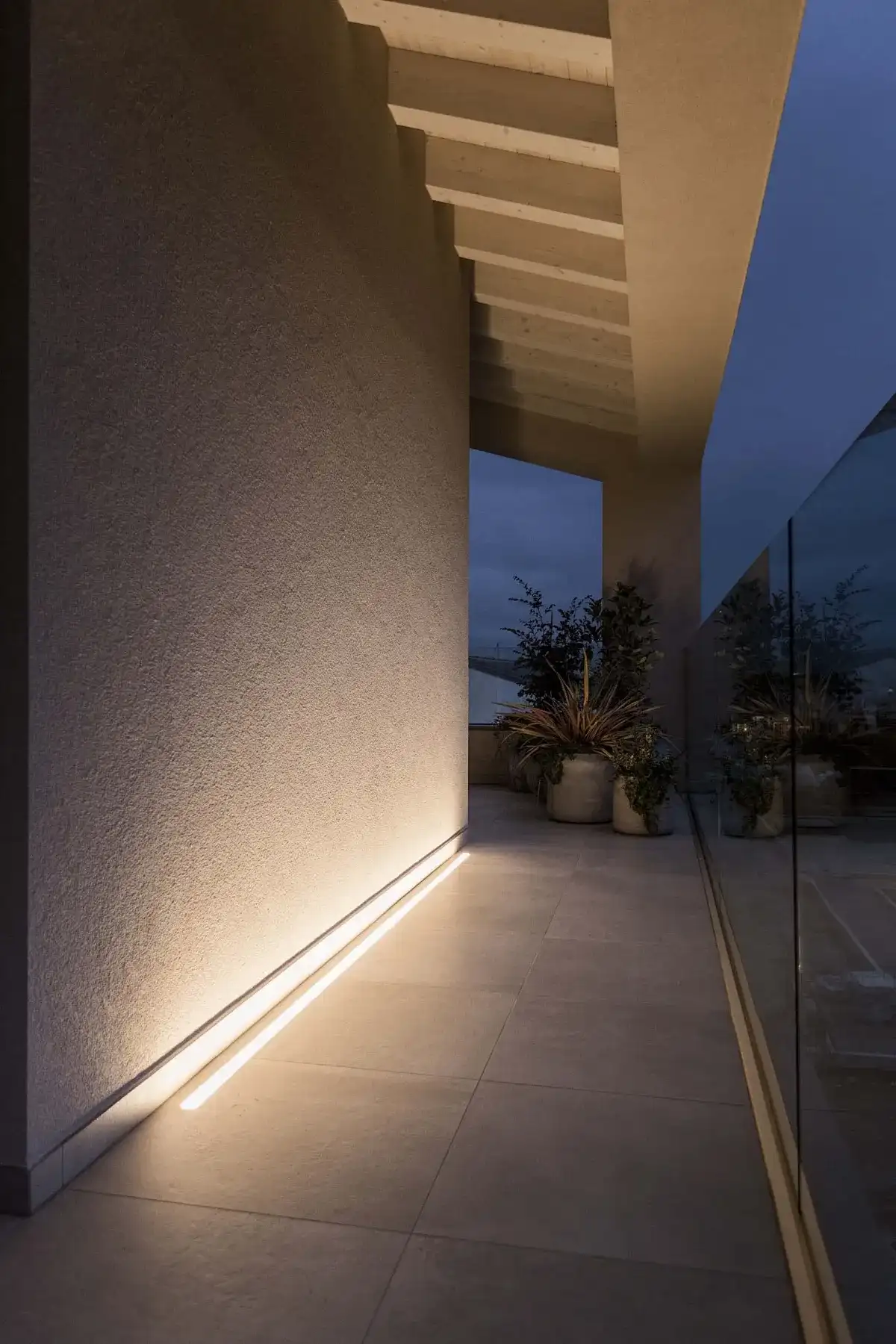
This outdoor waterproof cob led strip facade project covers the exterior linear-lighting refit of a mid-sized commercial building in Rotterdam, the Netherlands. The facade contractor came to Senfey after two years of trouble with the previous exterior ribbon: end-caps cracked at three parapet corners, salt-laden rain tracking down inside the profiles, and warm white drifting between the sun-facing south elevation and the shaded courtyard side.
The brief was to outline the parapet and vertical fins with one continuous linear light, sealed against driven rain, warm-white and color-stable across all four elevations. Because Rotterdam sits under near-constant coastal rain and North Sea wind loading, the design conversation started with ingress protection rather than beam angle. Two further constraints mattered: the longest vertical fin sits Approx. 22 m from the nearest service closet, and the facade overlooks a residential courtyard, so spill had to be controlled to the obtrusive-light categories published by CIE.
Why COB Strip Was the Wrong Platform Here
The contractor asked for a sealed COB strip. We did not supply one, and the reason is structural rather than commercial.
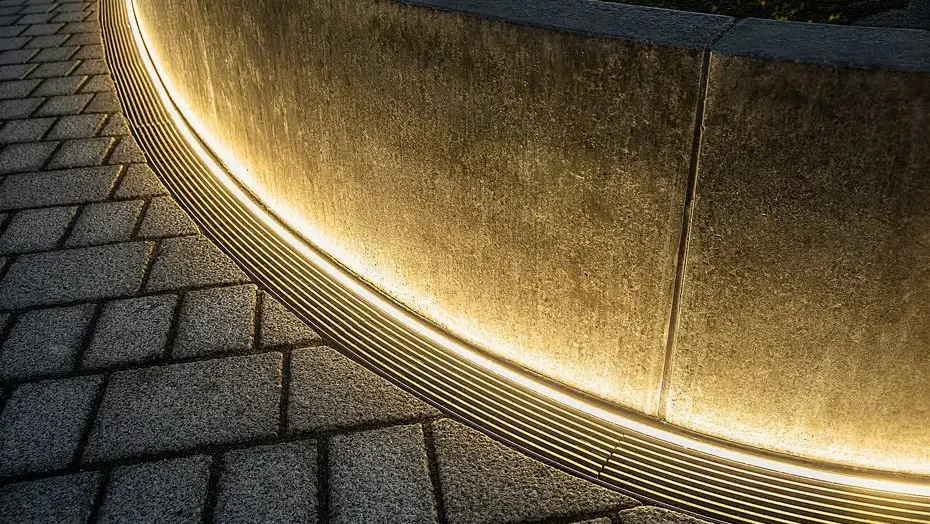
A waterproof COB strip is a flat PCB made weatherproof after the fact — a silicone sleeve or potted coating over the board, closed at each end with a cap and a gland. Every one of those is a seam, and on a coastal parapet the seams are what fail: thermal cycling works the end-cap loose, then capillary action walks salt water back inside the profile. That is exactly what the previous install produced at three corners. Neon flex is extruded as one continuous body with the emitters inside it, so along its length there is no seam to open. The trade-off is real — you give up the dotless flat-field read of COB and accept CRI 80 instead of CRI 90 — but nobody reads color fidelity off a parapet at 18 m. Full comparison in how COB strip and neon flex compare.
One correction to the brief worth recording: it asked for IP68 on horizontal parapet runs. IP68 describes continuous submersion, which is not what a parapet crown sees even in a storm — standing water and driven rain are IP67 and IPX6 conditions, different test axes under IEC 60529. IP67 is the correct ceiling here, and also where our sealed range tops out, so we said so rather than writing a number we could not ship.
Zone by Zone Across Four Elevations
Approx. 260 meters were supplied across the four elevations and the parapet crown, with IP rating matched to exposure rather than applied uniformly.
| Zone | Model | Spec | Approx. Length | Why this SKU |
|---|---|---|---|---|
| Vertical facade fins | ES-NEON-SIGN-01 | Silicone LED Neon Strip · 120 LEDs/m · 12V · IP65 · CRI 80 · 3000K | Approx. 90 m | A vertical face drains itself, so IP65 is the honest rating here; the silicone jacket is the UV-stable one, which is why it carries the south elevation. |
| Corner accent / civic-event bands | ES-NEON-SIGN-02 | RGB Silicone LED Neon Strip · 108 LEDs/m · 6×12 mm · 12V/24V · IP67 · CRI 80 | Approx. 45 m | The only reference of the three that runs at 24V, so the longer accent bands go here; dark in the default scene. |
| Parapet crown & horizontal exposed runs | the IP67 outdoor reference | PVC LED Neon Strip · 120 LEDs/m · 6/8 mm · 12V · IP67 · CRI 80 · 3000K | Approx. 125 m | IP67 for horizontal standing water. Note the jacket is PVC, not silicone — see the trade-off below. |
| Accessories | 12V and 24V constant-voltage drivers in ventilated cavity lockers · aluminum profile with stainless-steel mounting clips · IP67 quick connectors · ES-LC-RGB-016 controller for the accent bands | |||
The PVC jacket is the compromise in this package, and we flagged it at design stage rather than at handover. PVC is more UV-sensitive than silicone, and the parapet crown is the most sun-exposed line on the building — but it is also the run that genuinely needs IP67, and our IP67 outdoor reference is PVC. So the south parapet was mounted in a profile with a shading lip, and the maintenance schedule carries a jacket inspection at year three. Sealed-range options sit in the waterproof COB LED strip guidance.
The 22 m fin drove the wiring. Two of the three references are 12V, and 12V neon flex does not run 22 m from one feed — nothing like it. Rather than invent an AC-input product we do not make, the fin was split into short segments each fed from its own driver in the facade cavity, with lockers ventilated to hold enclosure temperature under 45 °C during commissioning at 34 °C ambient. Every supply is 12V or 24V DC, so the installation stays in the SELV band and inside the protective-measure class described in IEC 61140.
What the Old Install Got Wrong
| # | Failure observed | How we designed it out |
|---|---|---|
| 1 | Cracked end-caps at parapet corners let water track inside the profile after roughly 20 months of exposure. | Moved to one-piece extruded neon flex, so the only sealed points left are the terminations — which are IP67 quick connectors, with drainage relief every 2 m along horizontal runs so any water that does enter has somewhere to leave. |
| 2 | Warm white drifted between the sun-facing south elevation and the shaded courtyard side within roughly one summer. | Two causes, not one. Bin spread was addressed by ordering every warm-white run on a single PO; but drift that fast on the sun side is jacket ageing, not binning, so the south elevation was given the silicone reference rather than the PVC one. |
Both were resolved at design time and written into the schedule. The second matters most on any outdoor waterproof cob led strip facade: ordering one bin is the fix people reach for, and on a south-facing coastal elevation it solves half the problem.
If You’re Lighting a Similar Coastal Facade
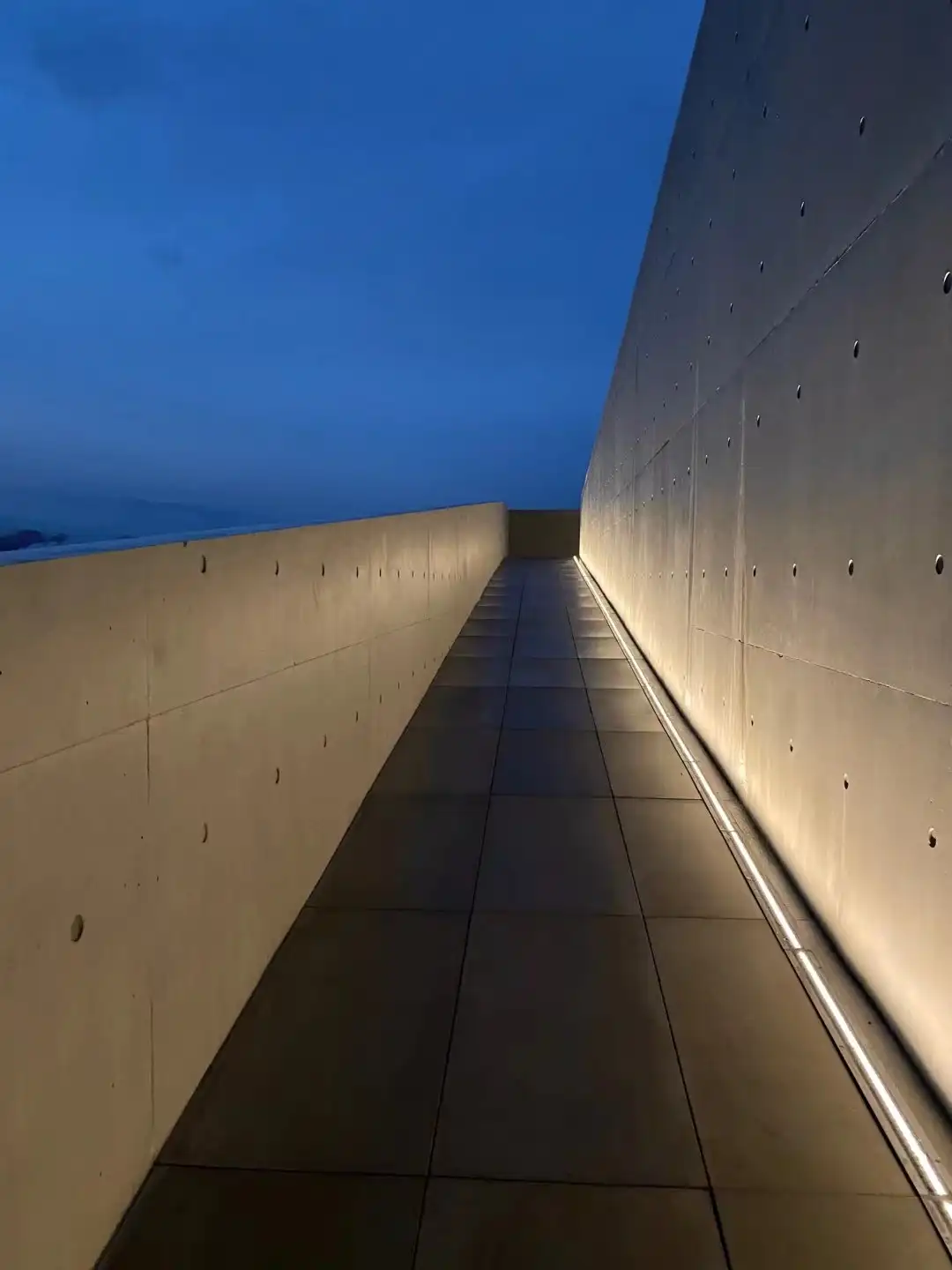
- Set IP per exposure, not per building. Vertical faces drain themselves and can sit at IP65; horizontal runs need IP67. Asking for IP68 on a parapet specifies submersion that will never happen.
- On an exposed run, count the seams. A jacketed flat strip is sealed after manufacture; extruded neon flex has no seam along its length. That outlives any IP number on the datasheet.
- Ask what the jacket is made of, not just its IP. Silicone holds up under UV better than PVC. Two products can share IP67 and age completely differently on a south elevation.
- Check run length against voltage before drawing the layout. A 12V reference will not carry a 20 m fin from one feed; plan distributed drivers into the cavity, or read up on AC voltage options first.
Planning a similar outdoor facade refit? Request a facade lighting quotation and we’ll draft a zone-by-zone list against your elevation drawings, marking which runs actually need a sealed jacket.
About Senfey
Senfey is a Chinese LED strip manufacturer founded in 2010, running a Shenzhen factory of roughly 12,000 m² with a monthly output above 250,000 meters. Our catalog covers COB, SMD, LED Neon Flex, addressable strips, controllers and power supplies. Browse Senfey’s COB LED strip catalog for the full pillar range.