
The best LED strip museum lighting solution uses a 24V high-CRI (≥95) flicker-free strip with UV/IR-free output, 2700K–3500K color temperature, and 0.1%–100% smooth dimming. For artifact display cases, low-heat COB strips inside aluminum profiles protect sensitive works while delivering accurate color rendering. For sculptural and architectural exhibits, neon LED flex strips for museum lighting create immersive, curved light forms that double as design elements. This guide walks museum curators, exhibition designers, and project contractors through every specification needed for a successful installation.
1. Why LED Strip Lighting Has Replaced Traditional Museum Fixtures
Halogen and fluorescent fixtures dominated museums for decades, but both produce heat, UV, and IR radiation that degrade pigments, textiles, paper, and organic artifacts. Modern LED strip museum systems solve all three problems while offering precise control over intensity, color, and beam direction.
Key reasons museums worldwide are switching to LED strip lighting:
- Conservation — near-zero UV and IR output protects sensitive works
- Energy savings — up to 75% less power than halogen track lighting
- Lifespan — 50,000+ hours reduces fixture changes inside sealed display cases
- Design flexibility — strips fit inside vitrines, coves, plinths, and curved sculptures
- Precise dimming — 0.1%–100% range supports curator-defined lux limits
2. Key Specifications for Museum-Grade LED Strips
Museum lighting is held to higher standards than retail or hospitality lighting. The five specifications below separate true museum-grade strips from consumer products.
CRI 95+ and Why Color Accuracy Defines a Museum
A painting’s blues, reds, and skin tones must appear exactly as the artist intended. Specify a strip with CRI ≥ 95 and R9 (deep red) ≥ 80. Anything lower will distort artwork colors and is unacceptable for art galleries.
UV and IR Output: Protecting Sensitive Artifacts
Unlike halogen lamps, quality LED strips emit virtually no UV or IR. However, verify with the manufacturer that the specific phosphor and lens combination is rated for conservation use. For paper, watercolors, and textiles, target 50 lux or less with zero UV.
Color Temperature: 2700K vs 3000K vs 4000K for Galleries
2700K–3000K warm white is the standard for art galleries, evoking the warmth of traditional gallery lighting. 3500K–4000K neutral white suits science museums, natural history exhibits, and contemporary art. Tunable white (2200K–6500K) is increasingly specified for galleries that rotate exhibitions.
Dimming Range: 0.1%–100% for Mood and Conservation
Curators frequently need to lower lux levels for sensitive works. A museum-grade driver should dim smoothly from 100% down to 0.1% without flicker or color shift. DALI and 0–10V are the dominant control protocols.
Flicker-Free Drivers (For Photography and Video)
Visitor smartphone videos pick up flicker that the human eye cannot see. Specify constant-current drivers with PWM frequency ≥ 25 kHz to eliminate visible flicker bands in social media content — a free marketing channel many museums overlook.
Museum LED Strip Specs by Exhibit Type
| Specification | Art Gallery | Science Museum | Historical / Artifact |
|---|---|---|---|
| CRI | ≥ 95 (R9 ≥ 80) | ≥ 90 | ≥ 95 (R9 ≥ 80) |
| Color Temperature | 2700K–3000K | 3500K–4000K | 2700K |
| Lux Level | 150–300 lx | 300–500 lx | 50–150 lx |
| UV Output | 0 µW/lm | < 75 µW/lm | 0 µW/lm |
| Dimming | DALI 0.1%–100% | 0–10V or DALI | DALI with timer |
| LED Type | COB or SMD 2110 | SMD 2835 or neon flex | COB low-output |
| Driver | Flicker-free, >25 kHz | Flicker-free | Flicker-free |
3. LED Strip Museum Applications: Display Case to Architectural Ceiling
Have an LED Lighting Project?
Share your project requirements — our engineering team will configure the complete LED strip system (strips + profiles + controllers + power supplies) and send you a detailed proposal within 24 hours.
A modern museum uses LED strip lighting across nearly every surface. Below are the five most common application zones and the recommended product types.
Display Case and Vitrine Lighting
Inside sealed display cases, heat buildup is the enemy. Use low-output 24V COB strips at 4–6W/m inside slim aluminum profiles. Mount strips at the top of the vitrine angled downward, never directly on the artifact. For full 360° viewing of sculptures, add side-mounted micro-strips with diffusers.
Wall-Washing for Artwork
Continuous wall-wash strips behind a baffle or cove deliver even, glare-free illumination across a gallery wall. Specify asymmetric optics so the upper third of the wall receives more light than the floor — matching how the human eye reads vertical surfaces.
Cove and Architectural Lighting in Galleries
Ceiling cove LED strips define a gallery’s spatial perception. A 24V high-CRI strip inside a 30° aluminum profile bounces warm indirect light across the ceiling, creating a calm, museum-appropriate atmosphere without competing with the artwork.
Floor and Step Lighting for Visitor Safety
Low-output IP65 LED strips at floor level guide visitors through dimmed exhibition zones. Use 2700K warm white at < 50 lux so wayfinding doesn’t interfere with display lighting.
Interactive Exhibit Lighting
Science and children’s museums use RGBW LED strips for interactive exhibits that respond to visitor input. DMX-controlled strips synchronize with sensors, projection, and sound for immersive storytelling.
4. Neon LED Flex Strips for Museum Lighting: Sculptural and Creative Applications
Neon LED flex strips for museum lighting have transformed how exhibitions handle creative, sculptural, and branded light elements. Unlike fragile glass neon, flexible silicone-encapsulated LED neon is shatterproof, dimmable, low-voltage (24V), and bendable into any 2D or 3D shape.
Common museum applications for LED neon flex include:
- Suspended sculptural installations — bent into curves, spirals, or text above atriums
- Exhibition signage and wayfinding — section names, exhibit titles, donor walls
- Interactive art pieces — visitor-controlled color and pattern changes
- Ceiling light forms — abstract shapes that double as both fixture and art
- Floor and stair edge lighting — continuous lines that direct circulation
For museum projects, choose a top-emitting or side-emitting neon flex with CRI 90+, IP67-rated silicone jacket, and a 5-year warranty. Avoid budget PVC neon — it yellows under continuous illumination within 12–18 months.
5. Inspiration from Iconic Projects: The Modern Art Museum of Fort Worth and Beyond
World-class institutions like the Modern Art Museum of Fort Worth have set the benchmark for how LED strip lighting integrates with architectural minimalism. Tadao Ando‘s concrete galleries rely on near-invisible continuous cove LED strip lines that wash walls evenly without revealing the light source itself — a design philosophy now copied in contemporary art museums worldwide.
Key takeaways from leading museum lighting design that apply to any project:
- Hide the fixture, show the light — recess strips inside coves, baffles, or vitrine frames
- Layer the light — combine ambient cove + accent track + display strip rather than relying on one source
- Match the architecture — strip color temperature should harmonize with the building’s material palette
- Plan for change — use DALI zones so future exhibitions can be re-lit without rewiring
While referencing landmark projects like the Modern Art Museum of Fort Worth LED strip approach can inspire your specification, the right product choice always depends on your specific artifacts, architecture, and conservation policies.
6. Conservation-Grade Requirements: UV, IR, and Lux Limits
International conservation bodies set strict illumination limits for sensitive works. A museum-grade LED strip specification should reference these standards directly:
| Material Category | Max Lux | Max Annual Exposure | UV Limit |
|---|---|---|---|
| Highly sensitive (textiles, watercolors, paper) | 50 lx | 15,000 lx-hours | 0 µW/lm |
| Moderately sensitive (oil paintings, leather) | 150 lx | 360,000 lx-hours | < 75 µW/lm |
| Insensitive (stone, ceramics, metal) | 300+ lx | unlimited | < 75 µW/lm |
Always request the LED strip’s full spectral power distribution (SPD) report and UV measurement from the manufacturer. Reputable suppliers provide third-party test reports from labs like Intertek, TÜV, or SGS.
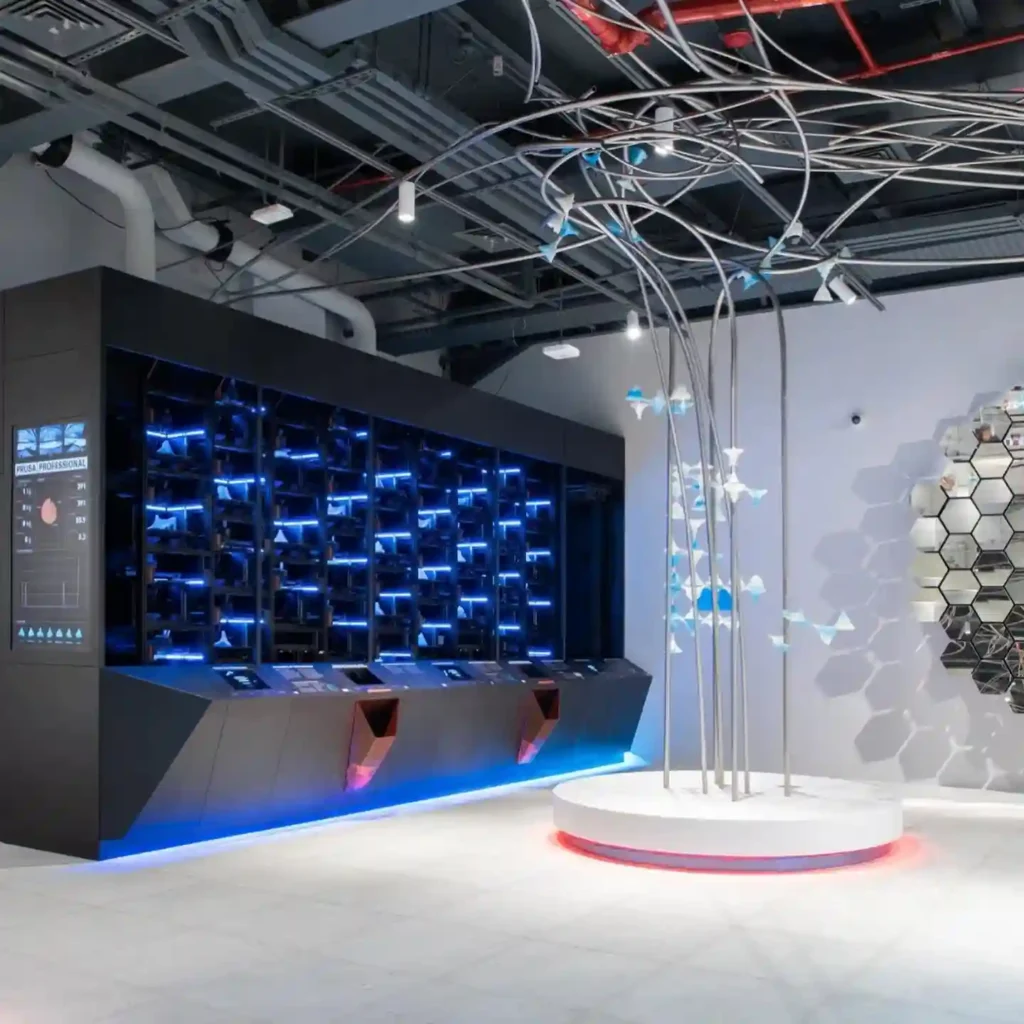
7. Real Museum Project Case Study: Interactive Science Exhibit
A recent interactive science museum project illustrates how multiple LED strip types combine in a single immersive space. The installation features:
- Display wall — vertical interactive panels backlit with 24V blue COB LED strips inside slim aluminum profiles, creating uniform glow without dot artifacts
- Suspended sculpture — custom-bent metal armature with embedded micro LED strips highlighting hundreds of acrylic translucent elements
- Platform accent — IP65 RGBW LED strip ring beneath the central plinth, programmable for exhibit-specific color scenes
- Wayfinding — floor-level cool white LED strip lines guiding visitor circulation in the dimmed gallery
The result is a multi-layered, photography-friendly exhibit space where light functions simultaneously as fixture, exhibit, and architectural feature. Total LED strip used: approximately 180 meters across four control zones, all DALI-dimmable and flicker-free.
8. Sourcing Museum-Grade LED Strips from China
Most premium LED strip components originate from Chinese manufacturers, but only a small fraction of suppliers are equipped for museum-grade specifications. When sourcing, verify:
- Spectrum testing capability — in-house spectrometer and SPD reports per batch
- UV/IR measurement reports — independent third-party verification
- CRI consistency — variation between reels should be ≤ 2 points
- MacAdam ellipse — color binning within 3-step SDCM for gallery applications
- Custom voltage and length — vitrine projects often need non-standard lengths
- Certifications — UL, CE, RoHS minimum; DLC and Energy Star for North American rebates
- Warranty — 5 years standard for museum-grade products
Senfey supplies museum-grade LED strips to exhibition designers and museum contractors in over 60 countries. Contact us for full specifications, spectral reports, and project references.
9. Common Mistakes in Museum LED Strip Installation
- Wrong CRI — using CRI 80 strips makes pigments appear flat and inaccurate
- Heat in sealed display cases — running strips at full power causes thermal buildup that damages artifacts and shortens LED life
- Visible flicker on camera — cheap PWM drivers ruin visitor video content
- Direct line-of-sight glare — strips mounted without baffles distract from the artwork
- Mismatched dimmers — Triac dimmers paired with DALI drivers cause color shift and audible noise
- Ignoring lux limits — over-illumination of sensitive works accelerates pigment fading
- Skipping spectral reports — accepting supplier claims without third-party SPD data
10. FAQ: LED Strip for Museums
What LED strip is best for museums?
A 24V COB LED strip with CRI ≥ 95, R9 ≥ 80, 2700K–3000K color temperature, near-zero UV output, and a flicker-free DALI-dimmable driver is the best LED strip for museum lighting. Use IP20 for indoor display cases and IP65+ for floor or outdoor architectural applications.
How many lux should museum lighting be?
Conservation standards recommend 50 lux for sensitive items (paper, textiles, watercolors), 150 lux for moderately sensitive items (oil paintings, leather), and 300+ lux for stone, ceramics, and metal. Always combine lux limits with annual exposure caps to prevent cumulative damage.
Are neon LED flex strips suitable for museum lighting?
Yes. Neon LED flex strips for museum lighting work well for sculptural installations, exhibition signage, ceiling light forms, and interactive exhibits. Choose CRI 90+, IP67 silicone-jacketed neon flex with a 5-year warranty to avoid yellowing or jacket degradation.
Do LED strips damage artwork?
Quality museum-grade LED strips produce near-zero UV and IR radiation, making them significantly safer than halogen or fluorescent fixtures. Damage risk comes from excessive lux levels and cumulative exposure, not from the LED technology itself.
What dimming protocol is used in museums?
DALI is the dominant dimming protocol in modern museums because it allows individual fixture addressability, scene programming, and smooth dimming down to 0.1%. 0–10V is common in smaller institutions, and DMX is used for interactive or dynamic-color exhibits.
How much does museum LED strip lighting cost?
Museum-grade LED strip material typically ranges from USD 30 to USD 120 per meter depending on CRI, driver quality, and certifications. A mid-size 2,000 m² gallery retrofit usually budgets USD 40,000 to USD 150,000 for LED strip materials, excluding fixtures, drivers, and installation labor.
Get Started With Your Museum Lighting Project
Specifying the right LED strip museum lighting solution protects priceless collections, supports curatorial intent, and creates the immersive visitor experience modern museums depend on. Senfey has manufactured museum-grade LED strips since 2015, supplying art galleries, science centers, and historical institutions worldwide with verified spectral performance and 5-year warranties.
